
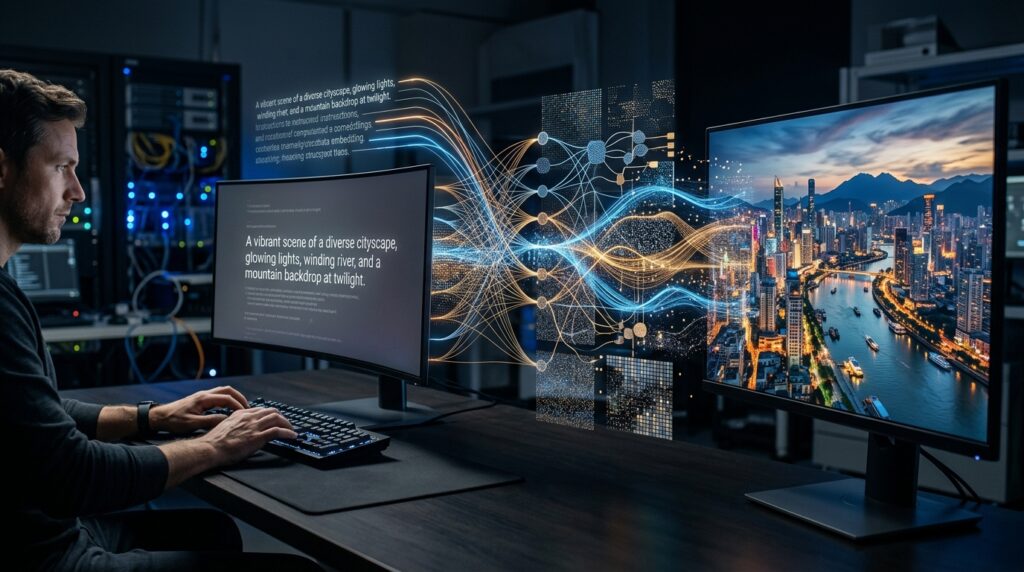
Artificial intelligence has transformed how creators and enterprises approach visual storytelling. Understanding how AI image generators work reveals a remarkable interplay of computer science, linguistics, and mathematical probability that transforms ordinary text prompts into production-ready visual art.
Not long ago, producing a realistic visual asset required specialized studio photographers, illustrators, 3D artists, or endless hours searching commercial stock catalogues. Today, a user can enter natural language instructions—such as “A modern Indian startup office at sunset, warm natural light, cinematic photography, founders collaborating around a digital workspace”—and receive a unique, high-resolution visual concept within seconds.
Current generative vision systems have also moved far beyond basic text-to-image synthesis. Modern platforms accept image references as inputs, execute context-aware inpainting, preserve subject identity across multi-shot campaigns, and follow sophisticated compositional instructions. To harness these tools effectively, creators and businesses must look beneath the hood: how do these models interpret human language, and what exact computational mechanisms allow them to render brand-new imagery from scratch?
How Do AI Image Generators Work?
At a foundational level, an AI image generator solves two interconnected computational problems:
- Semantic Interpretation: What does the user’s prompt actually mean in terms of physical entities, spatial relationships, lighting conditions, and emotional mood?
- Visual Synthesis: How can that abstract linguistic meaning be translated into high-dimensional pixel data?
Older explanations often described generative vision models simply as convolutional neural networks memorizing textures, shapes, and color palettes from image libraries. While directionally intuitive, modern architectures are far more sophisticated.
A high-level generative pipeline follows this structured progression:
Natural Language Prompt → Text Embedding Representation → Latent Space Conditioning → Iterative Noise Denoising → High-Resolution Pixel Decoding
Groundbreaking research—such as Google’s Imagen research and OpenAI’s generative vision studies—demonstrated that pairing large frozen transformer language models with cascaded diffusion engines produces dramatic improvements in both prompt fidelity and photorealism.
The Technical Pipeline: How AI Image Generators Work Under the Hood
Step 1: Semantic Parsing and Entity Extraction
Suppose a creator enters the prompt: “A golden retriever running through an open meadow of wildflowers at golden hour sunset.”
The system does not search a web database for matching photographs. Instead, its language comprehension encoder decomposes the text into semantic relationships:
- Core Subject: Golden retriever (canine anatomy, fur texture, typical posture).
- Action / Motion: Running (dynamic stride, motion blur, weight distribution).
- Spatial Environment: Meadow of wildflowers (organic vegetation, depth of field, horizon line).
- Lighting & Atmosphere: Sunset / golden hour (warm directional light, low sun angle, long cast shadows).
Step 2: Transforming Words into Numerical Embeddings
Computers cannot interpret raw human text. Prompts are converted into dense vector arrays known as text embeddings. Rather than treating vocabulary as static dictionary entries, embeddings position concepts within a multi-dimensional mathematical space where semantically similar ideas cluster together.
Because embeddings capture conceptual relationships, the system inherently recognizes that “sunset + outdoor meadow” implies warm amber highlights, rich contrast, and soft ambient shadows—even if the user never explicitly listed those technical photography terms.
Step 3: The Denoising Magic of Latent Diffusion
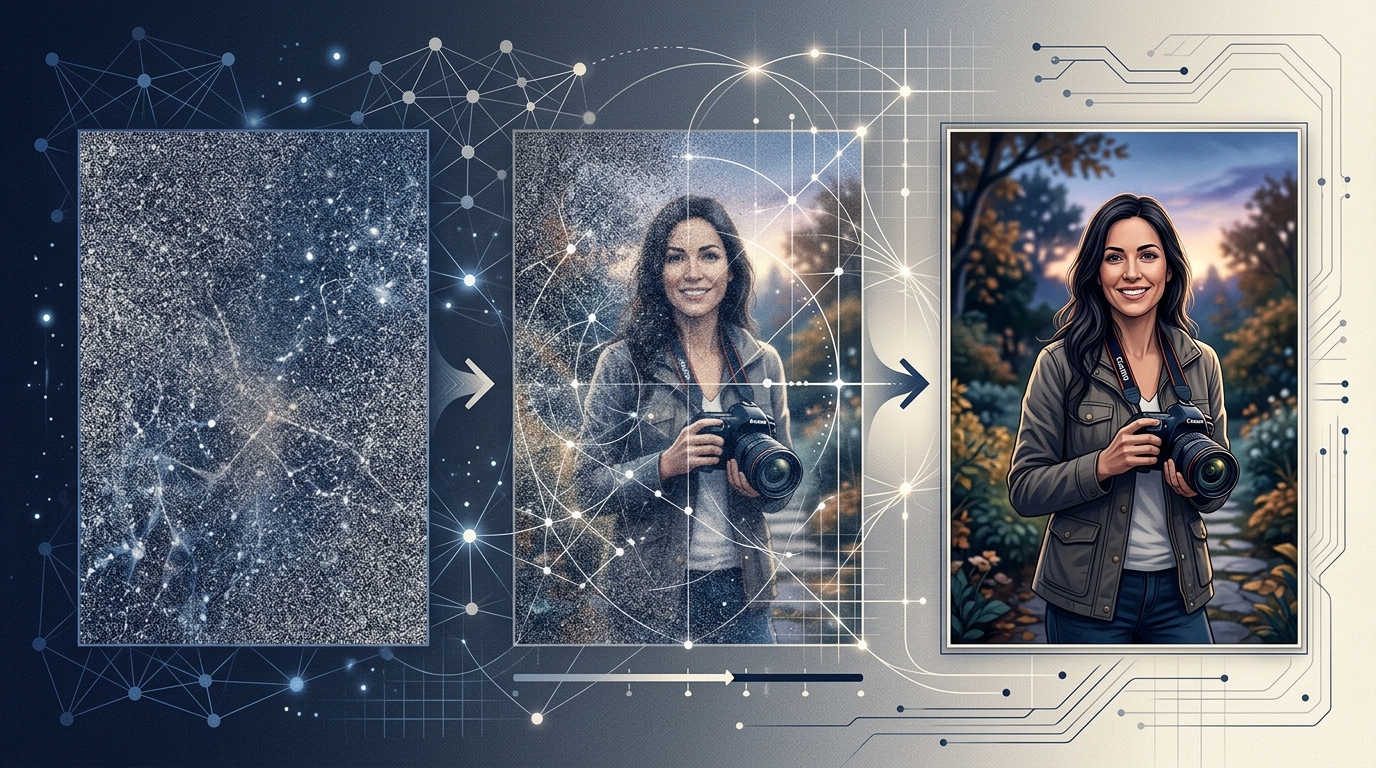
This stage represents the core breakthrough of modern generative image models. Rather than drawing an image top-to-bottom or left-to-right, a diffusion model begins with a field of pure, random Gaussian static noise.
As documented in the Hugging Face Diffusers framework, the model has been trained on the reverse of a noise-adding degradation process. Guided by cross-attention layers linked to the prompt embeddings, the model executes 20 to 50 mathematical denoising steps:
Pure Static → Structural Outlines → Anatomical Massing → Textural Definition → Micro-Lighting & Sharpness
With each computational step, the latent representation sheds entropy and converges closer to a visual scene that aligns mathematically with the input text.
Step 4: Latent Decoding and Super-Resolution Refinement
Because computing billions of parameters directly on high-resolution pixel grids is computationally prohibitive, modern models perform diffusion inside a compressed latent space. Once the latent representation is sculpted, a neural decoder (such as a Variational Autoencoder, or VAE) expands the mathematical representation back into visible, high-resolution RGB pixels.
For a hands-on exploration of popular creator tools utilizing this pipeline, read our recent overview of Top Free AI Image Generators to Try in 2026.
What Does the AI Actually Learn During Training?
A widespread misconception is that generative AI models act as sophisticated scrapers that store millions of copyrighted JPEGs and stitch them together like a digital collage. That is an inaccurate description of machine learning.
Generative vision models store weights and biases—numerical parameters representing statistical distributions and cross-modal correlations learned across millions of captioned images. The model internalizes:
- Geometric Structure: Perspective lines, vanishing points, foreshortening, and focal depth.
- Photometric Principles: How light scatters across matte fabric versus reflective chrome or subsurface human skin.
- Stylistic Signatures: The visual characteristics distinguishing macro lens photography, watercolor washes, 3D architectural renders, and vintage film stocks.
Because the network learns the foundational rules governing visual reality, it can generate scenarios it has never physically seen—such as “an electric sports car navigating a monsoon-drenched street in Mumbai in 2045”—by synthesizing learned principles of automotive reflection, rain-slicked asphalt, neon illumination, and urban architecture.
To see how content teams transition from generic imagery to distinctive visual systems, explore our guide on Beyond Stock Photos: Crafting Unique Visuals with AI Image Generators.
Why Do Some AI Images Still Exhibit Artifacts?
While foundation models have achieved astonishing photorealism, subtle anomalies can still occur. Understanding why helps creators design better prompts and quality-control workflows:
Common Generative Artifacts and Their Causes
- Hand & Finger Distortions: Human hands possess intricate degrees of freedom and complex self-occlusion. Models infer 2D visual statistics without possessing an internal 3D skeletal kinematic model.
- Inconsistent Shadow Vectors: If multiple lighting cues are mentioned (e.g., “studio flash + golden sunset”), the model may synthesize conflicting shadow directions.
- Optical Illusions & Impossible Geometry: Window reflections or architectural staircases may terminate unnaturally because the network predicts local pixel coherence rather than global physics.
Federal and industry testing initiatives, such as the NIST GenAI evaluation programme, actively benchmark how synthetic media systems maintain fidelity, mitigate hallucinations, and embed cryptographic watermarks (like C2PA Content Credentials) to safeguard information integrity.
Practical Industry Applications of Generative Vision
Demystifying the science behind generative models enables industries to deploy them with tactical precision:
1. Marketing, Advertising, and E-Commerce
Agile marketing teams use generative tools to develop custom visual variants across demographics, A/B test advertising headers, and mock up product packaging before committing to industrial manufacturing. Learn how automation connects these assets in our guide on n8n, Make.com and Zapier for AI Content Pipelines.
2. Architecture and Interior Design
Designers convert early schematic floor plans into atmospheric 3D interior renders, enabling clients to visualize spatial layouts, natural lighting angles, and custom material palettes in real-time consultations.
3. Healthcare and Scientific Communication: A Call for Caution
While generative vision aids conceptual medical illustrations, peer-reviewed clinical studies have revealed significant anatomic inaccuracies when general-purpose models attempt to render surgical procedures or anatomical cross-sections. In mission-critical healthcare contexts, expert clinical validation remains non-negotiable.
For brands competing in high-stakes environments, our Complete Guide to Search Everywhere Optimisation for Indian Businesses outlines how authoritative, verified multimedia establishes durable organic trust.
Best Practices for Implementing AI Image Workflows Responsibly
- Formulate Multi-Layered Prompts: Structure instructions logically: [Subject] + [Context/Setting] + [Composition] + [Lighting] + [Style/Lens] + [Aspect Ratio].
- Conduct Rigorous Quality Audits: Inspect fingers, reflections, symmetry, and brand color alignment prior to commercial publication.
- Respect Commercial Licensing: Verify whether your software tier grants commercial indemnification or restricts usage to personal evaluation. Read our comprehensive analysis on The Business Model Behind Free AI Tools for key pricing insights.
- Incorporate Post-Processing Polish: Use Photoshop, Lightroom, or Canva for final color grading, typography integration, and corporate logo placement.
Frequently Asked Questions
How do AI image generators work from text prompts?
AI image generators use deep language encoders to convert text into mathematical embeddings, which then guide a diffusion model to progressively remove noise from a latent canvas until a sharp, contextually accurate image emerges.
What is a latent diffusion model?
A latent diffusion model is a machine learning architecture that performs the generative denoising process in a compressed mathematical representation space rather than raw pixel grids, dramatically increasing rendering speed and computational efficiency.
Do AI image generators copy or steal existing pictures?
No. Rather than collaging or retrieving stored files, foundation models synthesize original pixels based on generalized mathematical patterns of lighting, texture, and geometry learned during pre-training.
Why do AI image generators sometimes struggle with hands and text?
Generative models predict visual patterns statistically rather than understanding mechanical bone structures or linguistic spelling rules. However, newer models (such as Ideogram and Imagen 4) have integrated specialized character-level encoders that render crisp, legible typography.
Will understanding how AI image generators work replace professional graphic designers?
No. While generative models automate technical rendering, professional design requires brand strategy, emotional storytelling, art direction, and nuanced communication. AI serves as a powerful creative accelerator, directed by human expertise.
Explore our complete archive of technical guides, AI platform benchmarks, and enterprise automation playbooks on the HuAI Content Blog.
Pingback: AI Tools for Video Editing: Streamline Post-Production in 2026
Pingback: AI Tools for Education: Interactive & Immersive Learning
Pingback: Free Online AI Art Generators in 2026: Creative Guide