
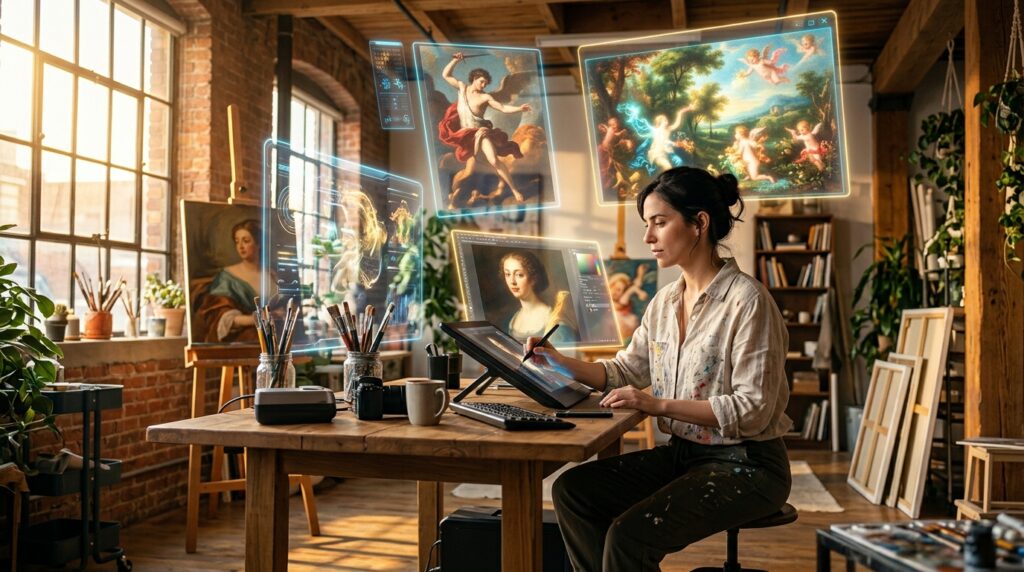
Artificial intelligence is no longer confined to academic research laboratories or experimental demonstrations. Today, intuitive free online AI art generators transform everyday creative expression across graphic design, marketing, concept art, and digital illustration.
For centuries, visual creativity was closely linked with physical drawing technique, specialized materials, and manual dexterity. However, modern diffusion algorithms can synthesize intricate illustrations, photographic scenes, and concept art from brief written descriptions in seconds. In addition, users can iterate on existing compositions effortlessly.
Crucially, this technological shift does not signal the demise of human artists. Instead, generative platforms redefine the partnership between human imagination and digital production tools. Discover how diffusion architectures interpret language in our deep-dive on How AI Image Generators Work.
What Is Modern AI Art?
Modern AI art refers to visual media synthesized, stylized, or modified using machine learning algorithms. Rather than applying rigid preset filters, intelligent models interpret natural-language instructions to construct entirely new visual assets.
Specifically, creative teams utilize these platforms to generate diverse visual formats:
- Photorealistic Imagery: Authentic lifestyle photography and product staging.
- Concept Art & Worldbuilding: Rapid environmental sketches for gaming and cinematic pre-production.
- Digital Illustrations: Editorial graphics, book covers, and stylized marketing banners.
- Brand Graphics: Social media carousels, ad creatives, and promotional posters.
- Iterative Inpainting: Modifying isolated objects, extending canvas boundaries, or refining textures.
For example, a designer can prompt: “A futuristic Kolkata skyline at sunset, viewed from a rooftop restaurant, cinematic photography, warm ambient lighting.” The neural network parses semantic relationships between lighting, architecture, and atmosphere, delivering a tailored rendering within moments. Learn how brands personalize visual assets in our guide on Personalising Content with Free AI Image Generators.
A Brief History: From Early Algorithms to Diffusion Models
The convergence of computing and visual art began decades before today’s generative boom. During the 1970s, pioneering researcher Harold Cohen developed AARON, an autonomous painting machine programmed with explicit algorithmic drawing rules. Historic works from this era are documented by institutions like the Victoria and Albert Museum.
However, early rule-based systems differed radically from contemporary neural networks. While early software executed hardcoded rules, modern models learn latent visual representations from massive image-text datasets.
Subsequently, the arrival of Generative Adversarial Networks (GANs) in 2014 accelerated synthetic imagery. A milestone moment occurred in 2018 with the Christie’s auction of Portrait of Edmond de Belamy. Soon after, diffusion models fundamentally transformed the industry, enabling Stable Diffusion, Midjourney, and DALL-E to achieve mainstream adoption.
By 2026, technology combines multimodal reasoning, canvas inpainting, and conversational editing. Explore how creators move beyond stock libraries in our report on Crafting Unique Visuals with AI Image Generators.
The Best Free Online AI Art Generators to Explore in 2026
While many platforms offer free access tiers, allowances frequently feature daily limits, watermarks, or slower rendering queues. Here are the leading platforms worth exploring today:
1. ChatGPT Images (DALL-E & Multimodal Canvas)
OpenAI has integrated conversational image generation directly into ChatGPT across web and mobile apps. Rather than restarting prompts repeatedly, creators refine compositions through iterative dialogue.
For example, a user can instruct the model to warm up background lighting, relocate the focal character, or remove unwanted clutter. Consequently, the creative experience mirrors an interactive art direction session.
2. Google Gemini Image Generation (Nano Banana 2)
Google’s Gemini ecosystem incorporates advanced visual models, including the Nano Banana family. Specifically, Nano Banana 2 emphasizes rapid generation, consistent facial anatomy, and complex prompt adherence.
Furthermore, Gemini connects smoothly with Google Workspace, allowing designers to insert generated visuals directly into collaborative docs and presentation decks.
3. Adobe Firefly
Adobe Firefly stands out for its uncompromising focus on commercial safety and enterprise licensing. Specifically, Adobe trains its proprietary models exclusively on licensed content from Adobe Stock and public-domain archives.
Therefore, creative agencies and corporate marketing departments often choose Firefly to eliminate copyright infringement risks during commercial client campaigns.
4. Canva AI Suite
Canva integrates generative image tools directly into its publishing and layout editor. Consequently, marketers can generate a visual, overlay typography, apply brand color palettes, and export social assets within a single browser tab.
This seamless workflow eliminates the friction of downloading raw images and importing them into secondary graphic editors.
5. Leonardo AI
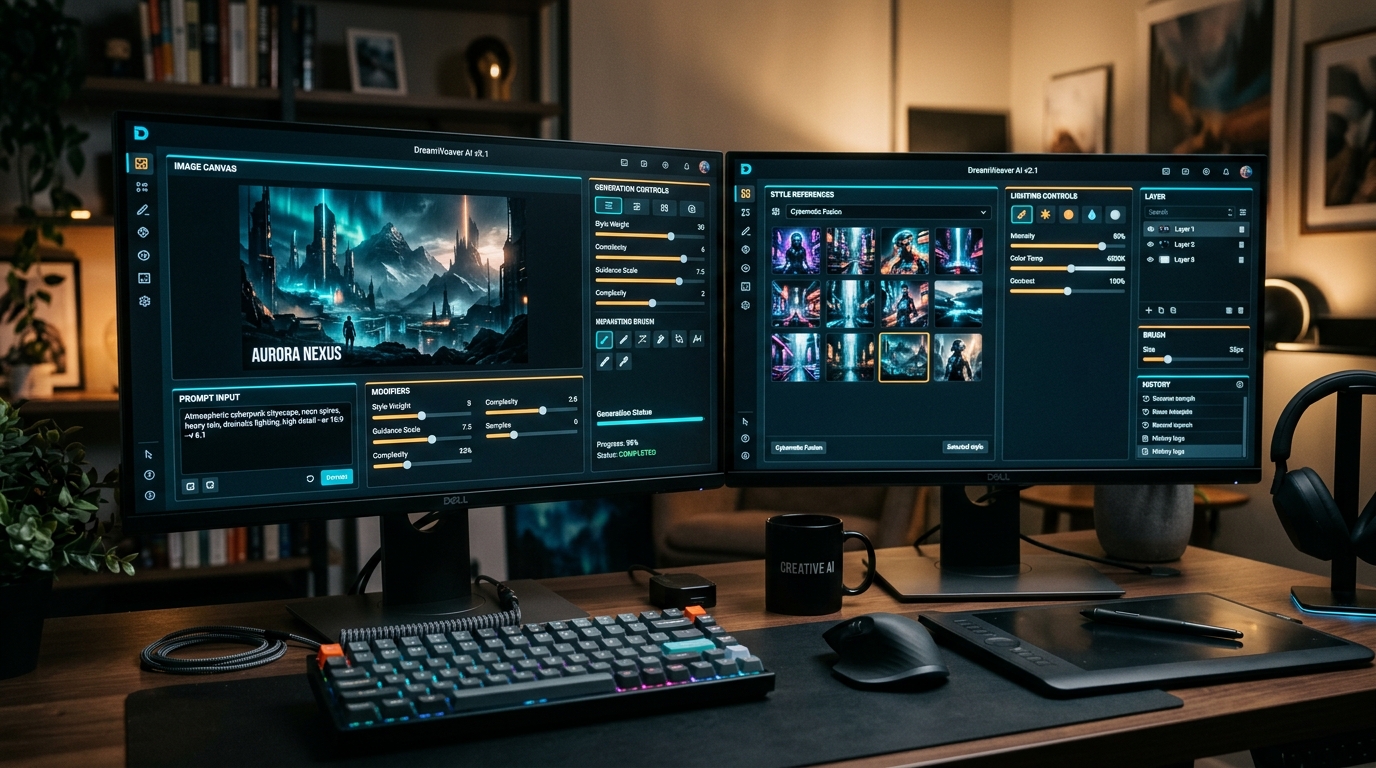
Leonardo AI remains a favorite among game developers, concept illustrators, and character designers. The platform provides granular controls over guidance scale, negative prompting, model weights, and custom style fine-tuning.
As a result, creators achieve significantly greater stylistic consistency across recurring characters and asset collections.
6. Ideogram
Historically, rendering legible typographic text inside synthetic images was a persistent weakness for generative models. Ideogram solved this barrier by specializing in coherent in-image lettering.
Consequently, Ideogram is an exceptional choice for designing event posters, T-shirt typography, book covers, and social graphics requiring sharp, readable headlines.
7. Stable Diffusion & Open-Model Workflows
For technical creators seeking complete privacy and unlimited experimentation, open-weights diffusion models offer unmatched freedom. Running models locally requires capable GPU hardware, but eliminates subscription fees and usage caps entirely.
Discover how automated pipelines connect content workflows across platforms in our guide on n8n vs Make.com vs Zapier for AI Pipelines.
What Types of AI Architectures Create Digital Art?
Understanding the underlying computational mechanics helps creators prompt models more effectively. Modern generative art relies on three primary architectures:
Generative Architectural Models
- Diffusion Models: Add mathematical Gaussian noise to source images during training, then iteratively denoise random static to synthesize crisp, high-resolution visuals.
- Multimodal Transformers: Treat image pixels as visual tokens, generating compositions autoregressively based on contextual language understanding.
- Generative Adversarial Networks (GANs): Pit a generator network against a discriminator network to refine photorealism through continuous statistical competition.
Explore how video editing platforms integrate generative features in our review of Innovative Features of AI-Powered Video Editing Platforms.
Copyright, Legal Ownership, and Commercial Protection
As synthetic imagery enters mainstream media, intellectual property questions have become paramount. In the United States, official guidance from the U.S. Copyright Office states that purely machine-generated visuals lacking human creative authorship cannot be copyrighted.
However, when human artists significantly transform, arrange, or edit synthetic elements, those expressive human contributions may qualify for copyright protection. Furthermore, enterprise creators must review platform terms of service regarding commercial usage rights and dataset indemnification.
Safeguard digital publishing standards with our comprehensive EEAT for YMYL Content Checklist. In addition, understand sustainable agency models in our guide to Pricing AI Automation Agency Services.
A Practical 5-Step Prompting Blueprint for Better AI Art
- Define the Core Subject: State the central focal point clearly (e.g., “A vintage brass microscope on a weathered oak workbench”).
- Specify the Artistic Medium: Indicate whether you need 35mm film photography, an oil painting, an architectural blueprint, or a 3D isometric render.
- Establish Lighting and Atmosphere: Incorporate specific lighting terms like golden hour sunlight, volumetric fog, or dramatic chiaroscuro shadows.
- Set the Perspective and Composition: Clarify camera angles such as macro close-up, low-angle hero shot, or symmetrical wide panoramic view.
- Iterate with Inpainting: Use canvas brush tools to replace minor imperfections rather than regenerating the entire image from scratch.
Frequently Asked Questions
Are free online AI art generators truly free?
Most platforms operate on a freemium model. They offer daily credits or free starter tiers, while reserving ultra-fast GPU speeds and high-resolution commercial downloads for paid subscribers.
Can I sell artwork created with free online AI art generators?
Commercial permissions depend on each platform’s terms of service. For instance, Adobe Firefly and Midjourney paid plans allow commercial usage, but free tiers on some services restrict commercial distribution.
Can AI art be copyrighted?
Under current legal guidelines, purely prompt-generated art cannot receive copyright protection. However, human artists who substantially edit, combine, and alter AI assets may copyright their creative additions.
Which free AI art generator is best for text inside images?
Ideogram is widely recognized as the industry leader for generating legible, beautifully styled typography directly inside synthetic compositions.
Explore our complete library of production workflows, automation benchmarks, and digital marketing insights on the HuAI Content Blog. In addition, discover how modern businesses expand search visibility in our guide to Search Everywhere Optimisation for Indian Businesses.
Pingback: How to Generate Art with AI: Free Tools in 2026