
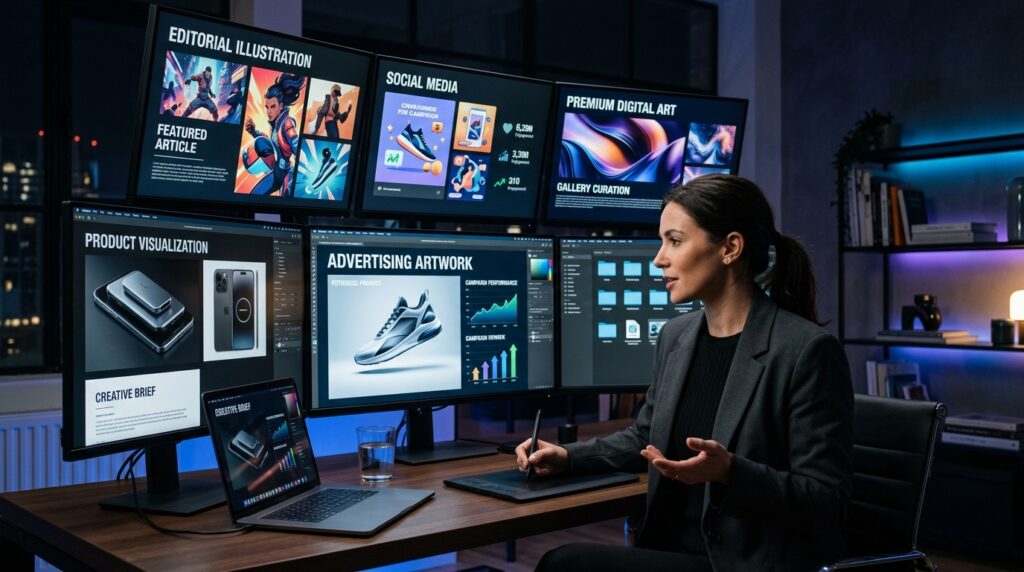
Artificial intelligence has moved far beyond a technical novelty for digital artists. Today, forward-thinking entrepreneurs actively discover how to monetize AI art. Consequently, they transform automated visual generation into high-value client solutions.
Modern businesses deploy generative models to create advertising concepts, social media campaigns, product mockups, and website graphics. Furthermore, they produce creative variations at a fraction of traditional production costs. You no longer require an expensive commercial design studio to launch a profitable visual services business.
However, the real commercial opportunity does not involve selling raw, prompt-generated images as digital commodities. Instead, sustainable profitability comes from solving genuine business problems. Clients do not pay for computational tokens; they pay for strategic outcomes, brand consistency, and streamlined turnaround times.
This comprehensive guide examines how to monetize AI art in 2026. Specifically, we explore viable business models, practical commercial applications, pricing strategies, copyright realities, and enterprise workflow integration.
What Makes Commercial AI Art a Major Business Opportunity?
Traditional visual asset production requires substantial overhead. A conventional marketing campaign often demands hiring commercial photographers, renting studio spaces, commissioning custom illustrators, and purchasing recurring stock photos. In addition, organizing human models, staging physical locations, and managing repetitive revision cycles drains operational budgets.
Generative software does not completely eliminate specialized production in every scenario. However, it dramatically reduces the time and cost required for conceptual and repeatable visual assets. Consequently, small and medium enterprises gain access to sophisticated creative firepower previously reserved for global corporations.
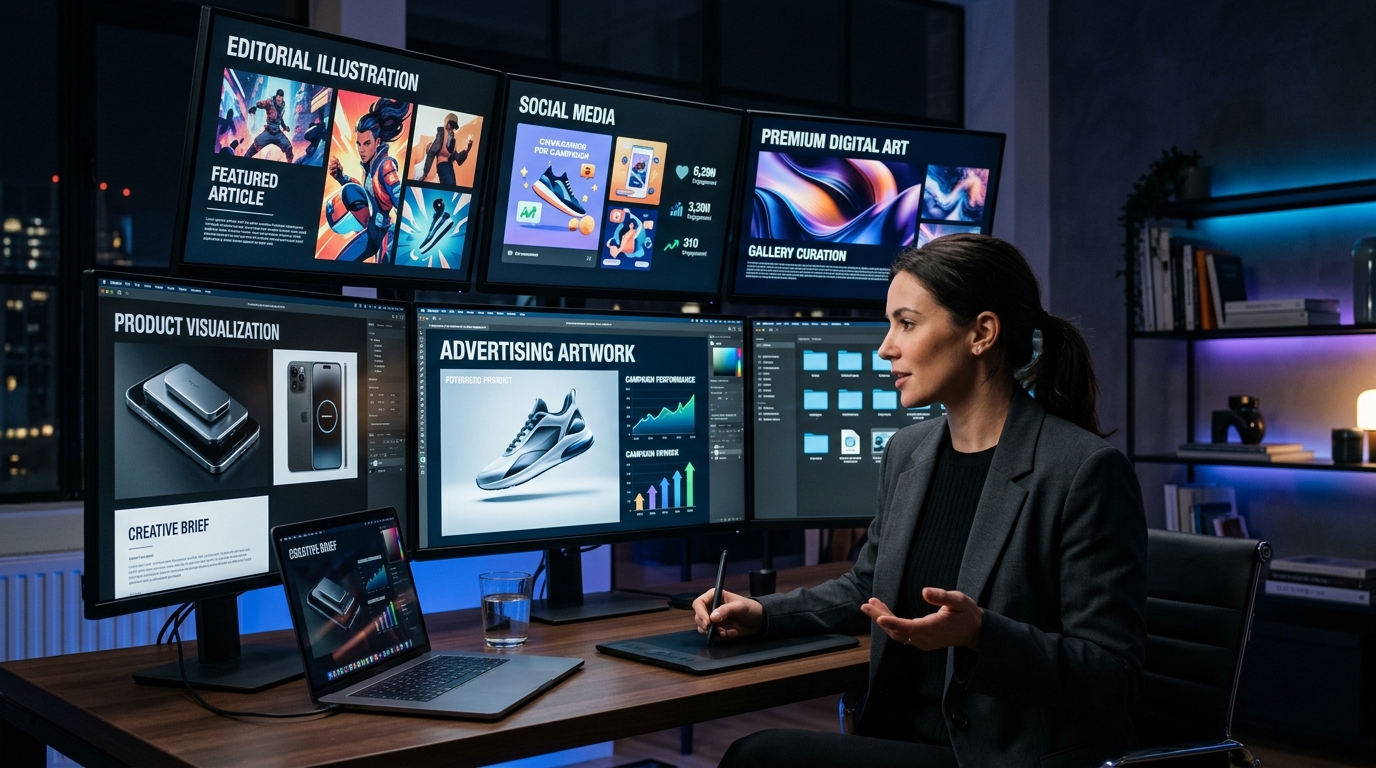
Consider a growing regional restaurant chain preparing seasonal promotions. Traditionally, producing dozens of localized social banners, festival campaign creatives, and menu graphics required weeks of coordination. In contrast, an agile creative director develops conceptual directions within hours. Then, they polish the strongest assets in professional design software.
Therefore, commercial value stems directly from speed, adaptability, and rapid creative iteration. For a foundational walkthrough on directing visual models, explore our guide on how to generate art with AI.
High-Yield Business Models to Monetize AI Art
Entrepreneurs can package algorithmic visual production into several lucrative commercial offerings. Specifically, the following business models demonstrate the highest client demand in 2026:
1. Social Media Creative Packages
Modern brands constantly require fresh visual content to sustain algorithmic engagement across social channels. In addition, you can offer recurring retainer packages delivering monthly content bundles.
For example, a monthly package might include 15 custom social graphics, 4 seasonal campaign banners, and tailored platform resizing. You are not simply selling raw images; you are providing an indispensable content production service.
2. Website and Editorial Visual Systems
High-growth websites and blogs need distinctive visual identities. Rather than relying on generic stock libraries, content teams seek bespoke editorial headers, explanatory diagrams, and branded infographics.
Custom imagery significantly reinforces topical authority. In our guide to pillar-cluster content architecture, we show how cohesive visual systems elevate dwell time and search performance.
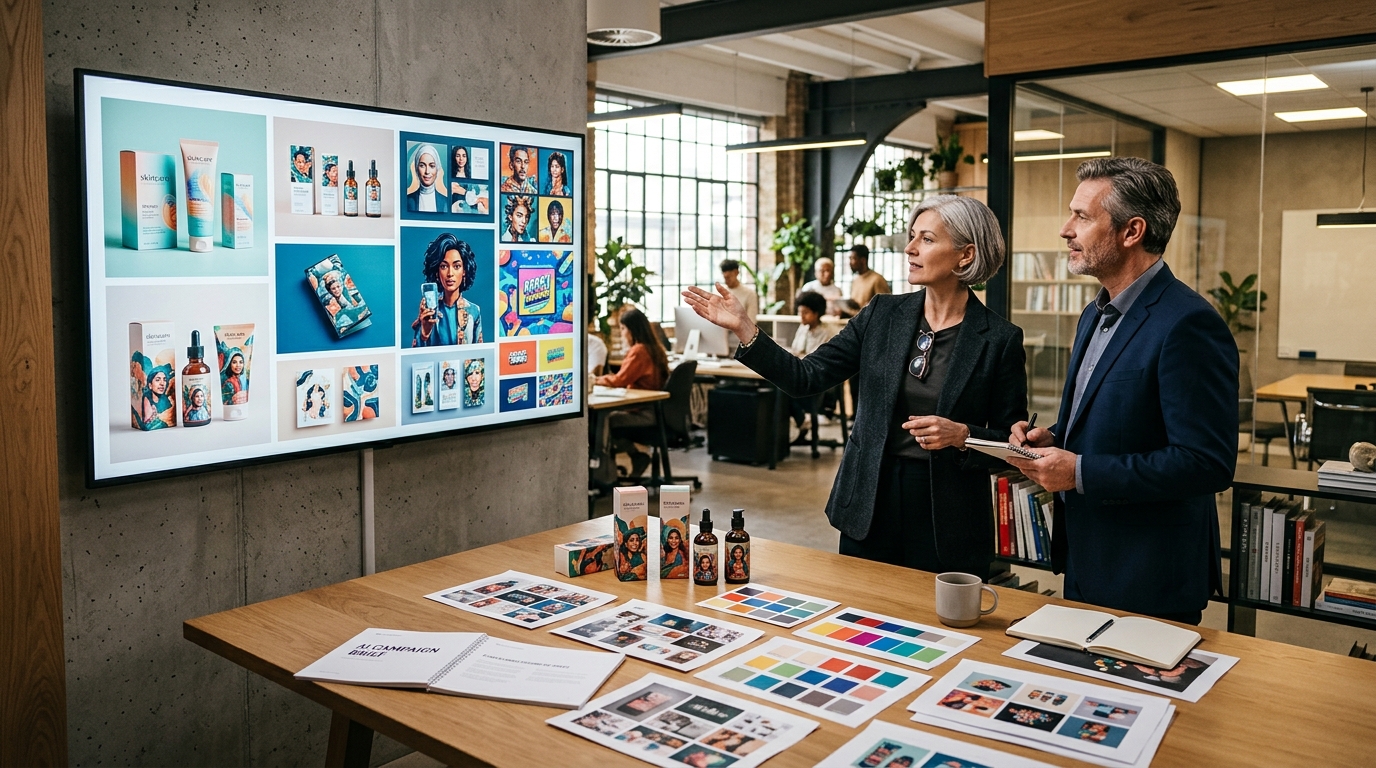
3. Rapid Product Prototyping and Packaging Concepts
Visualizing physical concepts before committing capital to manufacturing represents a massive commercial application. Founders can prototype packaging variations, cosmetic bottles, furniture concepts, and interior architectural schemes rapidly.
Consequently, this agility allows e-commerce brands to validate consumer interest with realistic digital mockups before initiating expensive production runs. For a curated review of leading generators, read our overview of free online AI art generators in 2026.
4. Dynamic Advertising Creative Variations
Performance marketers constantly test visual variations to optimize cost-per-acquisition metrics. Generative tools allow media buyers to test multiple backgrounds, seasonal themes, and lifestyle settings around a single hero product seamlessly.
As a result, marketing teams can deploy monsoon campaigns, festival discounts, and summer promotions without re-photographing physical inventory. In addition, discover practical customization workflows in our guide to personalising content with free AI image generators.
5. Print-on-Demand and Merchandising
Entrepreneurs can integrate unique visual designs into physical merchandise, including limited-edition posters, wall art, stationery, and apparel. However, standalone product sales require strict adherence to platform commercial licensing rules and copyright standards.
Comparing Generative AI Art with Traditional Stock Photography
Many creators view generative imagery as an outright replacement for recurring stock photography subscriptions. However, professional visual strategy requires a more nuanced perspective. Both mediums serve distinct operational needs.
Generative models excel when you require highly customized, unusual, or hyper-specific scenes that do not exist in stock databases. For instance, prompting for a solar farm engineer reviewing clean energy telemetry produces a tailored conceptual graphic immediately.
Conversely, traditional stock libraries retain distinct advantages when authentic photojournalism, recognizable public figures, or certified model releases are essential. Therefore, commercial strategists do not choose between AI or stock. Instead, they select the optimal medium for each specific visual requirement.
The Production Economics: Free Tools vs. Complete Operational Costs
The term “free” can be misleading in enterprise environments. While free AI tools offer generous starting credits, commercial production involves wider operational considerations.
First, free tiers often impose daily generation caps, slower processing queues, reduced image resolutions, and mandatory public gallery visibility. Second, professional deliverables require human time, graphic design subscriptions, cloud storage, client revision rounds, and quality control.
Therefore, calculate your business margins based on the entire creative lifecycle rather than software subscription costs alone. When establishing agency rates, consult our guide on how to price your AI automation agency services to ensure profitability.
Copyright Realities and Commercial Licensing in 2026
Building a defensible business around generative art requires understanding intellectual property law. Misconceptions regarding public domain status can expose agencies to significant legal risks.
Crucially, the U.S. Copyright Office has established clear policy guidance regarding synthetic media. Purely prompt-generated imagery lacking human authorship cannot receive federal copyright protection. The Copyright Office explicitly clarified that text prompts alone do not provide sufficient human expressive control.
However, works with substantial human creative contribution remain eligible for copyright. Specifically, this includes original digital arrangement, compositing, and manual modifications. Consequently, agencies that combine algorithmic synthesis with human artistic direction build protected, high-value assets for clients.
Furthermore, international regulatory standards are enforcing greater transparency. Under the European Union AI Act, Article 50 transparency requirements took effect in August 2026. These rules mandate machine-readable disclosures and watermarking for specific synthetic media formats.
To establish verified media provenance, organizations utilize open standards like the Coalition for Content Provenance and Authenticity (C2PA). For deeper philosophical insights into human authorship, explore our analysis of AI art generators and creativity.
A Proven 10-Step Workflow for Professional AI Art Production
To build a scalable commercial practice, replace improvised prompting with a standardized production pipeline:
- Client Creative Brief: Document the commercial objective, target demographic, platform specifications, and mandatory brand guidelines.
- Visual Direction & Style Guide: Define color palettes, camera lenses, lighting ratios, and composition rules before generating imagery.
- Structured Prompt Architecture: Develop modular prompts incorporating subject, action, environment, perspective, and constraints.
- Batch Concept Generation: Produce exploratory variations to present diverse compositional options to stakeholders.
- Strategic Curation: Select promising candidates that align strictly with commercial campaign objectives.
- Iterative Refinement: Utilize localized inpainting and conversational adjustments to eliminate anatomical or background flaws.
- Design Finishing: Import selected renders into graphic software to overlay typography, brand logos, and vector assets.
- Quality Control Audit: Verify resolution scaling, color profiles, trademark clearance, and license compliance.
- Multi-Format Asset Export: Deliver tailored aspect ratios optimized for web banners, mobile feeds, and print media.
- Asset Archiving: Catalog original prompts, seed numbers, editing revisions, and platform license receipts for client records.
For businesses seeking multi-channel reach, align visual deliverables with our comprehensive playbook on Search Everywhere Optimisation for Indian businesses. In addition, explore how autonomous agents streamline operations in our analysis of 5 ways agentic AI automation transforms content strategy.
Finally, when providing visual assets for compliance-heavy sectors, ensure adherence to our E-E-A-T checklist for YMYL content.
Frequently Asked Questions
How can beginners successfully monetize AI art?
Beginners can monetize AI art by packaging visuals into complete service bundles. Instead of selling raw files, offer social media packages, marketing banners, or blog illustration systems paired with graphic design.
Is it legal to sell images created with free AI tools?
Commercial legality depends strictly on each platform’s terms of service. While some generators grant commercial rights on free tiers, others restrict commercial use to paid subscriptions. Always check the specific platform license terms.
Can I copyright artwork created with AI assistance?
Under current legal precedents, prompts alone do not confer copyright ownership. However, you can copyright final works that incorporate substantial human creative modifications, digital compositing, and original arrangement.
What is the most profitable niche to monetize AI art?
High-margin niches include product prototyping for e-commerce, ad variation packages for performance marketing, and complete brand design for startups.
To discover more actionable automation strategies and enterprise content insights, visit the HuAI Content Blog. In addition, explore our technical deep dive on the science behind AI image generators.