

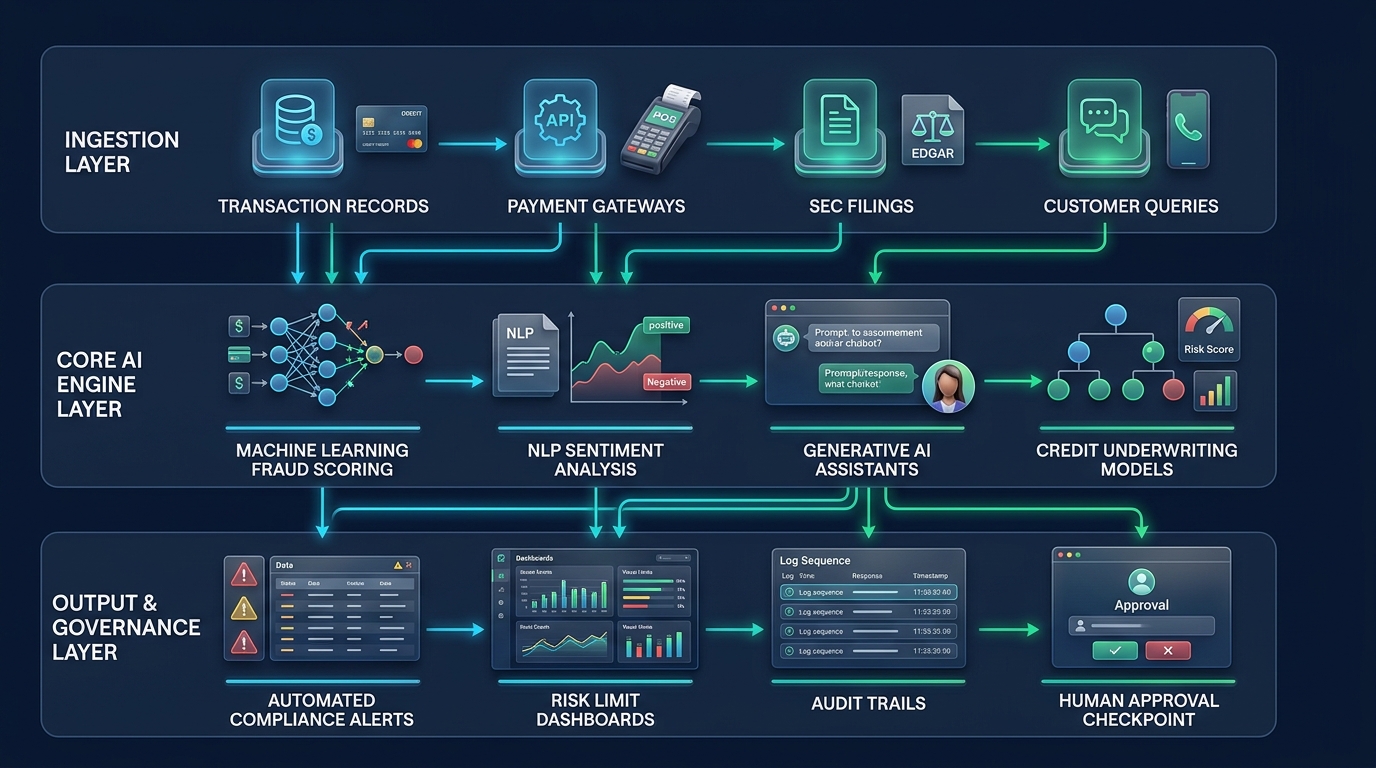
Artificial intelligence is fundamentally transforming how global financial services are designed, delivered, and governed. In 2026, the expanding AI in FinTech market enables retail banks, neobanks, payment networks, and digital lenders to analyze massive transaction feeds, detect sophisticated financial fraud, assess creditworthiness, automate complex back-office workflows, and deliver personalized customer interactions at scale.
The financial technology landscape has rapidly evolved beyond legacy statistical modeling. Modern generative AI and autonomous agentic systems are expanding the practical horizons of the AI in FinTech market—spanning everything from automated SEC filing summarization and customer support triage to real-time compliance monitoring and institutional investment research.
However, deploying artificial intelligence within financial technology is not merely a technical exercise in model acceleration. Financial institutions operate under strict fiduciary mandates, handling highly sensitive customer data, non-negotiable regulatory obligations, emerging cybersecurity threats, and automated decisions that materially impact human lives. Understanding how the AI in FinTech market operates—its practical architectures, tangible business advantages, and governance requirements—is essential for any forward-looking financial enterprise.

Understanding the AI in FinTech Market: Architecture and Core Capabilities
Within financial technology, artificial intelligence refers to the strategic deployment of advanced machine learning, deep neural networks, and automated reasoning systems to execute or augment financial operations. Core technological pillars driving the AI in FinTech market include:
- Supervised & Unsupervised Machine Learning: Classification and clustering algorithms applied to risk scoring, fraud detection, and churn prediction.
- Natural Language Processing (NLP): Ingestion and semantic parsing of unstructured regulatory filings, customer communications, and financial disclosures.
- Generative AI & LLMs: Context-aware conversational assistants, document summarization, and automated compliance drafting.
- Predictive Analytics & Time-Series Modeling: Forecasting payment volume spikes, cash-flow liquidity requirements, and market volatility.
- Autonomous AI Agents: Coordinated software agents authorized to execute permitted, multi-step financial workflows across secure APIs.
Research published by the Bank for International Settlements (BIS) confirms that institutional financial institutions are actively deploying AI across credit underwriting, transaction monitoring, market surveillance, and operational back-office automation, with generative models rapidly expanding customer-facing touchpoints.
How Is AI Used in FinTech? Core Applications
1. Financial Data Ingestion and Multi-Asset Analysis
Modern financial institutions process millions of structured and unstructured data points every second. Advanced machine learning models ingest transaction records, customer credit profiles, financial balance sheets, and real-time payment telemetry to uncover non-linear patterns that remain invisible to manual review.
The ultimate objective is not merely processing higher volumes of data, but transforming raw informational noise into actionable, high-conviction decision signals for risk officers and automated pipelines. To understand the granular mechanics of these implementations, explore our dedicated analysis on AI applications in FinTech.
2. Real-Time Fraud Prevention and Anomaly Detection
Fraud prevention represents one of the most mature and mission-critical applications within the AI in FinTech market. Rather than relying on static heuristic rules (such as blocking transactions above a fixed dollar threshold), adaptive machine learning algorithms evaluate multidimensional behavioral signals:
- Unusual transaction frequency and velocity anomalies
- Geographic and IP location discrepancies
- Abnormal transaction values relative to historical spending profiles
- Device fingerprint changes and biometric telemetry shifts
- Complex syndication patterns across coordinated money-mule networks
Crucially, effective fraud detection must balance risk mitigation with customer friction. Excessive false positives alienate legitimate cardholders, making continuous threshold calibration and human escalation pathways vital.
3. Credit Risk Assessment and Alternative Underwriting
Traditional credit bureaus rely on historical FICO scores, which often exclude credit-invisible consumers and small businesses. In the modern AI in FinTech market, machine learning algorithms assess creditworthiness using permitted alternative data streams—including cash-flow velocity, recurring utility payments, and merchant transaction histories.
While algorithmic underwriting accelerates approval times from days to seconds, it introduces profound ethical responsibilities. Financial institutions must rigorously audit credit algorithms to eliminate algorithmic bias, ensure explainability under adverse action notices, and comply with fair lending statutes.
4. Intelligent Conversational Banking and Virtual Assistants
AI-powered conversational interfaces provide retail banking customers with 24/7 instant support. Leveraging modern large language models, virtual assistants handle account inquiries, transaction disputes, wire status updates, and spending categorization with natural dialogue.
However, conversational banking requires zero-trust security architecture. Chatbots must enforce strict authentication boundaries, prevent prompt-injection exploits, and automatically escalate complex financial disputes to experienced human representatives.
5. Hyper-Personalized Financial Services
By analyzing customer spending patterns and recurring obligations, AI models empower FinTech platforms to deliver tailored financial wellness insights, proactive savings recommendations, and contextual micro-credit offerings. However, personalization must always respect data privacy and client consent, avoiding manipulative design patterns or predatory credit promotion.
6. Algorithmic Trading and Capital Markets
Capital markets represent the frontier of mathematical automation. Machine learning models evaluate order book microstructure, macroeconomic releases, and narrative sentiment to optimize trade execution and portfolio rebalancing. For a dedicated technical examination of how machine learning powers quantitative strategies, see our companion pillar article on AI in stock trading and machine learning investment strategies.
7. Regulatory Technology (RegTech) and Supervisory Compliance
FinTech enterprises operate under demanding anti-money-laundering (AML) and Know Your Customer (KYC) regulations. AI-driven RegTech platforms automate sanctions screening, politically exposed person (PEP) cross-referencing, suspicious activity report (SAR) generation, and market abuse surveillance. These systems drastically reduce manual audit backlogs while maintaining comprehensive digital audit trails.
8. Enterprise Risk Management and Stress Testing
Beyond individual transaction fraud, artificial intelligence powers institutional balance-sheet stress testing. Quantitative engines deploy Monte Carlo simulations and generative models to evaluate liquidity coverage ratios under simulated economic shocks, capital flight scenarios, and sudden interest-rate shifts.
9. Generative AI and Document Intelligence
Generative AI streamlines back-office document workflows across banking and asset management. Financial analysts utilize domain-specific models to summarize 100-page loan prospectuses, extract key covenants from commercial credit agreements, and draft routine regulatory filings. For institutions scaling enterprise automation pipelines, our specialized HuAI Content workflow automation services provide production-grade infrastructure.
Top Benefits of AI in the FinTech Market
Organizations successfully integrating machine learning into financial workflows capture distinct competitive advantages:
| Operational Dimension | Legacy Financial Banking | AI-Powered FinTech Ecosystem |
|---|---|---|
| Credit Underwriting Speed | Manual paper review taking 3–7 business days | Automated multi-factor risk assessment in under 60 seconds |
| Fraud Detection Logic | Static rule-based filters with high false-positive rates | Real-time machine learning anomaly scoring across behavioral telemetry |
| Customer Support Availability | Standard call-center hours with long phone queues | Instant 24/7 conversational assistance with natural language resolution |
| Compliance & AML Monitoring | Sampled batch audits and manual transaction reviews | Continuous 100% transaction screening and automated SAR drafting |
| Operational Scalability | Headcount-dependent scaling with linear cost growth | Elastic digital infrastructure supporting millions of concurrent users |
Critical Challenges and Governance in Financial AI
While the economic potential of the AI in FinTech market is enormous, operating in heavily regulated financial markets demands rigorous risk mitigation across five critical dimensions:
1. Data Governance and Client Privacy
Financial records constitute highly confidential personal data. Organizations must enforce strict data minimization, cryptographic encryption at rest and in transit, and role-based access controls to prevent catastrophic data breaches.
2. The Explainability and Black-Box Dilemma
When an automated credit algorithm denies a loan or freezes an account, regulatory statutes require clear, actionable explanations. Uninterpretable deep neural networks pose significant compliance hurdles, requiring techniques like SHAP (Shapley Additive Explanations) and LIME to generate transparent adverse-action rationales.
3. Algorithmic Bias and Systemic Fairness
Machine learning models learn patterns from historical datasets. If training data reflects historical lending discrimination or societal biases, algorithms will reinforce and amplify those inequities. Continuous disparate impact testing is non-negotiable.
4. Cybersecurity and Third-Party Cloud Dependencies
Modern FinTech platforms rely heavily on external cloud infrastructure and foundation model APIs. A security compromise or service outage at a major provider can propagate systemic contagion across payment networks. For a detailed breakdown of these risks, read our guide on the ethical implications of AI in FinTech.
The Road Ahead: Agentic Systems and Connected Financial Ecosystems
The next evolutionary leap within the AI in FinTech market is the convergence of generative models with autonomous agentic execution. Rather than simply answering a customer’s question or generating a report, future financial agents will coordinate multi-step workflows:
Ingest Customer Request → Verify Identity & Permissions → Retrieve Financial Telemetry → Evaluate Risk Limits → Execute Secure API Transaction → Log Audit Trail → Escalate Exceptions
To examine the breakthrough products emerging from this evolution, explore our technical breakdown of AI-driven innovations in FinTech.
Conclusion
The rapid expansion of the AI in FinTech market is reshaping banking, lending, fraud prevention, compliance, and wealth management. Machine learning enables financial organizations to process information faster, operate with unprecedented efficiency, and deliver tailored customer experiences.
However, sustainable market leadership requires balancing technological speed with institutional responsibility. The financial institutions that dominate the next decade will not simply be those that deploy the most algorithms, but those that establish transparent governance, protect client data, eliminate algorithmic bias, and ensure experienced human professionals remain in ultimate control.
To dive deeper into modern enterprise technology and digital transformation, visit the HuAI Content blog.
Frequently Asked Questions (FAQ)
What is the primary role of AI in FinTech market operations?
The role of AI in FinTech market operations is to automate and enhance critical financial activities, including real-time fraud detection, algorithmic credit assessment, conversational customer service, automated AML compliance, and risk management.
How does artificial intelligence detect financial fraud?
AI fraud systems evaluate real-time transaction telemetry—such as device fingerprinting, IP geolocation, transaction velocity, and spending amounts—comparing incoming events against behavioral baselines to identify and block fraudulent activity within milliseconds.
Can AI completely replace human bankers and financial advisors?
No. While AI automates repetitive calculations, document extraction, and routine customer inquiries, human professionals remain indispensable for strategic advisory, fiduciary accountability, complex risk governance, and regulatory oversight.
What are the primary ethical concerns surrounding AI in financial technology?
Key ethical concerns include data privacy violations, algorithmic bias in credit decisions, lack of model explainability, third-party technology dependency, and systemic financial stability risks during market stress.
How does generative AI impact FinTech operations?
Generative AI enhances financial document intelligence by summarizing complex loan agreements, parsing SEC regulatory disclosures, generating natural language financial reports, and powering intelligent conversational banking assistants.
Editorial Disclaimer: This article is published exclusively for educational, technical, and informational purposes and does not constitute financial, investment, legal, or regulatory advice.