

Artificial intelligence is no longer an experimental sandbox technology within financial services—it has become the core operational infrastructure behind contemporary banking and digital finance. In 2026, institutional financial institutions deploy intelligent AI applications in FinTech to ingest multi-source data feeds, detect sophisticated fraud, automate credit underwriting, assist retail customers, and govern enterprise risk.
The definitive industry shift is that machine learning has moved from isolated pilot programs directly into daily mission-critical operations. Rather than treating automation as a novelty, financial institutions are integrating machine learning across payment gateways, risk committees, customer support channels, and regulatory reporting.
This technical analysis examines the primary AI applications in FinTech, how institutional teams implement them, the tangible efficiency dividends they unlock, and the practical governance required to deploy them safely.

What Are the Main AI Applications in FinTech?
Modern financial technology platforms deploy diverse algorithmic architectures tailored to specific transaction velocities, risk boundaries, and data modalities. Below are the eight foundational use cases.
1. High-Velocity Financial Data Ingestion and Analysis
Financial institutions operate under a constant influx of heterogeneous data, including payment settlement streams, credit card swipes, mobile app sessions, corporate SEC filings, and global news wires. Traditional relational databases struggle to process this volume without severe latency.
Advanced machine learning models structure, normalize, and interpret multi-asset data feeds in milliseconds. By uncovering hidden non-linear relationships across transaction velocities, regional liquidity, and customer spending habits, quantitative algorithms provide human portfolio managers and operational teams with high-conviction decision telemetry.
2. Real-Time Fraud Prevention and Behavioral Scoring
Fraud prevention represents one of the most proven and economically impactful AI applications in FinTech. Static rule-based systems—which simply flagged transactions over a fixed amount—create unacceptably high false-positive rates that inconvenience legitimate cardholders.
Machine learning anomaly-detection engines analyze every transaction against dynamic behavioral baselines, evaluating:
- Transaction frequency anomalies and velocity spikes
- Geographic impossible-travel anomalies and IP proxies
- Merchant category discrepancies and sudden deviation from historical profiles
- Device hardware fingerprinting and typing cadence telemetry
- Coordinated multi-account syndication patterns
When anomalous telemetry is detected, the engine can trigger step-up multi-factor authentication, apply temporary micro-limits, or route the case directly to fraud analysts for forensic inspection.
3. Algorithmic Credit Risk Assessment
Credit assessment is moving away from static, backward-looking credit bureau scores toward dynamic machine-learning underwriting. By ingesting verified alternative data—such as cash-flow seasonality, payroll telemetry, and recurring vendor payments—credit models can assess thin-file borrowers and early-stage entrepreneurs accurately.
However, algorithmic credit models demand strict mathematical governance. Models must be rigorously tested for demographic parity and disparate impact, ensuring that automated scoring does not reproduce historical lending discrimination.
4. Intelligent Conversational Chatbots and Virtual Assistants
Natural language processing and generative AI have transformed retail banking customer service. Rather than forcing users through frustrating touch-tone IVR trees or rigid button menus, conversational assistants interpret natural user inquiries, clarify complex billing entries, assist with wire transfers, and explain fee structures.
These applications are part of a broader wave of AI-driven FinTech innovations, from robo-advisors to generative AI assistants that handle multi-step customer inquiries seamlessly.
5. Hyper-Personalized Wealth and Banking Experiences
FinTech platforms utilize predictive clustering to deliver individualized financial experiences. By evaluating spending trends and balance trajectories, AI engines provide automated budgeting insights, flag duplicate recurring subscriptions, and deliver contextual savings nudges. Personalization transforms a passive banking portal into an active financial advisory partner.
6. Automated Compliance, AML, and Sanctions Screening
Regulatory compliance is one of the heaviest operational burdens in digital finance. AI-driven Regulatory Technology (RegTech) automates Anti-Money Laundering (AML) transaction monitoring, Office of Foreign Assets Control (OFAC) sanctions cross-referencing, and automated Suspicious Activity Report (SAR) compilation. Machine learning models reduce manual alert backlogs by over 60%, allowing compliance officers to focus on complex investigations.
Beyond retail banking, institutional trading desks apply similar machine learning methods to market data and liquidity monitoring. To see how these algorithmic frameworks operate in capital markets, explore our analysis on stock market AI analysis and trading.
7. Enterprise Balance-Sheet and Counterparty Risk Management
Financial technology platforms face complex market risks, interest-rate swings, and counterparty defaults. Machine learning risk engines aggregate enterprise-wide exposures in real time, simulating liquidity crunches and counterparty failures under stressed macroeconomic regimes to ensure capital reserve adequacy.
8. Generative AI for Financial Document Research
Financial analysts routinely review 100-page bond indentures, commercial lease covenants, and quarterly earnings transcripts. Domain-adapted large language models extract key legal provisions, summarize debt amortization schedules, and identify forward guidance revisions in seconds. However, financial teams must always retain source documents as the ultimate source of truth, enforcing human verification before deploying capital.
Crucially, AI applications in FinTech also raise important questions around privacy, cybersecurity and responsible deployment. Our guide to AI ethics in FinTech examines these issues in greater detail.
Core Benefits of AI Applications in FinTech
Deploying machine learning across financial workflows unlocks substantial operational and strategic benefits:
| Strategic Benefit | Operational Mechanism | Business Impact |
|---|---|---|
| Sub-Second Processing | Evaluates complex multi-feature inputs instantaneously | Instant loan decisions and real-time fraud intervention |
| Operational Scalability | Automates repetitive back-office and compliance workflows | Supports millions of users without proportional headcount expansion |
| Proactive Risk Mitigation | Uncovers non-linear anomalies across transaction networks | Dramatically lowers chargebacks, defaults, and AML regulatory fines |
| Superior Customer Experience | 24/7 conversational assistance and personalized insights | Increases customer retention, engagement, and cross-sell velocity |
Operational Limitations and Failure Modes
Despite their power, machine learning algorithms are probabilistic mathematical models, not infallible decision-makers. Institutional teams must actively manage core vulnerabilities:
- Data Contamination and Leakage: Incomplete, biased, or unadjusted historical data results in erratic algorithmic outputs.
- False Positives and Customer Friction: Overly aggressive fraud detection models risk declining legitimate transactions, eroding client trust.
- Concept Drift: Financial consumer behavior and macroeconomic environments shift continuously; models require rolling re-estimation to prevent decay.
- Explainability Hurdles: Highly complex deep neural networks cannot easily articulate their mathematical reasoning during regulatory audits.
- Third-Party Cloud Dependencies: Relying on external foundation models creates shared supply-chain risks and potential single points of failure.
Research published in 2026 by the Bank for International Settlements (BIS) explicitly identifies data privacy, cybersecurity resilience, and third-party cloud concentration as critical supervisory challenges that institutions must mitigate when deploying AI.
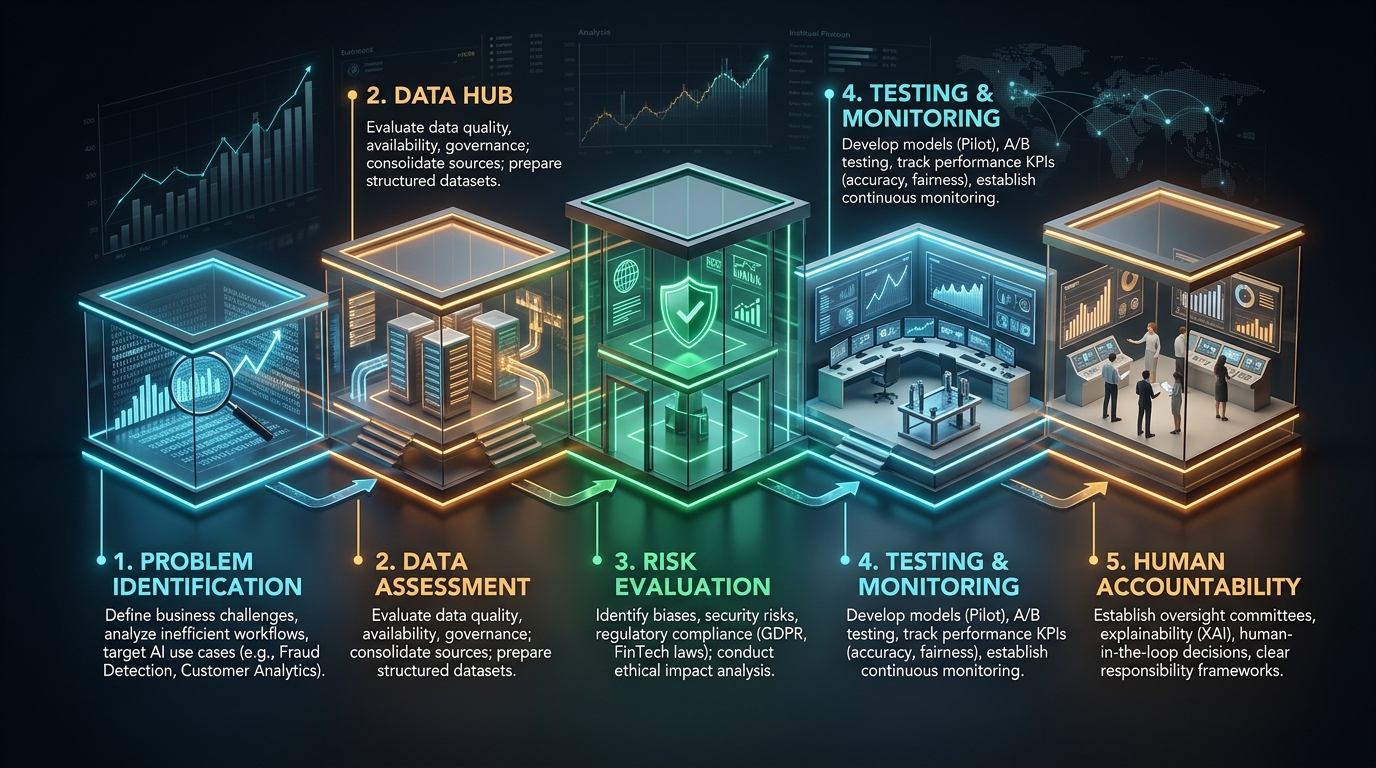
A Practical 5-Stage Framework for FinTech AI Adoption
To avoid costly implementation failures, financial engineering organizations should adopt a disciplined five-stage lifecycle aligned with the NIST AI Risk Management Framework:
- Problem Identification: Start with an explicit business challenge (e.g., reduce manual invoice reconciliation by 70%) rather than adopting AI for novelty.
- Data Quality & Governance Assessment: Audit data lineage, eliminate survivorship bias, and enforce strict encryption and data anonymization pipelines.
- Tiered Risk Evaluation: Classify use cases into low-risk (internal document summarization) versus high-risk (autonomous credit underwriting, capital allocation).
- Rigorous Testing & Monitoring: Perform out-of-sample backtesting, shadow deployment, and real-time drift tracking before live production rollout.
- Unambiguous Human Accountability: Clearly designate the human risk officer responsible for the model, establishing instant manual override mechanisms.
For organizations looking to build scalable automated data extraction pipelines and production-grade quantitative workflows, exploring our specialized HuAI Content workflow automation services provides proven architectural guidance.
Conclusion
The strategic deployment of AI applications in FinTech is redefining how capital flows, how credit is allocated, and how consumers interact with their money. Machine learning provides financial organizations with unmatched computational speed, scalable fraud prevention, and operational agility.
Yet true financial leadership requires discipline. The most critical operational question for modern FinTech leaders is not “Where can we add AI?” but rather “Where can AI solve genuine customer friction without generating unacceptable regulatory or systemic risk?”
For a broader view of AI across the financial technology ecosystem, read our pillar guide on the AI in the FinTech market. You can also explore our technical analyses and tutorials across the HuAI Content blog.
Frequently Asked Questions (FAQ)
What are the primary AI applications in FinTech?
The primary AI applications in FinTech include automated fraud detection, algorithmic credit assessment, conversational customer chatbots, automated AML compliance screening, balance-sheet risk modeling, and financial document intelligence.
How does artificial intelligence improve digital banking operations?
AI improves digital banking by automating repetitive administrative workflows, accelerating credit approvals from days to seconds, flagging anomalous transactions in real time, and delivering personalized financial wellness insights.
What are the primary risks associated with AI in financial services?
Key risks include client data privacy breaches, algorithmic bias in lending decisions, model opacity (black-box decisions), model drift across changing macroeconomic cycles, and third-party cloud concentration vulnerabilities.
Can artificial intelligence make automated lending decisions without human oversight?
While machine learning models can technically automate credit approvals, high-impact financial lending requires strict human-in-the-loop governance, fair lending compliance testing, adverse action explainability, and regulatory supervision.
How do FinTech organizations prevent algorithmic bias?
Organizations prevent algorithmic bias through rigorous training data audits, removing proxy variables that correlate with protected demographic traits, conducting continuous disparate impact testing, and enforcing multi-stakeholder model review committees.
Editorial Disclaimer: This article is published exclusively for educational, technical, and informational purposes and does not constitute financial, investment, legal, or regulatory advice.