

Artificial intelligence has become a pivotal technology in modern financial research, enabling institutional desks and retail analysts to deploy stock market AI to ingest vast multi-asset feeds and uncover non-linear relationships across complex financial datasets.
Global equity markets are governed by an intricate matrix of dynamic variables, including corporate earnings releases, macroeconomic interest-rate regimes, market liquidity depth, breaking news sentiment, and unpredictable investor psychology. While artificial intelligence cannot eliminate this fundamental market complexity, it provides the computational framework required to process market signals systematically and objectively.
This article examines the primary capabilities of stock market AI, how quantitative teams apply them, and where their practical boundaries begin.

Core Benefits of Stock Market AI in Financial Analysis
Deploying machine learning and algorithmic architectures within equity analysis offers distinct operational advantages over purely manual spreadsheet research.
1. Streamlining the Quantitative Research Process
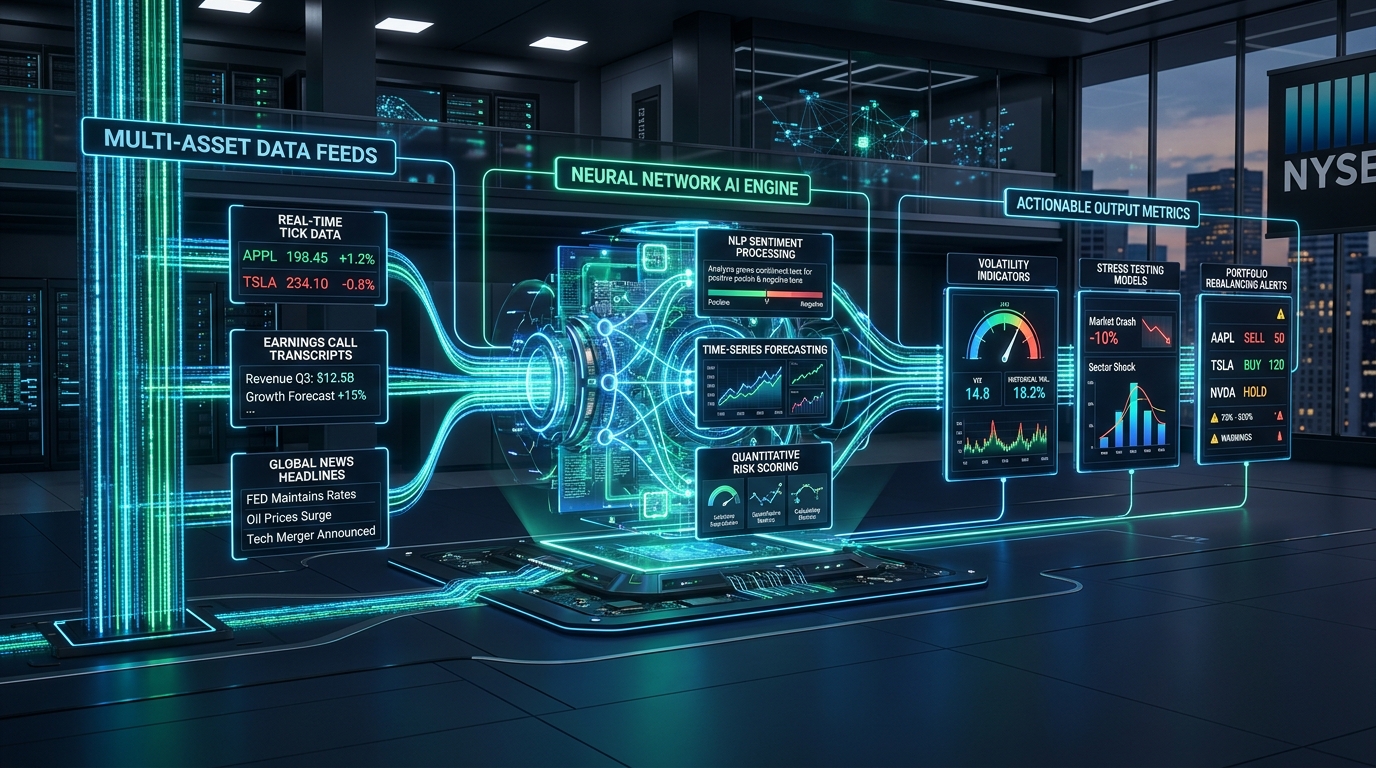
Modern equity research requires evaluating mountains of diverse financial data. Intelligent algorithms process decades of tick-level price histories, regulatory SEC disclosures, balance-sheet statements, and news wires in fractions of a second. This allows quantitative researchers to:
- Find relevant information instantly: Surface historical parallels and anomalous trading setups across thousands of equities simultaneously.
- Compare companies dynamically: Perform multi-factor peer comparisons across valuation ratios, margins, and growth trajectories.
- Detect statistical patterns: Identify cross-asset correlation breakdowns and emerging volatility cycles.
- Organise market data: Structure heterogeneous information into clean, normalized feature stores.
- Monitor real-time developments: Filter out noise and flag material corporate disclosures immediately.
- Generate research summaries: Synthesize complex transcripts into concise, quantitative executive briefings.
The primary advantage of these tools lies in drastically reducing informational overhead, freeing analysts to focus on capital allocation and strategic validation rather than manual data entry.
2. Automating Repetitive Financial Workflows
Algorithmic systems excel at executing deterministic operational tasks with complete consistency. When integrated into quantitative pipelines, automation encompasses:
- Automated Data Collection: Scheduled ingestion of exchange tick feeds, central bank press releases, and macroeconomic data.
- Continuous Market Monitoring: Tracking order book depth, liquidity imbalance, and spreads across multiple trading venues.
- Rule-Based Signal Generation: Computing mathematical indicators and statistical arbitrage signals in real time.
- Portfolio Alerts & Triggers: Notifying portfolio managers when positions breach predefined risk budgets or stop-loss limits.
- Real-Time Risk Calculations: Calculating Value at Risk (VaR), portfolio beta, and tracking error continuously.
- Smart Order Routing & Execution: Slicing large block orders using TWAP (Time-Weighted Average Price) and VWAP (Volume-Weighted Average Price) algorithms to minimize market impact.
- Automated Compliance Reporting: Creating auditable transaction logs for regulatory compliance and risk committees.
3. Improving Systematic Risk Analysis
Risk management is where computational intelligence provides some of its greatest value. Machine learning systems analyze multi-decade historical time series to uncover subtle risk vectors that static linear models routinely miss. Advanced architectures synthesize:
Market Price Feeds + Portfolio Exposures + Breaking News Sentiment + Realized Volatility + Cross-Asset Correlations
By continually combining these multi-modal inputs, systems construct dynamic risk matrices. These tools provide portfolio managers with real-time insight into concentration hazards without creating the false illusion that investment risk can ever be completely eliminated.
4. Processing Structured and Unstructured Data Streams
Traditional econometric and quantitative models have historically focused on structured tabular numbers: closing prices, volume, price-to-earnings ratios, and interest rates. However, a significant portion of market-moving intelligence originates in unstructured human language.
Modern stock market AI platforms combine numerical price series with natural language processing (NLP) to ingest:
- Global news articles and wire services
- Quarterly earnings call transcripts and executive Q&A sessions
- SEC regulatory filings (10-K, 10-Q, 8-K) and proxy statements
- Sell-side equity research notes and industry reports
- Public sentiment indicators and social media sentiment telemetry
Large language models and transformer embeddings translate unstructured narrative sentiment into normalized quantitative vectors. These sentiment scores can then be evaluated alongside technical indicators and fundamental metrics to refine probabilistic trade models.
Comparing AI Systems and Human Analysts
The institutional reality of quantitative finance is not an adversarial competition between machines and humans. Successful asset managers combine computational speed with human strategic governance.
| Analytical Dimension | Machine Learning & Algorithmic Engines | Human Portfolio Managers & Analysts |
|---|---|---|
| Data Processing Scope | Processes millions of multi-asset data points and order books in milliseconds | Synthesizes nuanced geopolitical context and qualitative business models |
| Pattern Recognition | Identifies subtle, non-linear mathematical correlations across vast datasets | Recognizes unprecedented historical shifts and black-swan anomalies |
| Execution Discipline | Monitors markets continuously without emotional bias or fatigue | Investigates unexpected structural market events and liquidity disruptions |
| Decision Framework | Generates probabilistic alerts and automated mathematical trade triggers | Makes discretionary capital decisions based on corporate governance and strategic mandates |
| Workflow Automation | Automates repetitive data extraction, backtesting, and order routing | Provides ethical oversight, investor accountability, and fiduciary responsibility |
The most resilient operational framework is a collaborative human-in-the-loop pipeline: Automated AI Discovery → Algorithmic Risk Validation → Human Strategic Governance.
Advanced Operational Applications in Modern Markets
5. Continuous Market Monitoring and Anomaly Detection
Because financial markets operate globally across overlapping time zones, human analysts cannot manually monitor every asset class simultaneously. Contemporary stock market AI tools monitor asset classes without human fatigue, alerting teams when anomalous market behavior occurs, such as:
- Sudden volatility spikes and implied volatility term-structure inversions
- Unusual volume surges and dark-pool block trading activity
- Flash price anomalies across cross-listed dual-currency equities
- Geopolitical breaking news triggers and central bank announcements
- Portfolio risk-budget threshold breaches and margin utilization warnings
6. Forecasting and Machine-Learning Pattern Recognition
Modern quantitative teams deploy diverse machine learning architectures to identify predictive patterns in historical price and volume data. Common methodologies include:
- Ensemble Models: Gradient-boosted decision trees (XGBoost, LightGBM) and Random Forests for tabular equity screening.
- Deep Neural Networks: Multi-layer perceptrons and convolutional networks for feature abstraction.
- Recurrent Architectures: Long Short-Term Memory (LSTM) networks and Gated Recurrent Units (GRUs) for sequential time-series modeling.
- Transformer Models: Self-attention mechanisms applied to multi-horizon financial time-series forecasting.
Research published by the Bank for International Settlements (BIS) highlights that machine-learning methods such as random forests and recurrent neural networks are increasingly utilized to forecast financial-market conditions and identify the core drivers of market stress. However, researchers emphasize that forecasting remains probabilistic rather than deterministic—no model can promise guaranteed predictive accuracy.
7. Supporting Portfolio Risk Management and Stress Testing
Beyond individual stock selection, artificial intelligence powers institutional portfolio optimization by facilitating:
- Continuous asset correlation matrix tracking across shifting macro regimes
- Multi-factor scenario simulation and Monte Carlo stress testing
- Dynamic asset allocation research under simulated liquidity crunches
- Automated portfolio rebalancing alerts when factor exposures drift
Critical Challenges and Limitations of Stock Market AI
Despite its computational power, relying blindly on automated market algorithms introduces severe operational hazards that engineers and investors must navigate carefully.
1. Historical Data Is Not the Future (Non-Stationarity)
Unlike physical sciences where universal laws remain constant, financial markets are non-stationary adaptive systems. A model trained on historical data from a zero-interest-rate environment will routinely fail when confronted with aggressive monetary tightening or sudden supply-chain shocks.
2. False Signals and Overfitting
Complex deep learning architectures can easily overfit historical market noise, discovering mathematical correlations that have zero predictive validity out-of-sample. Backtested strategies that appear exceptionally profitable on historical data often degrade rapidly in live trading.
3. Model Explainability and the Black-Box Dilemma
Highly complex neural networks cannot easily articulate why a specific trade signal was generated. In institutional finance, lack of explainability creates friction with risk committees, internal compliance officers, and regulatory authorities.
4. Data Quality and Survivorship Bias
An algorithm is only as reliable as the data it consumes. Incomplete order-book data, latency gaps, corporate restructuring adjustments, and survivorship bias (failing to include delisted companies) distort model weights and invalidate quantitative findings.
5. Model Drift and Degradation
As market participants adopt similar analytical tools, previously profitable statistical anomalies get arbitraged away. Models require continuous performance tracking, concept drift detection, and systematic retraining to remain viable.
How to Deploy Stock Market AI Responsibly
To deploy stock market AI responsibly in institutional and retail environments, quantitative engineers follow a structured lifecycle:
Collect → Clean → Analyse → Validate → Monitor → Review
The validation stage must never be bypassed. Before allocating live capital, quantitative models must undergo rigorous walk-forward out-of-sample testing, synthetic Monte Carlo stress testing, and slippage simulation across multiple economic cycles.
Furthermore, organizations can align their algorithmic practices with the NIST’s AI Risk Management Framework, which outlines the four core governance pillars of Govern, Map, Measure, and Manage to systematically oversee machine learning risks throughout the system lifecycle.
For organizations looking to build robust automated data extraction pipelines and AI-driven internal workflows, exploring specialized HuAI Content workflow automation services provides production-tested operational guidance.
Conclusion
Artificial intelligence provides unprecedented analytical scalability for equity research, data ingestion, sentiment extraction, and systematic risk management. However, these tools are computational instruments designed to augment human judgment, not infallible crystal balls.
Ultimately, the performance of any analytical system depends on data integrity, rigorous validation, sound risk governance, and disciplined human oversight. For the complete picture of how these capabilities fit into algorithmic trading, portfolio optimisation and market workflows, read our pillar guide on The Rise of AI in Stock Trading: How Machine Learning Is Changing Investment Strategies.
You can also explore related articles and technical tutorials across the HuAI Content blog.
Frequently Asked Questions (FAQ)
What can stock market AI do in equity research and analysis?
Stock market AI can process massive financial datasets, identify non-linear statistical patterns, analyze corporate news sentiment, monitor global market anomalies in real time, and support portfolio stress testing.
Can natural language processing analyze stock market news and earnings calls?
Yes. Modern natural language processing models parse news feeds, regulatory filings, and corporate earnings call transcripts to quantify market sentiment, detect executive tone changes, and extract material corporate disclosures within milliseconds.
Does stock market AI guarantee accurate trading predictions?
No. Machine learning models produce probabilistic forecasts based on historical data patterns. Changing macroeconomic regimes, black-swan events, and model drift can cause predictive forecasts to fail.
Why is human oversight indispensable in AI-driven financial analysis?
Human analysts provide critical context, evaluate corporate governance, validate model assumptions, oversee regulatory compliance, and make strategic risk determinations that automated algorithms cannot assess.
Editorial Disclaimer: This article is published solely for educational and informational purposes and does not constitute financial, investment, legal, or trading advice.