
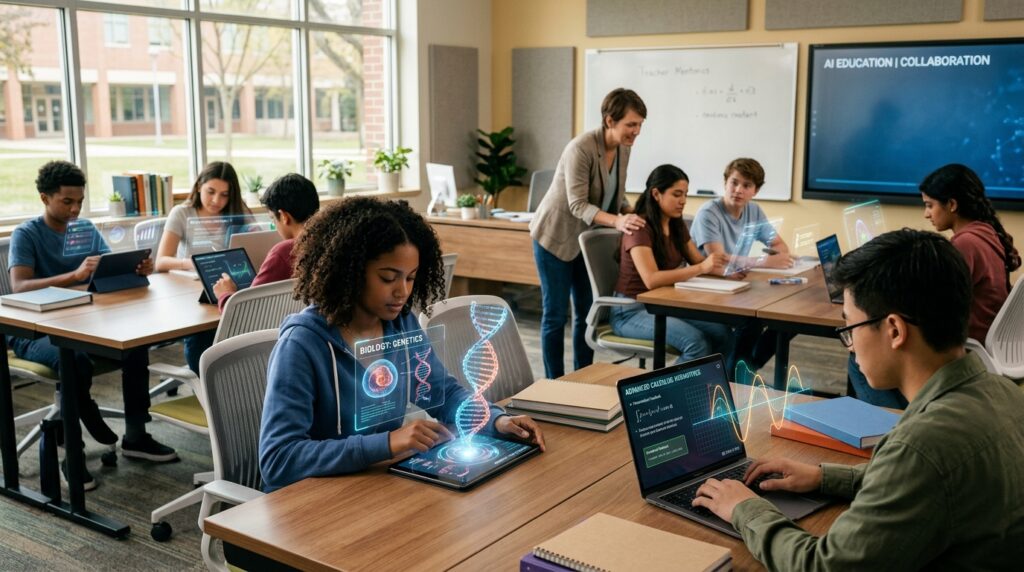
Every student learns differently. Implementing personalised learning with AI allows educational institutions to tailor curriculum pacing, explanations, and formative practice directly to individual student needs.
Some learners grasp complex concepts after a single explanation. In contrast, others require practical demonstrations, interactive diagrams, or additional practice problems before ideas become clear. In addition, some students ask questions confidently during class, whereas others prefer revising privately at their own pace.
This reality highlights a fundamental challenge of traditional schooling. Specifically, a single educator must support dozens of learners while adhering to rigid timetables and uniform assessments. Fortunately, modern AI tools for education create actionable opportunities to address this instructional friction.
The ultimate goal is never to replace teachers with software. Instead, the most valuable applications provide teachers with diagnostic data while giving learners continuous feedback. Organizations like UNESCO emphasize that artificial intelligence offers major educational opportunities, provided institutions address data privacy and ethical governance. Explore our strategic analysis of Agentic AI and Automated Systems to understand how intelligent workflows operate.
How Personalised Learning with AI Revolutionises Modern Classrooms
Modern pedagogical technology combines predictive algorithms, natural language processing, and diagnostic analytics. Consequently, classrooms can shift from rigid teaching models toward flexible, student-centered learning paths.
1. Smart Tutoring Systems and Guided Practice
Intelligent tutoring systems represent one of the most visible applications in modern digital education. Traditional online portals typically present identical lecture videos and static worksheets to every learner.
In contrast, smart tutoring systems respond dynamically to student queries. For example, if a student struggles with a geometry proof, an AI tutor does not simply reveal the answer. Instead, the system asks reflective guiding questions, provides scaffolded hints, and suggests relevant practice problems.
A notable example is Khan Academy’s Khanmigo, which functions as an intelligent conversational coach. Khan Academy’s research highlights that guided tutoring prompts foster critical thinking far more effectively than passive answer delivery. Therefore, personalised learning with AI reinforces conceptual understanding while preserving academic integrity.
Core Advantages of Intelligent Tutoring
- Adaptive Concept Breakdown: Explains difficult ideas using alternative metaphors and relatable real-world examples.
- Scaffolded Hinting: Prompts learners to discover solutions independently without spoon-feeding answers.
- Targeted Skill Mastery: Generates immediate practice variations until foundational competency is demonstrated.
- Psychological Safety: Allows introverted students to ask questions repeatedly without fear of peer judgment.
Nevertheless, human educators remain entirely indispensable. Teachers understand emotional nuances, student motivation, and social classroom dynamics in ways algorithms cannot replicate.
2. Adaptive Learning Mechanisms
Instructional personalisation becomes significantly more powerful when software continuously adapts to real-time student progress. Adaptive platforms analyze granular interaction data, including previous answers, quiz scores, problem-solving speed, and recurrent errors.
For example, imagine a student working through an algebra curriculum. If the learner consistently solves quadratic equations correctly but struggles with polynomial factoring, the platform dynamically adjusts. Consequently, it delivers focused factoring exercises rather than forcing the student to repeat mastered concepts.
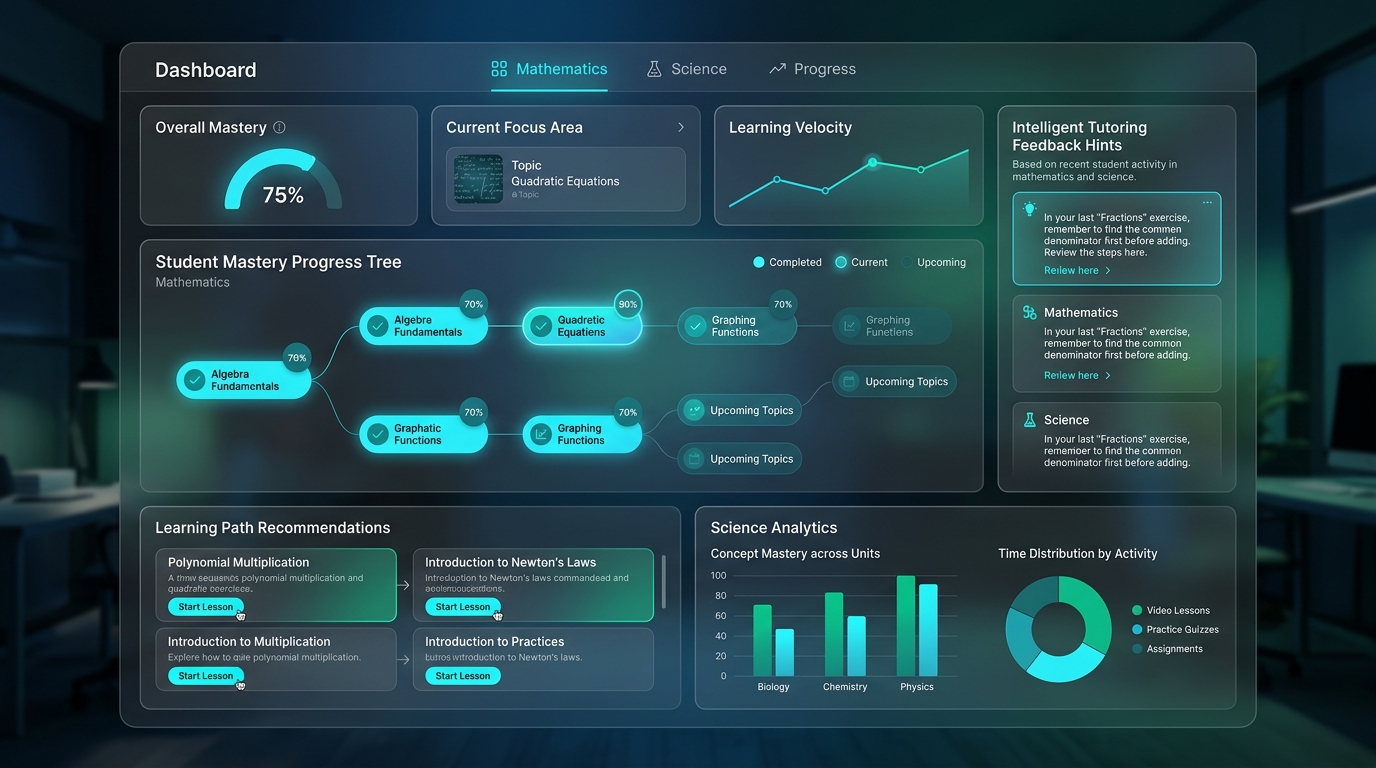
Research published by the OECD underscores that adaptive software helps students progress at their optimal pace. For instance, Singapore’s national Student Learning Space integrates adaptive machine learning to infer concept mastery and recommend tailored activities.
This marks a decisive evolution from uniform instruction toward data-informed progression:
- Legacy Model: Identical Textbook Chapter → Uniform Homework → Identical Exam
- Personalised Model: Continuous Diagnostics → Tailored Content → Adaptive Next Step
Discover how structured content architectures support comprehensive learning in our report on Pillar-Cluster Content Architecture.
3. Curated and Personalised Reference Material
Modern students frequently experience digital information overload. When conducting academic research, learners often sift through hundreds of unstructured web articles, videos, and research papers.
Intelligent discovery engines streamline this process by curating tailored study resources based on reading level and curriculum goals. For instance, an introductory student studying molecular biology might receive visual diagrams and short explanatory clips. In contrast, an advanced learner receives peer-reviewed journal papers and clinical case studies.
However, educational institutions must emphasize source evaluation and critical literacy. Because generative engines can occasionally produce flawed summaries, educators must prioritize verified, curriculum-aligned databases. Learn how synthetic media is generated in our technical breakdown of How AI Image Generators Work.
4. Multimodal and Immersive Educational Experiences
Every learner processes information differently across diverse cognitive modalities. While some students absorb written text easily, others understand concepts faster through visual diagrams, auditory explanations, or interactive simulations.
Modern machine learning enables rich multimodal instruction by synthesizing varied content formats automatically. Specifically, an instructional module can integrate written text, animated diagrams, audio commentary, and interactive exercises within a unified interface.
Furthermore, combining multimodal models with Augmented Reality (AR) and Virtual Reality (VR) allows students to explore historical events or molecular structures immersively. Discover how next-generation multimedia platforms streamline production in our review of Innovative Features of AI-Powered Video Editing Platforms.
5. Smart Testing and Adaptive Assessment
Traditional examinations typically administer identical question sets to all students simultaneously. While standardized testing serves administrative purposes, formative assessment benefits greatly from dynamic adaptation.
Intelligent testing engines adjust question difficulty based on sequential learner responses. For example, when a student answers correctly, the platform introduces a slightly more challenging scenario. Conversely, when a student struggles, the engine provides diagnostic hints or foundational reviews.
Consequently, assessment transforms into an active learning experience rather than merely a final score. Teachers can identify conceptual misconceptions early, enabling targeted small-group interventions before official grading periods.
6. Automatic Grading and Personalised Feedback
Evaluating student assignments consumes an extraordinary proportion of teacher working hours. Automated assessment tools assist educators by analyzing objective quizzes, coding exercises, and structured essays swiftly.
Importantly, the primary benefit is not merely saving time. When routine evaluation is automated, educators gain valuable hours to provide nuanced mentorship and one-on-one coaching.
For example, if thirty percent of a classroom struggles with identical fraction conversions, the analytics engine notifies the instructor immediately. Consequently, the teacher can deliver a targeted mini-lesson during the next period. Meanwhile, learners receive constructive feedback instantly, allowing them to correct errors while concepts remain top of mind.
Explore how automated pipelines streamline data processing across enterprise environments in our guide on n8n vs Make.com vs Zapier for AI Pipelines.
7. Ethical Governance, Data Privacy, and Human Agency
Deploying personalised learning with AI requires strict ethical standards and data privacy protections. Because educational software collects sensitive student performance records, institutions must guarantee robust security.
Furthermore, institutions must protect against algorithmic bias. Training datasets must represent diverse cultural backgrounds to prevent disadvantageous recommendations for underrepresented learners. Safeguard content reliability using our comprehensive EEAT for YMYL Content Checklist.
Ultimately, successful educational technology keeps teachers firmly in control of pedagogical decisions. When software handles computational diagnostics, human educators can dedicate their energy to inspiring curiosity and emotional growth.
A Practical 8-Step Implementation Framework for Educators
- Identify Instructional Objectives: Define concrete learning goals before selecting any digital software platform.
- Establish Rigorous Privacy Safeguards: Ensure all vendor platforms comply with strict student data protection regulations.
- Curate High-Quality Content Repositories: Populate learning systems with vetted, curriculum-aligned educational assets.
- Train Educators Comprehensively: Provide thorough professional development on interpreting learning analytics dashboards.
- Deploy Scaffolded Tutoring Tools: Introduce conversational AI tutors designed to prompt reflection rather than output solutions.
- Monitor Real-Time Diagnostic Insights: Review automated performance alerts weekly to guide targeted small-group interventions.
- Foster Critical AI Literacy: Teach students how to interrogate algorithmic recommendations and cross-check factual accuracy.
- Gather Ongoing Teacher and Student Feedback: Refine instructional workflows regularly based on authentic classroom observations.
Frequently Asked Questions
What is personalised learning with AI?
Personalised learning with AI is an instructional approach powered by machine learning. It dynamically tailors curriculum pacing, explanations, and practice exercises to every student’s individual abilities.
Will AI tutors replace human classroom teachers?
No, artificial intelligence cannot replace human educators. Software delivers immediate practice hints and diagnostic metrics. In contrast, human teachers provide emotional mentorship, moral leadership, social development, and contextual motivation.
How does adaptive learning improve student engagement?
Adaptive learning platforms prevent boredom and frustration by calibrating difficulty dynamically. Advanced students encounter engaging challenges, while learners needing reinforcement receive scaffolded explanations without public embarrassment.
How can schools safeguard student data privacy with AI tools?
Schools must partner with reputable educational technology providers that adhere to student privacy regulations. Furthermore, platforms must maintain zero-retention data policies and prevent student records from being utilized for commercial training.
Discover our comprehensive collection of AI benchmarks, editorial workflows, and digital marketing insights on the HuAI Content Blog. In addition, explore how modern businesses expand search visibility in our guide to Search Everywhere Optimisation for Indian Businesses.
Pingback: AI Tools for Education: Interactive & Immersive Learning