
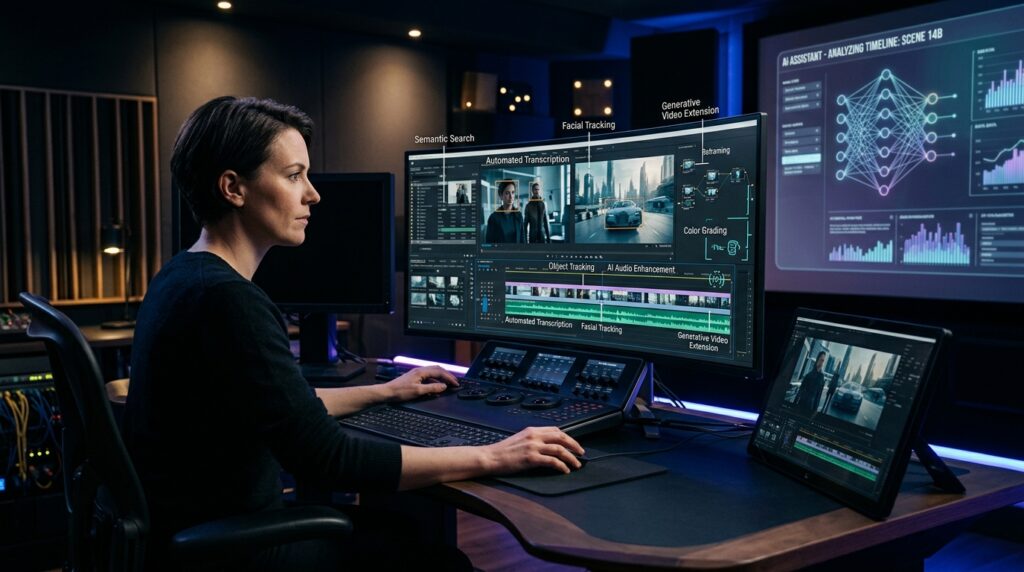
Artificial Intelligence has moved from an experimental curiosity into an essential pillar of everyday post-production workflows. Today, innovative next-generation video editing platforms and specialized AI tools for video editing are reshaping the landscape of modern cinema.
Only a few years ago, automated editorial tools were theoretical concepts discussed at technology conferences. Today, editors routinely search massive footage archives using natural language, transcribe multilingual dialogue in seconds, and track dynamic subjects effortlessly. In addition, they clean compromised audio, reframe widescreen shots, and synthesize generative media directly inside their timeline.
Consequently, the central question is no longer whether machine learning will impact filmmaking. Rather, the industry is exploring how deeply intelligent software will integrate into the human creative process. Explore our comprehensive breakdown of Innovative Features of AI-Powered Video Editing Platforms to evaluate modern tools.
The Role of AI in Next-Generation Video Editing
The evolution of film technology points toward an intelligent collaborative partnership between human creators and synthetic co-pilots. Here are ten major frontiers defining the future of post-production:
1. AI as a Contextual Creative Assistant
The first major industry shift moves from rigid automation toward proactive creative assistance. Traditionally, nonlinear editing software sat completely idle until an editor issued manual commands.
In contrast, next-generation video editing systems understand semantic context through natural language. For example, an editor can simply ask the workstation to locate specific emotional scenes. Adobe Premiere Pro’s Media Intelligence already analyzes visual objects, speech cadence, and audio cues to retrieve matching takes instantly.
As a result, editorial teams spend substantially less time searching media bins. Instead, they focus on higher-level narrative pacing and dramatic tension.
2. Intelligent Scene-Aware Audio Mixing
Audio post-production has historically required meticulous manual equalization, spectral de-noising, and multi-track gain leveling. Poor acoustic environments can easily compromise even the most pristine cinematography.
Fortunately, modern neural audio engines evaluate vocal frequencies in real time. For instance, Adobe Enhance Speech and DaVinci Resolve’s AI Audio Assistant isolate dialogue from harsh HVAC reverberation and wind noise. Furthermore, upcoming systems will understand multi-track relationships automatically.
Consequently, when a character speaks, the audio engine smoothly ducks background orchestration without requiring manual volume automation.
3. Persistent Character and Subject Tracking
Facial recognition was among the earliest machine learning tools introduced to post-production. However, modern implementations extend far beyond static face boxes.
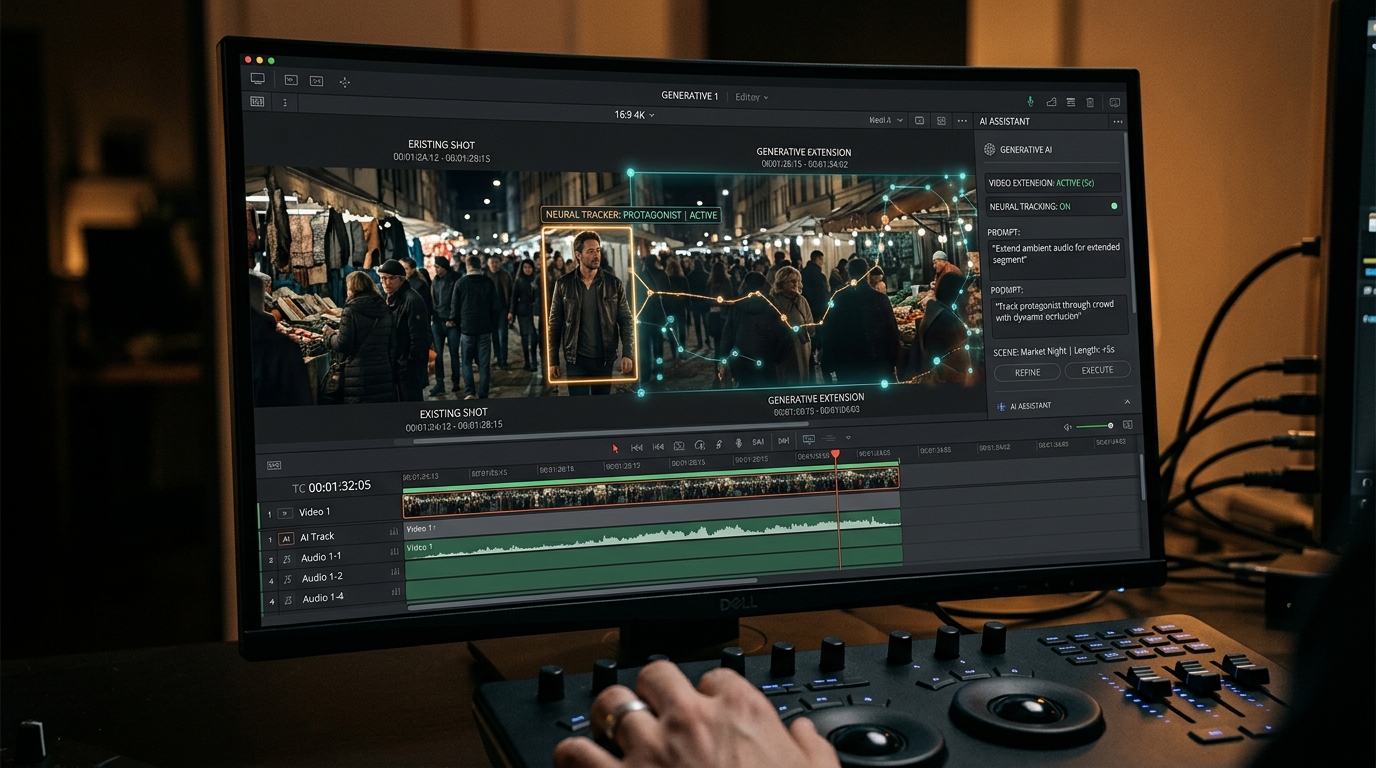
Today, neural vision models track dynamic characters through crowded streets and occluded camera movements. For example, Adobe Premiere’s Object Mask allows editors to track a moving subject across wide shots with persistent spatial awareness. Therefore, colorists can grade skin tones or blur backgrounds without drawing manual rotoscoping splines frame by frame.
4. Natural Language and Text-Based Timeline Control
Speech-to-text models have already revolutionized talking-head content and documentary rough cuts. More importantly, transcription is rapidly evolving into a primary editorial control surface.
For instance, Premiere’s Text-Based Editing lets creators assemble sequences simply by highlighting lines in a transcript. Furthermore, emerging models interpret high-level editorial directives effortlessly:
- “Assemble a three-minute highlight sequence focusing on key product milestones.”
- “Remove all false starts, speaker stumbles, and redundant filler words.”
- “Tighten conversational pauses between both interview subjects by twenty percent.”
These natural language capabilities do not discard the timeline ruler. Instead, they give filmmakers an expressive semantic interface to manipulate story pacing.
5. Automated Content-Aware Reframing and Stabilisation
Omni-channel distribution requires master cinematic footage to appear across diverse screen dimensions simultaneously. A single horizontal feature (16:9) must frequently be adapted into vertical mobile cuts (9:16) for YouTube Shorts and Instagram Reels.
Fortunately, intelligent auto-reframing algorithms evaluate focal action dynamically. Rather than applying a fixed mathematical center crop, next-generation video editing tools track narrative priority. Consequently, the frame follows the speaking character, ensuring essential action remains perfectly framed across every viewport.
Discover how automated pipelines connect multi-format publishing in our guide on n8n vs Make.com vs Zapier for AI Content Pipelines.
6. In-Timeline Generative Media and Shot Extension
Historically, editorial software could only rearrange media that had already been recorded during principal photography. Generative AI fundamentally rewrites this boundary.
For example, Premiere’s Generative Extend synthesizes additional video frames and ambient room tone at the tail of a shot. Consequently, editors can hold a poignant reaction or smooth transitions without returning to set for reshoots. Furthermore, the Generative Media Tool lets filmmakers synthesize video clips and sound effects directly inside the timeline using text prompts.
Read our in-depth guide on How AI Image Generators Work to understand diffusion mechanics.
7. Automated Multilingual Dubbing and Versioning
Modern global distribution requires content to connect with international audiences across diverse linguistic communities. Traditionally, foreign language localization was expensive and slow.
Today, neural dubbing systems synthesize natural voice translations while preserving original vocal timbre and emotional inflection. For creators in multilingual markets, a single production can seamlessly serve audiences across Hindi, Bengali, Tamil, and English. In addition, automatic speech translation provides rich text signals that reinforce search discoverability.
Learn how multi-format content strengthens discovery in our guide to Search Everywhere Optimisation for Indian Businesses. In addition, discover how to position your brand in our report on How to Get Your Indian Business Cited by ChatGPT.
8. End-to-End Autonomous Production Pipelines
The true evolution of film post-production lies in connecting isolated features into unified automated ecosystems. Future pipelines will link screenwriting, media ingestion, rough cuts, color balancing, and distribution into a continuous feedback loop.
Moreover, intelligent agentic architectures coordinate multi-stage editorial tasks autonomously. Explore how intelligent systems manage complex production workflows in our analysis of 5 Ways Agentic AI Is Changing Content Strategy.
However, automation yields maximum value only when anchored by a rigorous content architecture. Discover why focused topic clusters outperform scattered publishing in our report on Pillar-Cluster Content Architecture: Why 50 Focused Articles Beat 500 Random Ones.
9. The Unmatched Creative Moat of Human Storytelling
As computational models grow more proficient, human creative judgment becomes more valuable than ever before. Algorithms excel at statistical pattern recognition, but cinema requires emotional truth.
Why Next-Generation Video Editing Requires Human Direction
- Emotional Vulnerability: A machine selects the sharpest technical take; an experienced editor selects the take with the heartbreaking hesitation in the actor’s eyes.
- Dramatic Rhythmic Pacing: Algorithms optimize for retention metrics; great filmmakers know exactly when to hold silence to build emotional resonance.
- Intentional Imperfection: Handheld camera shake and raw acoustic textures often convey authentic realism that sterile perfection destroys.
Therefore, the winning philosophy for modern filmmakers remains constant: let artificial intelligence handle technical friction, while human storytellers direct the creative soul.
10. Ethical Transparency, Provenance, and Editorial Integrity
The increasing realism of synthetic media elevates the necessity of editorial transparency and provenance verification. In news, documentary filmmaking, healthcare, and finance, audiences must trust the authenticity of visual records.
For instance, news organizations like Reuters use plain-language AI search while maintaining strict editorial verification standards. Explore sustainable agency models in our guide to Pricing AI Automation Agency Services. In addition, safeguard credibility using our EEAT for YMYL Content Checklist.
A Practical 9-Step AI-Assisted Filmmaking Workflow
- Narrative Pre-Visualization: Define thematic core, character arcs, and script objectives clearly.
- High-Fidelity Capture: Record clean source footage, because AI cannot fix careless cinematography.
- Semantic Asset Ingestion: Let neural classifiers tag scene elements, dialogue, and camera angles automatically.
- Interactive Rough Cut: Assemble the initial story sequence directly from text transcripts.
- Neural Audio & Color Polish: Clean ambient rumble, level vocal tracks, and balance disparate camera sensors.
- Targeted Generative Extensions: Synthesize tail frames or room ambience to smooth awkward editorial transitions.
- Dynamic Multi-Format Reframing: Render vertical, square, and widescreen social cuts with intelligent subject tracking.
- Human Creative Master Review: Inspect emotional beats, verify factual accuracy, and conduct final polish.
- Multi-Channel Distribution: Deploy localized dubbed cuts and monitor real-time audience engagement.
Frequently Asked Questions
How does next-generation video editing differ from traditional post-production?
Traditional editing relies on manual scrubbing, frame-by-frame cuts, and physical timeline manipulation. In contrast, next-generation video editing leverages natural language search, automated transcription, generative extensions, and intelligent subject tracking.
Will AI tools for video editing replace professional human editors?
No, human storytelling remains fundamentally irreplaceable. While AI executes technical calculations swiftly, emotional pacing, comedic timing, and moral judgment require human creative direction.
What is the Generative Media Tool in next-generation video editing?
The Generative Media Tool allows filmmakers to generate supplemental video clips and atmospheric sound effects directly inside the editing timeline using natural-language text prompts.
How does AI help film editors create multiple platform versions?
For example, intelligent auto-reframe algorithms track focal characters dynamically. They automatically crop and center action for vertical formats like Instagram Reels and YouTube Shorts without requiring manual keyframing.
Explore our complete library of production workflows, automation benchmarks, and digital marketing insights on the HuAI Content Blog.