
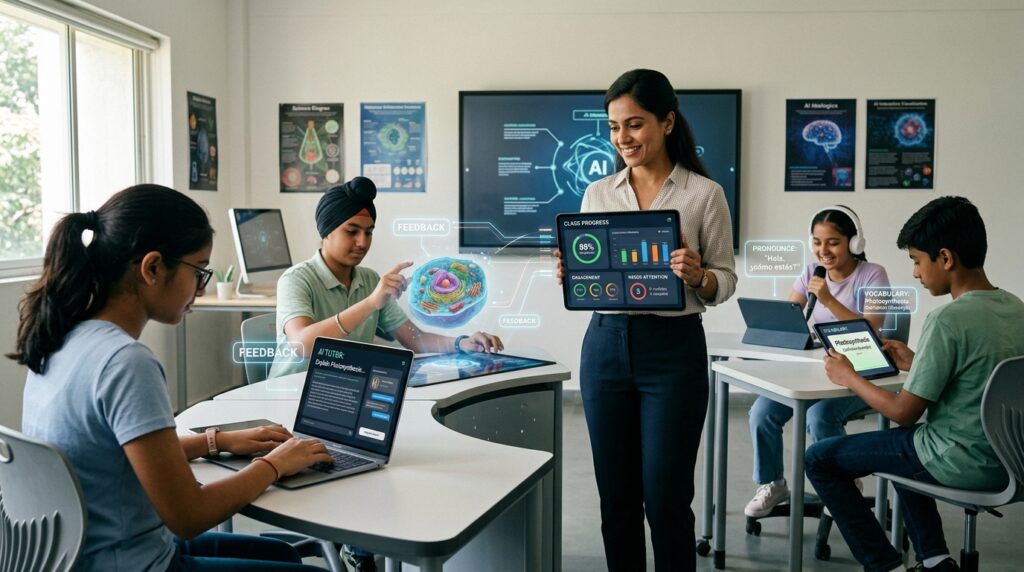
Education is no longer confined to a teacher standing before rows of silent desks while students copy notes. Today, modern AI tools for education transform classrooms into dynamic, responsive environments tailored to individual inquiry.
Digital learning previously introduced instructional videos, simulations, and online course libraries. However, machine learning takes this evolution further by making software genuinely responsive to the learner. Consequently, students receive personalized explanations, convert raw study notes into diagnostic tests, and explore complex topics interactively.
Importantly, this shift is not simply about distributing more devices. Rather, it centers on how intelligent technology adapts to human curiosity. For instance, an AI learning system can rephrase difficult concepts, generate immediate practice variations, and pinpoint cognitive misconceptions. Discover our comprehensive analysis of Personalised Learning with AI to explore foundational adaptive frameworks.
Currently, systems like OpenAI’s Study Mode guide students through multi-step problem solving rather than blurting out direct answers. Similarly, Google’s Gemini ecosystem incorporates Study Notebooks that convert uploaded course materials into tailored lesson paths. Explore how intelligent systems manage complex knowledge workflows in our analysis of Agentic AI and Automated Strategy.
Top 5 AI Tools for Education in Interactive Learning
Modern pedagogical platforms employ diverse methodologies, ranging from conversational tutoring to source-grounded research synthesis. Here are five leading applications reshaping contemporary education:
1. ChatGPT Study Mode and Conversational Tutoring
Conversational tutoring has quickly become one of the most widely accessible educational technologies. Specifically, ChatGPT’s Study Mode encourages interactive reasoning rather than passive answer copying.
Consequently, the system asks probing Socratic questions, provides scaffolded hints, and adjusts conceptual depth to the learner’s grade level. For example, instead of asking for a factual definition of photosynthesis, a student can request an interactive exam preparation session. The tutor prompts the learner with step-by-step questions, identifying precise gaps in chemical understanding.
Therefore, learning becomes an active dialogue rather than a one-directional lecture. Furthermore, students can upload syllabi, worksheets, and lecture slides to keep practice aligned with classroom goals.
2. Gemini Study Notebooks and Guided Learning
Google has similarly integrated guided instructional experiences directly into Gemini. Announced in mid-2026, Study Notebooks transform the conversational model into an adaptive study environment.
Specifically, students define clear learning objectives and upload authentic class materials. The platform then administers a diagnostic quiz to identify weak areas before generating bite-sized interactive modules. Furthermore, Google integrates these tools into Google Classroom, ensuring teachers retain supervisory oversight.

This represents a crucial formula for contemporary educational technology:
The Modern Educational Formula
Curriculum Material + Active Student Effort + Guided AI Dialogue + Teacher Mentorship
Discover how structured content frameworks organize information effectively in our report on Pillar-Cluster Content Architecture.
3. Quizlet AI Study Tools
Flashcards and retrieval practice have formed the bedrock of effective study habits for decades. Today, generative algorithms accelerate the creation of structured revision assets significantly.
For example, Quizlet’s AI suite transforms lecture slides, textbook PDFs, and class outlines into comprehensive study guides and practice tests. In addition, its conversational assistant provides alternative mathematical derivations and targeted homework support. Consequently, students spend substantially less time manually formatting flashcards and more time actively testing their memory.
However, thorough human review remains essential. Students must verify technical formulas, historical dates, and vocabulary definitions against verified course texts rather than assuming machine perfection.
4. Duolingo and AI-Powered Conversational Language Practice
Language acquisition is exceptionally well suited to responsive software because fluency requires continuous interactive communication. Traditional textbooks typically offer static vocabulary lists and rigid example scripts.
In contrast, Duolingo’s generative features—such as Roleplay and interactive Video Calls—provide real-time conversational practice. For example, a learner can practice ordering coffee in Paris or negotiating a job interview in Tokyo. Consequently, the platform introduces an immediate feedback loop: speak, receive instant corrections, refine grammar, and try again.
This dynamic conversational cycle turns passive grammar memorization into natural dialogue. Learn how visual and audio generation models operate in our technical explainer on How AI Image Generators Work.
5. Gemini Notebook (NotebookLM) for Source-Grounded Learning
Another indispensable category of AI tools for education focuses on source-grounded research synthesis. Google’s NotebookLM—renamed Gemini Notebook in July 2026—allows learners to query defined document repositories securely.
Specifically, university students can organize assigned research papers and lecture transcripts into a single notebook. They can then ask the system to compare contrasting historical theories, extract core arguments, and construct revision outlines. Because answers cite source line numbers directly, students avoid generative hallucinations and verify facts rapidly.
Discover how modern enterprises connect automated document pipelines in our guide on n8n vs Make.com vs Zapier for AI Pipelines.
How Interactive AI Tools for Education Elevate Student Comprehension
The shared strength across these platforms is that they fundamentally alter the trajectory of learning. Traditional education often relied on a linear pattern: read the chapter, memorize facts, and complete an examination.
In contrast, responsive machine learning establishes an active exploratory cycle:
- Inquire: Ask questions in natural conversational language.
- Explore: Examine alternative explanations, visual models, and historical analogies.
- Practise: Tackle scaffolded exercises tailored to your current competency.
- Receive Feedback: Understand precisely why an answer was flawed within seconds.
- Reflect: Consolidate long-term understanding without peer pressure.
For instance, imagine a student struggling with cellular respiration. Rather than rereading the same dense paragraph, the student explores an interactive visual model, completes a targeted quiz, and reviews diagnostic explanations immediately.
Making Abstract Academic Concepts Accessible
Many academic subjects are inherently challenging because their underlying concepts are invisible or highly abstract. Examples include atomic orbital structures, calculus derivatives, economic supply equilibria, and distributed software architectures.
Fortunately, responsive algorithms present difficult concepts across multiple complementary representations. A student can request a simple plain-language overview, followed by an everyday analogy, an interactive diagram, and a worked sample problem. Consequently, learners can rotate through diverse explanations until conceptual clarity is achieved.
Explore multimedia post-production techniques in our breakdown of Innovative Features of AI-Powered Video Editing Platforms.
The Real Role of Immersive Learning
True educational immersion does not require every student to wear an expensive virtual reality headset. Instead, authentic immersion emerges through responsive scenario-based practice, dynamic simulations, and interactive problem solving.
For example, medical trainees can navigate simulated patient diagnoses, while engineering students manipulate structural stress simulations. Because the algorithm responds dynamically to user decisions, students learn from mistakes in a safe, risk-free environment.
Why AI Must Encourage Critical Thinking Rather Than Replace It
There is a profound pedagogical difference between software that helps a student think and software that completes tasks on their behalf. If an AI tool merely outputs homework solutions, cognitive development halts completely.
Fortunately, modern educational initiatives explicitly prioritize guided learning. Systems like Khan Academy’s Khanmigo and ChatGPT Study Mode emphasize Socratic questioning. When a student asks for an answer, the tutor prompts them to explain their existing methodology first.
Passive vs Active AI Engagement
- Passive Answer Seeking: “Write my history essay for me.” → Bypasses research, critical evaluation, and cognitive synthesis.
- Active Guided Inquiry: “Critique my thesis statement on the Industrial Revolution and suggest two counter-arguments.” → Stimulates analytical reasoning.
Therefore, educators must teach students to treat synthetic tools as rigorous sparring partners rather than automated ghostwriters.
Teachers Remain the Vital Heart of the Classroom
The widespread adoption of educational software will never diminish the indispensable role of human educators. Algorithms can identify that a student failed five consecutive math problems, but only an empathetic teacher understands why.
Specifically, teachers perceive student anxiety, personal emotional turmoil, peer dynamics, and creative passions that no dataset can capture. Consequently, modern education strategies position educators at the helm, with technology serving as a diagnostic assistant.
Responsible Principles for Implementing AI Tools for Education
Integrating synthetic technology into academic settings demands strict adherence to ethical and operational safeguards:
- Mandatory Source Verification: Never accept machine outputs uncritically; cross-check definitions, historical dates, and equations against authoritative textbooks.
- Uncompromising Data Protection: Schools must ensure learning platforms enforce strict zero-retention policies regarding student performance records.
- Cultivating AI Literacy: Follow international benchmarks like the UNESCO AI Competency Framework to teach students ethical model evaluation.
- Academic Honesty: Students must respect institutional guidelines regarding AI assistance in graded assignments.
Safeguard information integrity across digital publishing with our comprehensive EEAT for YMYL Content Checklist.
An 8-Step Daily Routine for AI-Assisted Study
- Ground in Approved Material: Always begin with your official textbook, lecture notes, or course syllabus.
- Pinpoint Conceptual Friction: Identify the specific paragraphs or formulas that feel confusing or incomplete.
- Initiate Socratic Dialogue: Ask your AI study tutor for step-by-step guided hints rather than complete solutions.
- Generate Diagnostic Practice: Produce five targeted practice questions covering the difficult concept.
- Test Without Assistance: Attempt the questions independently before consulting notes or software.
- Analyze Misconceptions: Ask the tutor to explain precisely why an incorrect option was wrong.
- Verify Facts: Re-confirm critical terminology and formulas with your primary course text.
- The Self-Explanation Test: Ensure you can explain the concept clearly in your own words without looking at any screen.
Frequently Asked Questions
What are AI tools for education?
AI tools for education are software applications that leverage artificial intelligence to personalize instruction, generate study materials, provide automated feedback, and guide students through complex problem-solving interactively.
How does ChatGPT Study Mode help learners?
ChatGPT Study Mode uses Socratic questioning and structured hints to guide students through problems step by step. Consequently, learners build foundational understanding rather than merely receiving copied answers.
What is the difference between Quizlet AI and Gemini Notebook?
Quizlet AI specializes in creating practice tests, flashcards, and homework reviews from notes. In contrast, Gemini Notebook (NotebookLM) specializes in source-grounded research synthesis, allowing students to query uploaded documents with verifiable citations.
Can AI tools replace classroom teachers?
No, artificial intelligence cannot replace human teachers. While software handles routine drills and diagnostic feedback, human educators provide emotional mentorship, classroom leadership, moral development, and tailored motivation.
Explore our comprehensive library of automation guides, AI benchmarks, and digital strategies on the HuAI Content Blog. In addition, discover how brands build sustainable organic discovery in our guide to Search Everywhere Optimisation for Indian Businesses.