

The relationship between artificial intelligence and digital advertising has evolved past basic automated task triggers. In 2026, the synergy between AI and digital marketers represents the foundation of high-performance marketing operations—spanning multi-channel research, creative iteration, complex attribution modeling, automated personalization, and customer lifecycle engagement.
As algorithmic tools demonstrate extraordinary processing speed across creative workflows, an understandable concern arises across creative industries: will AI replace digital marketers? The practical operational reality is that machine learning replaces isolated repetitive tasks while simultaneously creating expansive strategic responsibilities. When AI and digital marketers work together, enterprise teams unlock the computational velocity of machines alongside the irreplaceable discernment, empathy, and strategic vision of human specialists.
At HuAI Content, we assist forward-thinking enterprises in architecting hybrid human-in-the-loop workflows that empower marketing departments to scale production while safeguarding brand voice and strategic differentiation.
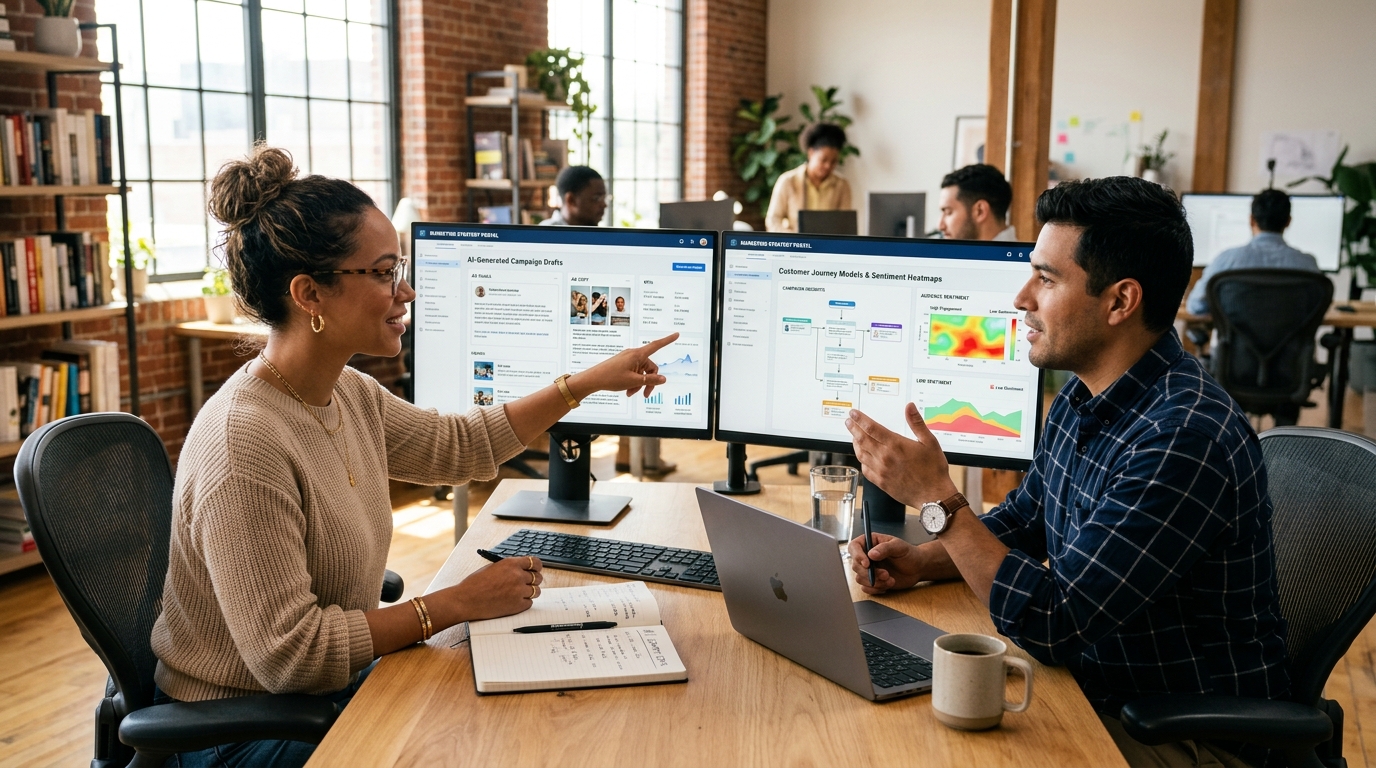
Strategic AI Capabilities for Modern Digital Marketers
Modern marketing engineering has moved far beyond primitive keyword scripts. The collaborative partnership between AI and digital marketers leverages advanced machine learning disciplines:
1. Advanced Natural-Language Processing (NLP) & LLMs
Natural-language processing enables software to comprehend, categorize, and synthesize human language across multiple formats. Key applications for AI and digital marketers include:
- Continuous Customer Sentiment Analysis: Ingesting thousands of social mentions, reviews, and support tickets to detect brand sentiment shifts.
- Semantic Search Intent Mapping: Decoding nuanced query phrasing to optimize search engine architectures.
- Contextual Email Personalization: Dynamically customizing newsletter intros and subject lines based on subscriber activity.
- Multivariate Copy Variations: Formulating dozens of tailored value propositions for targeted account tiers.
Rather than manually reading through vast comment logs, marketing analysts deploy NLP models to surface recurring consumer frustrations, then personally design empathetic campaigns to address those findings.
2. Multimodal AI and Computer Vision
Modern machine learning models process text, static graphics, audio streams, and video telemetry simultaneously. AI and digital marketers utilize computer vision for:
- Automated visual asset tagging and brand compliance verification
- Creative analysis of high-performing thumbnail imagery
- Contextual video scene summarization and short-form clip generation
- Dynamic ad banner resizing across multi-device display dimensions
This multimodal intelligence allows marketing strategists to evaluate not merely what prospects read, but exactly how they visually engage with brand content.
Four Practical Ways AI and Digital Marketers Work Together
1. Virtual Conversational Assistants and Tiered Customer Triage
AI-driven conversational assistants operate outside traditional business hours, handling high-frequency consumer inquiries with natural language resolution. They explain return policies, clarify pricing structures, and schedule product demonstrations.
However, successful marketing organizations avoid treating customer interactions as entirely disposable. A fundamental rule for AI and digital marketers is:
Automate predictable, high-frequency inquiries. Escalate complex, high-consequence customer relationships to experienced human professionals.
2. Predictive Analytics and Propensity Modeling
Machine learning models ingest historical customer journeys to forecast behavioral outcomes. Marketing teams deploy predictive engines for:
- Dynamic lead scoring and sales pipeline qualification
- Behavioral churn risk forecasting and proactive retention nudges
- Customer Lifetime Value (LTV) cohort projections
- Algorithmic purchase propensity scoring for timely cross-sell promotions
Crucially, AI and digital marketers recognize that predictive algorithms are probabilistic estimators, not infallible crystal balls. When training telemetry contains survivorship bias or outdated market assumptions, predictions falter. Human analysts must continuously evaluate algorithmic forecasts against macroeconomic realities.
3. AI-Assisted Brand Reputation and Crisis Monitoring
Automated web crawlers continuously monitor global social feeds, Reddit forums, news outlets, and review portals for emerging reputational threats. When anomalous complaint spikes or coordinated negative discourse occur, AI alerts the crisis team immediately.
However, human discernment must govern the institutional response. An automated, generic AI apology delivered during a sensitive public controversy exacerbates brand damage exponentially.
4. Data Privacy, Governance, and Consumer Consent
Modern artificial intelligence relies on immense volumes of customer telemetry. That technical dependency transforms data privacy from an IT compliance chore into a central marketing pillar. When AI and digital marketers coordinate campaigns, marketing leaders must audit:
- What specific consumer data is ingested and whether explicit consent exists
- Whether third-party foundation model APIs retain proprietary user data for public training
- How data retention windows align with global data minimization mandates like the GDPR
Maintaining institutional transparency and strict governance is essential. For an exhaustive analysis of compliance frameworks, explore our companion guide on AI marketing ethics and consumer privacy.
When campaigns operate in heavily scrutinized domains such as healthcare, legal services, or finance, adhering to rigorous EEAT for YMYL content standards protects both user safety and organic search viability.
Division of Responsibility: What AI Should Handle vs. What Humans Must Govern
Sustainable productivity is achieved through intelligent allocation of responsibilities between AI and digital marketers:
| Marketing Operational Area | Machine Learning Core Role | Human Marketer Essential Role |
|---|---|---|
| Data Ingestion & Analytics | Identifies subtle multi-variable patterns and anomalies | Interprets contextual business meaning and commercial impact |
| Creative Asset Drafting | Generates dozens of initial headline and copy variations | Applies editorial polish, brand authenticity, and voice alignment |
| Customer Support & Inquiries | Resolves repetitive, predictable FAQs instantly | Manages high-stakes enterprise relationships and complex disputes |
| Programmatic Advertising | Optimizes micro-bidding and real-time audience matching | Defines commercial unit economics, creative positioning, and budget limits |
| SEO & Intent Analysis | Surfaces emerging search query clusters and technical errors | Selects strategic content priorities and builds industry partnerships |
| Personalization Engines | Recommends contextual products based on past telemetry | Establishes ethical boundaries to prevent manipulative marketing |
| Campaign Strategy | Provides multi-source market intelligence and forecasting | Makes final executive decisions and assumes fiduciary accountability |
This structured division illustrates why the interaction between AI and digital marketers is not an adversarial competition, but a high-leverage partnership.
The Evolving Professional Identity of the Digital Marketer
As machine learning automates baseline execution, the day-to-day profile of the marketing professional is transforming. Rather than spending entire workdays writing individual social updates or formatting spreadsheets, marketers increasingly operate as:
- Strategic Architects: Formulating defensible value propositions that set products apart from competitors.
- AI Workflow Designers: Connecting automated pipelines across CRM, generative APIs, and analytics dashboards.
- Brand Custodians: Ensuring that algorithmic output rigorously adheres to corporate voice, tone, and legal standards.
- Customer Psychologists: Conducting deep qualitative research to uncover emotional drivers that data models cannot perceive.
- Editorial Directors: Transforming raw AI drafts into compelling, high-conviction thought leadership.
For organizations evaluating the commercial cost of scaling these capabilities, reviewing current AI automation agency pricing in India provides clear financial insight into custom workflow development and managed service retainers.
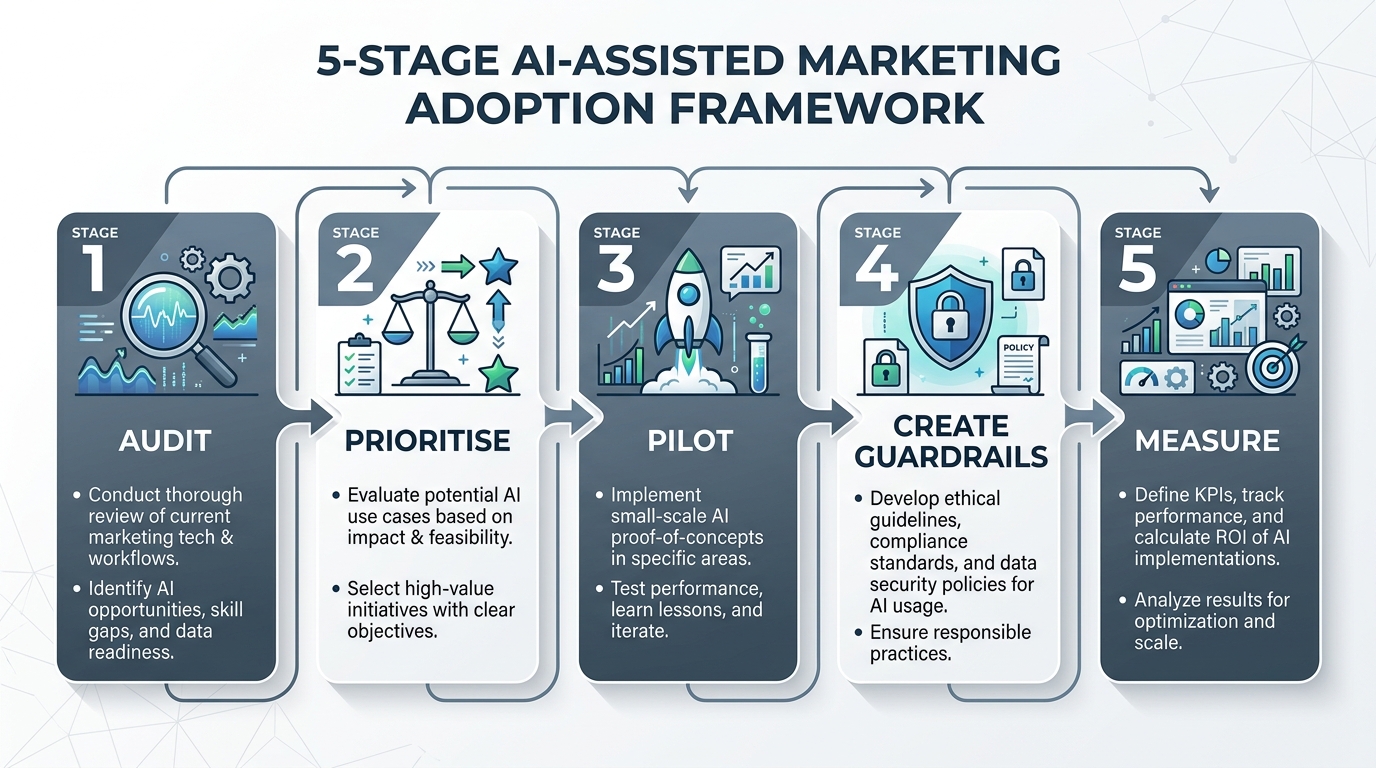
A Practical 5-Stage Framework for Building an AI-Assisted Marketing Department
To successfully unite AI and digital marketers without operational friction, enterprises should follow a structured five-stage implementation methodology:
- Stage 1: Operational Audit — Catalogue every repetitive, manual task across the marketing department (e.g., social scheduling, weekly reporting, ad banner resizing).
- Stage 2: Prioritisation Matrix — Rank workflows based on potential time savings versus regulatory and brand risk. Begin with high-volume, low-risk activities.
- Stage 3: Targeted Pilot Deployment — Implement automation on a single isolated workflow rather than overhauling the entire department simultaneously.
- Stage 4: Institutional Guardrails & Human Gates — Establish strict approval hierarchies, privacy safeguards, and mandatory human review gates for all public-facing assets.
- Stage 5: Quantitative & Qualitative Measurement — Track hours saved, lead conversion velocity, error frequency, customer satisfaction, and net team ROI.
Orchestrating these five stages efficiently requires dependable backend automation. Utilizing tools like n8n vs Make.com vs Zapier allows non-technical marketing teams to construct resilient, webhook-triggered workflows that seamlessly connect LLMs to publishing platforms.
Topical Authority and Multi-Platform Search Discovery
The proliferation of generative AI tools makes generic content trivial to produce. Because anyone can generate a generic blog post in seconds, commodity content no longer yields organic search visibility.
Official webmaster documentation from Google Search Central emphasizes that websites should focus on user-centric utility and authentic domain authority. To establish durable market visibility, modern marketing strategies implement a structured Pillar-Cluster Content Architecture. Organizing your website into comprehensive core topic hubs surrounded by deeply analytical supporting clusters signals unquestionable topical authority to search crawlers.
Simultaneously, marketing discoverability is expanding beyond conventional Google SERPs into conversational AI engines. Forward-thinking teams optimize for multi-platform indexing through Search Everywhere Optimisation and actively master how to get cited by ChatGPT and generative search platforms.
As autonomous software capabilities expand into multi-agent coordination, explore our technical breakdown on Agentic AI content strategy to prepare your marketing operations for the next decade of automated execution.
To examine the long-term industry projections where artificial intelligence and human strategists thrive side-by-side, read our companion piece on the future of digital marketing and human expertise.
Conclusion
The future of digital advertising does not belong to unassisted human teams working at manual speeds, nor does it belong to fully autonomous algorithms producing soulless commodity copy. The enduring competitive advantage belongs entirely to the dynamic partnership between AI and digital marketers.
Machine learning delivers computational scale, real-time data synthesis, and operational agility. Human marketers provide the soul of marketing: empathy, cultural nuance, strategic discernment, creative bravery, and fiduciary accountability. By uniting these strengths within a disciplined framework, marketing teams achieve unprecedented commercial performance while safeguarding the human resonance that inspires consumers to take action.
Discover more in-depth analyses, enterprise automation frameworks, and tutorials across the HuAI Content blog.
Frequently Asked Questions (FAQ)
How do AI and digital marketers collaborate effectively?
Effective collaboration between AI and digital marketers relies on clear operational division: machine learning handles high-volume data analysis, automated reporting, and creative drafting, while human marketers govern brand positioning, strategic decision-making, and final editorial approval.
Can artificial intelligence replace the creative direction of human marketers?
No. While generative AI can produce variations of existing creative concepts, it operates through statistical probability and lacks original emotional lived experience. Human marketers provide the cultural relevance, bold differentiation, and narrative depth that build iconic brands.
What are the primary risks when AI and digital marketers implement automated tools?
Primary operational risks include client data privacy violations, algorithmic bias in advertising targeting, factual hallucinations, and the erosion of brand trust caused by publishing unedited synthetic copy.
Which marketing disciplines benefit most from artificial intelligence?
Customer data analysis, real-time conversion optimization, 24/7 conversational support, programmatic ad bidding, and multi-channel content repurposing experience the most immediate productivity dividends from AI integration.
How does hybrid marketing improve overall return on marketing spend?
Combining AI and digital marketers lowers operational overhead, accelerates campaign deployment cycles from weeks to days, and ensures marketing budgets are dynamically allocated to high-performing audience cohorts in real time.
Editorial Disclaimer: This article is published for educational and informational purposes and does not constitute formal legal, corporate governance, or advertising regulatory counsel.