
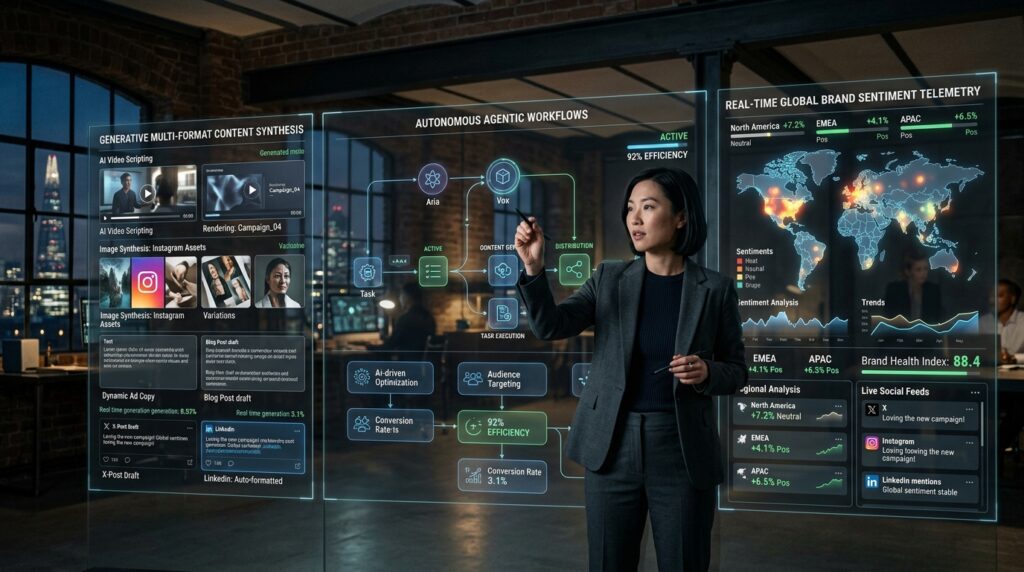
When modern generative artificial intelligence emerged into mainstream enterprise adoption, marketing leaders and agency executives confronted a disruptive question: what happens to commercial growth when machines can write, design, analyze, and optimize campaigns autonomously? In 2026, the future of digital marketing is no longer defined by an adversarial battle between human professionals and algorithms, but by an integrated hybrid operating model where machine velocity amplifies human strategic sovereignty.
The rapid acceleration of computational marketing has transformed the foundational definition of creative labor. Rather than debating whether will AI replace digital marketers, the industry has realized that automation claims repetitive execution while exponentially expanding the strategic value of human discernment, cultural intuition, and ethical accountability. Exploring the future of digital marketing reveals how forward-thinking marketing organizations are restructuring their teams, content operations, and search discovery engines to dominate an AI-first commercial landscape.
At HuAI Content, we design and deploy scalable, human-in-the-loop content systems that unite advanced agentic workflows with high-level editorial governance to secure lasting brand equity.
How Artificial Intelligence Has Redefined Marketing Work
Historically, digital marketing specialists dedicated the majority of their workweeks to manual data collection before reaching strategic decisions. Analysts manually exported CSV files, compiled weekly performance decks, and wrote dozen of repetitive ad variants.
Today, machine learning engines execute those preliminary baseline steps in seconds. A modern marketing strategist prompts an AI intelligence layer to:
- Synthesize hundreds of qualitative customer support logs into core objection clusters
- Extract non-linear attribution insights across complex paid ad accounts
- Generate diverse audience persona hypotheses backed by behavioral telemetry
- Formulate multi-channel creative variations tailored to specific buyer journeys
- Repurpose cornerstone long-form thought leadership into social snippets, video scripts, and newsletter digests
This computational speed does not replace the requirement for deep marketing acumen. It fundamentally elevates where that acumen is applied—shifting the marketer from an isolated asset producer into a high-level system architect governing the future of digital marketing.
The Irreplaceable Human Edge: Five Enduring Capabilities
As algorithmic tools democratize content production, technical capabilities that were once scarce have become commodities. In the future of digital marketing, an organization’s competitive moat depends on human attributes that probabilistic algorithms cannot synthesize:
1. High-Conviction Strategic Thinking
Machine learning models generate statistical recommendations based on past telemetry. However, algorithms cannot determine whether a specific campaign aligns with a company’s five-year enterprise vision, market defense strategy, or disruptive product positioning. Human executives decide which commercial hypotheses deserve capital investment.
2. Emotional Intuition and Deep Empathy
Marketing is fundamentally grounded in human psychology. Understanding the complex emotional undercurrents of consumer fear, professional ambition, skepticism, and institutional trust requires genuine human lived experience. Algorithms detect surface sentiment; people comprehend emotional meaning.
3. Contextual Discernment Across Cultural Nuances
The identical campaign concept that resonates in London may trigger intense backlash in Tokyo or Mumbai. Human marketers possess the cultural fluency, historical sensitivity, and social awareness required to navigate nuanced regional discourse without reputational harm.
4. Authentic Brand Voice and Distinctive Storytelling
Generative AI mimics statistical averages; unchecked, it inevitably produces formulaic corporate platitudes. Enduring commercial brands are constructed through unique points of view, authentic vulnerability, and bold contrarian stances. Human leadership authors the authentic soul of what the company stands for.
5. Ethical Restraint and Fiduciary Accountability
An autonomous algorithm ruthlessly optimizes for its programmed mathematical objective—even if that optimization exploits consumer vulnerabilities, breaches privacy, or compromises brand integrity. Human oversight provides the moral guardrails necessary for sustainable enterprise governance, as examined in our guide on AI marketing ethics and consumer privacy.
Furthermore, in regulated domains handling financial, medical, or legal advice, rigorous adherence to EEAT for YMYL content standards remains mandatory for maintaining consumer safety and search engine viability.
From Simple AI Assistants to Autonomous Agentic Teammates
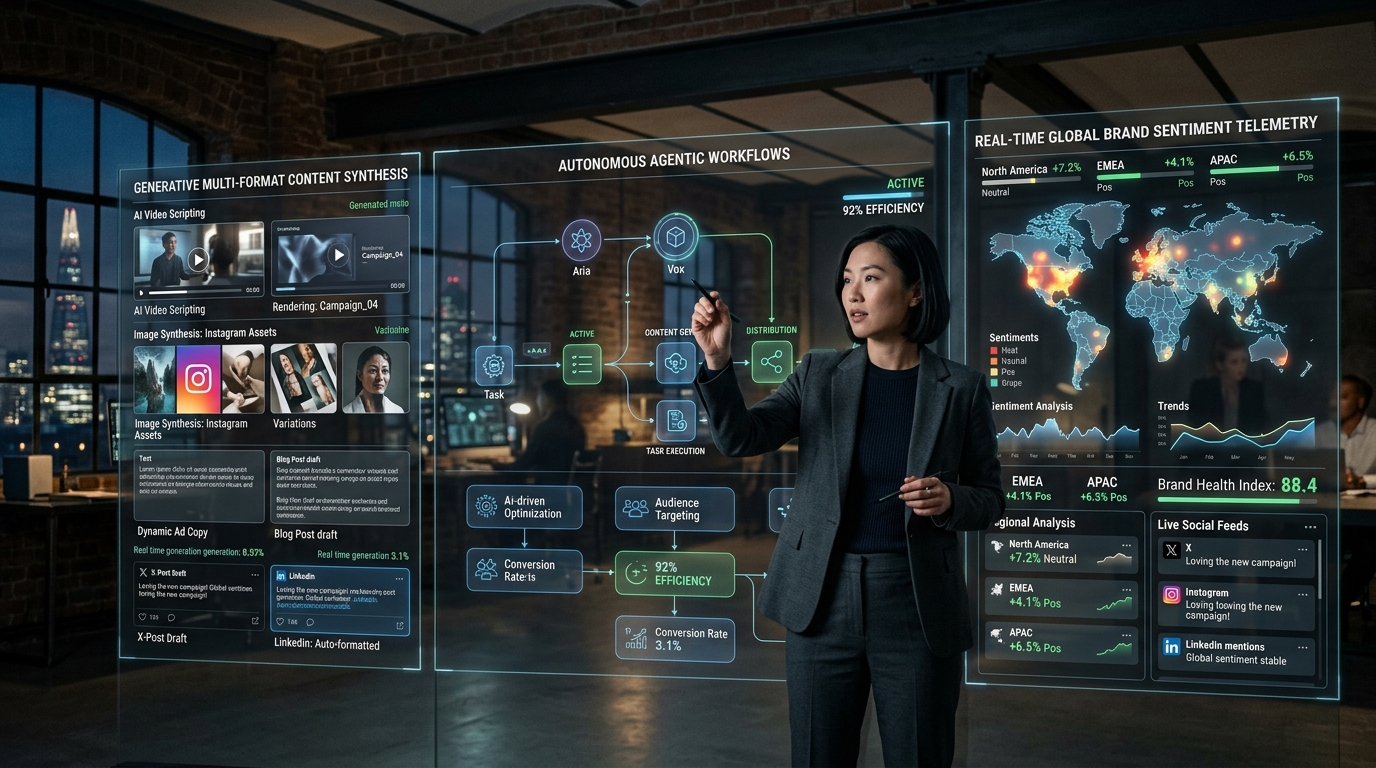
The evolutionary trajectory of marketing technology is advancing from passive conversational prompts to autonomous multi-agent execution. As detailed in our roadmap on Agentic AI content strategy, agentic systems participate directly within marketing workflows:
- Continuous Market Surveillance: Agent monitors industry trends, competitor product launches, and search anomalies.
- Topical Opportunity Identification: Agent identifies an emerging content gap and alerts editorial leadership.
- Multi-Source Research Synthesis: Agent gathers verified statistics, regulatory filings, and customer quotes.
- Multi-Format Asset Drafting: Agent generates an initial article draft, supporting email sequence, and social copy.
- Automated Compliance & Brand Audit: Secondary validation agent checks claim accuracy, tone consistency, and data privacy safeguards.
- Human Gatekeeper Approval: Human editor reviews, polishes, and signs off on the final creative package.
- Scheduled Distribution & Telemetry: Agent distributes assets and initiates real-time performance tracking.
To connect these multi-agent pipelines reliably across diverse enterprise software stacks, evaluating integration frameworks such as n8n vs Make.com vs Zapier enables engineering and marketing teams to establish secure, low-latency webhook pipelines without vendor lock-in.
The Organizational Structure of the Future Marketing Department
In the future of digital marketing, high-performing enterprises will not simply inflate department headcount. Instead, they will assemble agile, interdisciplinary teams of specialized human strategists augmented by coordinated AI agents:
| Emerging Team Role | Primary Strategic Responsibility | AI Augmented Workflow |
|---|---|---|
| Chief Marketing Strategist | Brand positioning, unit economics, and growth bets | Interprets enterprise-wide predictive market simulations |
| AI Workflow Architect | Constructs and maintains automated data pipelines | Orchestrates API connections, agent prompts, and webhooks |
| Creative & Editorial Director | Brand voice integrity, emotional storytelling, and polish | Transforms raw synthetic drafts into memorable thought leadership |
| Topical Authority Architect | Information architecture and search ecosystem mapping | Surfaces entity graphs and programmatic internal linking structures |
| Customer Intelligence Analyst | Qualitative customer interviews and ethnographic research | Ingests thousands of customer touchpoints into semantic models |
| AI Ethics & Compliance Officer | Algorithmic fairness, GDPR consent, and claim validation | Monitors real-time compliance logs and manages kill-switches |
For brands evaluating the financial investment required to transition toward an automated agency model, exploring current benchmarks on AI automation agency pricing in India provides practical clarity on development retainers and ROI expectations.
To examine the daily collaboration patterns between specialists and algorithms, explore our detailed analysis on the complementary roles of AI and digital marketers.
Search Discovery in the AI Era: Beyond Traditional Google Rankings
The future of digital marketing demands a radical re-evaluation of search engine visibility. Consumers no longer restrict their product research to static ten-blue-links results on Google. Information discovery has fragmented across conversational LLMs, social search feeds, video platforms, and answer engines.
To secure enduring commercial discoverability, modern marketing organizations implement two foundational pillars:
- Topical Domain Authority: Implementing an interconnected Pillar-Cluster Content Architecture that demonstrates comprehensive coverage of your core vertical, ensuring search crawlers recognize your domain as an authoritative reference source.
- Multi-Platform Indexing: Embracing Search Everywhere Optimisation across YouTube, LinkedIn, Reddit, and TikTok, alongside mastering how to get cited by ChatGPT, Perplexity, and Google AI Overviews through verified entity citations and structured schema.
The Content Paradox: Why Original Expertise Has Never Been More Valuable
Artificial intelligence has rendered the mechanical production of generic content virtually free. Today, anyone can prompt an LLM to generate a 2,000-word article on any subject in fifteen seconds. Consequently, generic, commodity information has lost all market value.
This creates the defining paradox shaping the future of digital marketing:
The easier baseline content becomes to generate, the more exceptionally valuable genuine, first-hand human expertise becomes.
Global enterprise research from McKinsey & Company reveals that leading organizations combine generative automation with deep qualitative insights. Similarly, documentation from Google Search Central confirms that search engines aggressively disregard repetitive synthetic summaries. Enduring commercial advantage belongs to enterprises that inject proprietary customer datasets, original field research, verified case studies, and bold contrarian perspectives into their marketing assets.
Conclusion: The Symbiosis of Machine Velocity and Human Meaning
The future of digital marketing does not require choosing between human creativity and artificial intelligence. It requires orchestrating their deliberate, high-leverage symbiosis.
Artificial intelligence provides immense computational scale, real-time multivariate analysis, and automated operational execution. Human professionals provide the essential elements that give commerce purpose: strategic vision, emotional depth, cultural discernment, and uncompromising ethical accountability. By combining machine power with human wisdom, ambitious organizations will not only survive the automated revolution—they will establish lasting commercial leadership.
Discover more strategic insights, enterprise automation frameworks, and guides across the HuAI Content blog.
Frequently Asked Questions (FAQ)
What is the future of digital marketing in the age of AI?
The future of digital marketing is defined by a hybrid human-in-the-loop operating model where machine learning automates data analysis, reporting, and creative drafting, while human strategists govern brand positioning, consumer empathy, and ethical decision-making.
How will marketing team structures evolve over the next five years?
Marketing departments will shift toward leaner, highly specialized teams of strategic directors, AI workflow architects, and customer researchers supported by coordinated autonomous agentic systems that handle multi-channel execution.
Why is original expertise essential for future SEO success?
Because generative AI makes generic content ubiquitous, search engines prioritize first-hand experience, original data, proprietary research, and unique author perspective (E-E-A-T) over commodity synthetic articles.
What is Search Everywhere Optimisation?
Search Everywhere Optimisation is the practice of optimizing brand visibility across all platforms where modern consumers seek information—including conversational AI engines, social networks, video platforms, and traditional search engines.
How can marketing agencies adopt AI without sacrificing quality?
Agencies must establish strict human review gates, implement brand voice guidelines, audit algorithmic outputs for accuracy, and maintain transparent governance frameworks across all client deliverables.
Editorial Disclaimer: This article is published for educational and informational purposes to explore emerging enterprise technology and does not constitute formal legal, corporate governance, or advertising regulatory advice.