
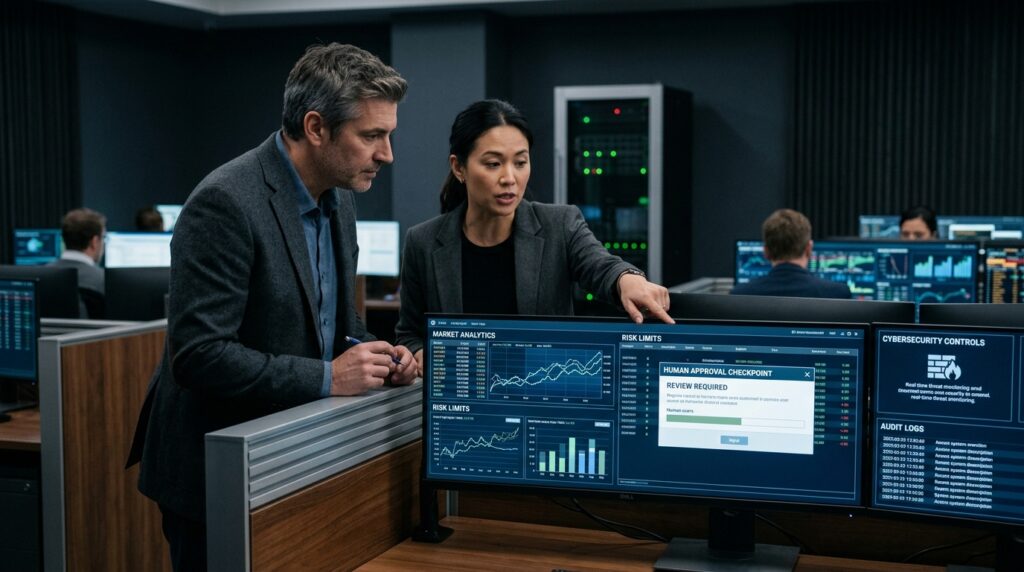
Artificial intelligence can process vast market data streams at extraordinary velocity, enabling quantitative funds and algorithmic desks to deploy AI-driven stock trading to automate core stages of market research, signal discovery, and order execution.
However, global financial markets are not ordinary digital sandboxes. An algorithmic execution engine operating in real-world equity exchanges directly impacts retail investors, liquidity dispersion, market-making spreads, and underlying price formation. When autonomous algorithms make capital allocation decisions in milliseconds, fundamental dilemmas surrounding operational transparency, ethical accountability, cyber resilience, and market integrity become paramount.
The responsible implementation of AI-driven stock trading demands far more than raw algorithmic predictive accuracy—it necessitates robust institutional governance, continuous human oversight, and verifiable compliance checkpoints.
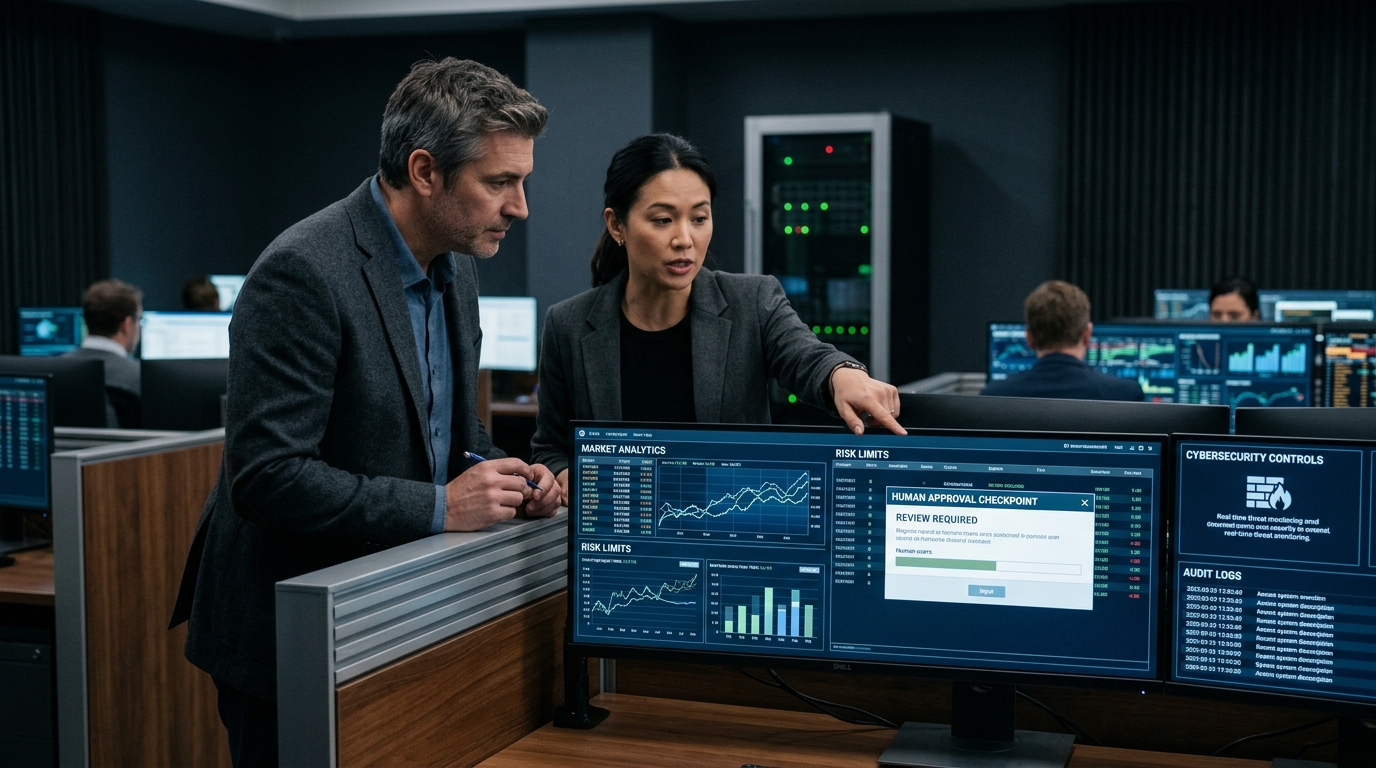
Assessing the Ethical Risks of AI-Driven Stock Trading
As trading firms transition from deterministic rule-based algorithms to adaptive machine-learning systems, understanding core operational vulnerabilities and ethical hazards in AI-driven stock trading is vital for safeguarding market stability.
1. Market Manipulation, Spoofing, and Algorithmic Misuse
High-frequency algorithms can execute thousands of orders per second across multiple exchanges. While rapid execution can provide valuable liquidity during orderly markets, unsupervised algorithms can intentionally or unintentionally generate deceptive market depth.
Practices such as algorithmic spoofing (placing non-bona fide orders to manipulate order-book queues), quote stuffing, and predatory latency arbitrage distort fair price discovery. The deployment of autonomous machine learning does not absolve trading entities of their legal obligations: every algorithmic strategy must strictly comply with securities statutes, market-conduct rules, and exchange-level surveillance standards.
2. Model Risk, Biased Datasets, and Erratic Predictions
Machine learning models formulate probabilistic hypotheses entirely from historical data distributions. If training datasets contain survivorship bias, structural regime gaps, or stale liquidity conditions, the resulting algorithmic outputs become dangerous.
Even the most mathematically sophisticated deep neural network can hallucinate correlations or fail abruptly during unseen liquidity dislocations. To mitigate model risk, institutional firms must enforce:
- Continuous Model Validation: Out-of-sample backtesting, walk-forward testing, and synthetic stress simulation.
- Real-Time Performance Telemetry: Monitoring tracking errors, realized slippage, and statistical regime changes.
- Automated Data-Quality Filters: Timestamp synchronization, corporate action adjustments, and outlier screening.
- Pre-Trade Exception Handling: Strict pre-trade risk gates preventing aberrant position sizes or runaway executions.
- Structured Human Escalation: Clear operational protocols enabling human risk officers to pause trading engines instantly.
3. Explainability, Interpretability, and the Black-Box Dilemma
Modern transformer models and deep neural architectures excel at non-linear pattern recognition, but their internal weights and latent spaces are notoriously opaque. When an algorithmic strategy experiences unexpected drawdowns or executes abnormal trades, risk committees and financial regulators require clear explanatory rationales.
The Bank for International Settlements (BIS) has repeatedly emphasized that explainability, robust data governance, and auditable accountability are non-negotiable prerequisites for financial machine learning. A foundational governance principle for modern capital markets is clear:
If a financial institution cannot thoroughly explain, continuously audit, and deterministically govern an automated model, that model must never be granted autonomous execution authority.
4. Client Data Privacy and Proprietary Telemetry
Enterprise quantitative pipelines frequently process sensitive organizational and investor information, including:
- Individual client identities and KYC disclosures
- Confidential institutional order flow and trade execution histories
- Detailed portfolio holdings and private wealth allocations
- Proprietary quantitative feature stores and predictive alpha signals
- Alternative consumer behavioral datasets and credit-card telemetry
Organizations deploying automated market models must maintain strict cryptographic encryption, zero-trust role-based access controls, and data-anonymization pipelines to prevent unauthorized exfiltration or competitive data leakage.
5. Cybersecurity and Distributed Supply-Chain Dependencies
Modern quantitative trading infrastructure is heavily dependent on distributed third-party software stacks, including cloud infrastructure providers, real-time market data APIs, containerized microservices, and open-source machine learning libraries.
A zero-day exploit, dependency poisoning, or network outage in a single external data vendor can propagate systemic errors across automated execution desks. Regulatory authorities—including the Bank for International Settlements (BIS) and the Reserve Bank of India (RBI)—have explicitly identified third-party software dependencies, cyber vulnerabilities, and cloud concentration risks as urgent systemic concerns for institutional finance.
Implementing Ethical Practices and Regulatory Standards
Translating ethical principles into everyday quantitative engineering requires explicit institutional controls, transparent client communications, and rigorous regulatory alignment.
1. Client Transparency and Regulatory Mandates
Clients and market participants possess an ethical right to understand when and how algorithmic models influence their capital. In India, the Securities and Exchange Board of India (SEBI) issued an updated Master Circular for Investment Advisers that establishes groundbreaking regulatory requirements for artificial intelligence:
- Fiduciary Accountability: Registered advisers utilizing AI tools remain entirely accountable for client data security, confidentiality, and data integrity.
- Advice Integrity: Financial advisers retain full legal liability for any algorithmic advice generated by automated systems.
- Mandatory Client Disclosure: Financial institutions must clearly disclose to clients the specific extent, scope, and operational role of AI systems in their investment workflow.
This regulatory precedent demonstrates that artificial intelligence cannot be treated as a legal shield: technological complexity never diminishes fiduciary duty.
2. Active Human Oversight (Human-in-the-Loop Architecture)
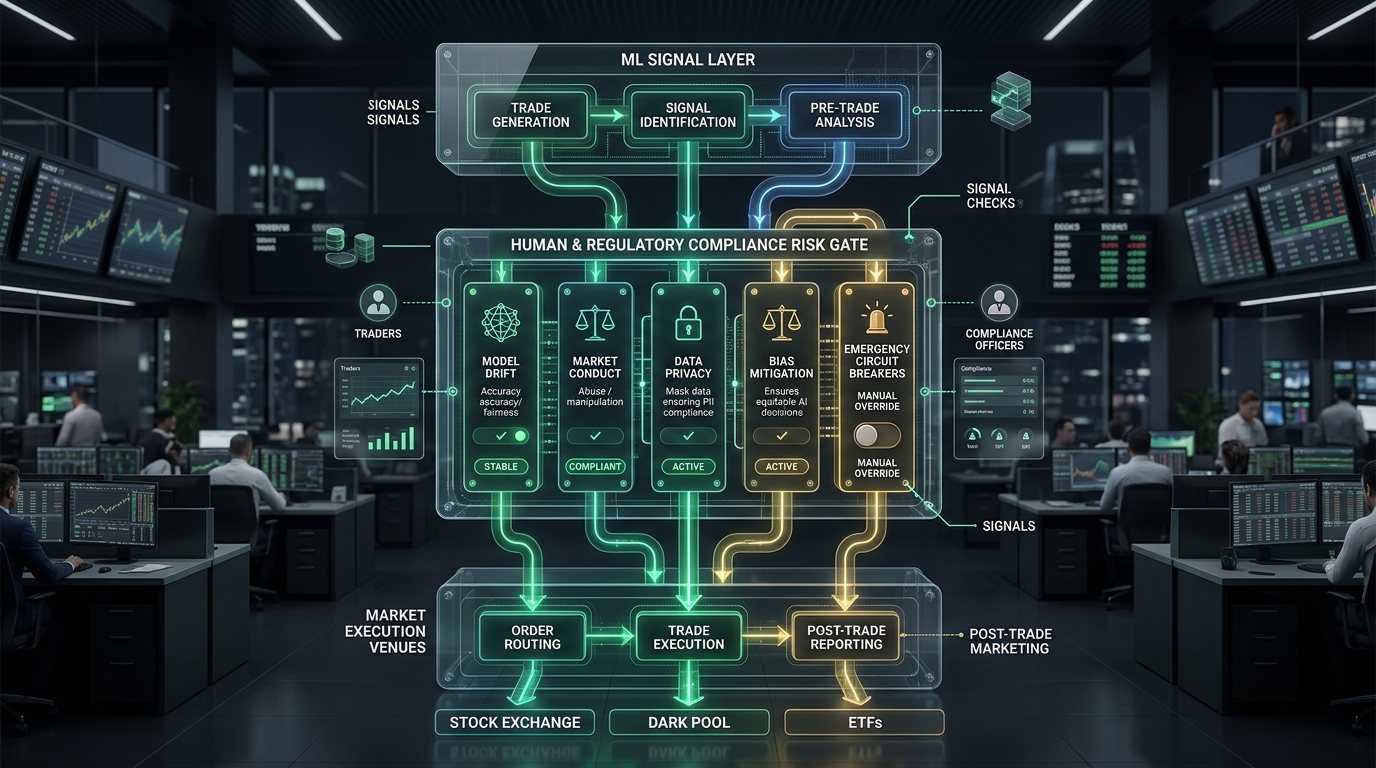
Automation must never become an excuse for abdicated responsibility. In production environments, human oversight must be operationalized through structured checkpoints:
- Mandatory Peer Review: Formal risk committee approval before deploying any new quantitative model or modifying algorithmic risk budgets.
- Continuous Real-Time Supervision: Dedicated risk managers actively monitoring live execution speeds, order fill ratios, and abnormal volatility alerts.
- Emergency Circuit Breakers: Hardware and software kill-switches capable of halting execution across exchanges in microseconds.
- Post-Trade Auditing: Comprehensive forensic reviews of anomalous trading days and unexpected slippage events.
3. Rigorous Testing, Validation, and Model Drift Monitoring
Quantitative models must be rigorously stress-tested prior to live deployment and continuously monitored throughout their active lifecycle. Essential testing protocols include:
| Testing Dimension | Validation Focus | Key Mitigation Mechanism |
|---|---|---|
| Historical Overfitting | Evaluates whether models memorize random market noise | K-fold cross-validation, walk-forward testing, out-of-sample data splits |
| Market Regime Drift | Detects performance degradation during macro shifts | Statistical distance metrics (Kolmogorov-Smirnov test, PSI), rolling re-estimation |
| Extreme Tail Risk | Simulates liquidity freezes and flash crashes | Monte Carlo stress tests, historical scenario analysis (2008, 2020 dislocations) |
| Cyber & Latency Resilience | Assesses system stability during feed outages | Redundant network pipelines, failover servers, synthetic tick interruption tests |
4. Defining Unambiguous Ownership and Governance
An institutional organization must explicitly define individual human accountability across every component of the quantitative pipeline:
- Model Ownership: Who designed and verified the mathematical logic?
- Data Governance: Who audited the data cleaning and survivorship bias filters?
- Trading Strategy: Who authorized the strategy mandate and capital allocation?
- Pre-Trade Risk Controls: Who sets and reviews maximum leverage and loss limits?
- Incident Response: Who holds authority to pull the emergency kill-switch?
Vague assertions such as “the neural network made an autonomous decision” represent catastrophic governance failures that carry severe legal and financial liabilities.
Systemic Market Risk, Correlated Crowding, and Financial Stability
The ethical dimension of financial algorithms extends far beyond individual trading firms. When dozens of institutional hedge funds and proprietary desks train similar transformer architectures on identical public data feeds, their automated responses become dangerously synchronized.
Research conducted by the Bank for International Settlements (BIS) and the International Monetary Fund (IMF) highlights that correlated algorithmic trading strategies compress the timeframe across which market shocks unfold. During sudden volatility spikes, simultaneous automated selling can drain market depth across entire asset classes, triggering cascading flash crashes and widespread systemic instability.
A Practical Governance Framework for AI-Driven Stock Trading
To establish institutional accountability, engineering and compliance teams can implement a five-pillar governance matrix aligned with the NIST AI Risk Management Framework:
Govern → Understand → Measure → Monitor → Manage
- Govern: Establish unambiguous human accountability, regulatory compliance structures, and institutional audit committees.
- Understand: Map data provenance, identify algorithmic assumptions, and ensure explainability across model parameters.
- Measure: Quantify performance, track feature drift, and conduct rigorous out-of-sample risk simulations.
- Monitor: Implement real-time surveillance for execution anomalies, cyber threats, and abnormal market feedback loops.
- Manage: Enforce deterministic pre-trade risk gates, human approval checkpoints, and operational kill-switches.
Balancing Algorithmic Automation with Human Responsibility
The ultimate objective of ethical governance in AI-driven stock trading is not to stifle technological progress or abandon computational efficiency. Rather, financial institutions must draw clear, deliberate boundaries between operations suited for autonomous automation and workflows requiring non-negotiable human governance.
| Workflows Suitable for Algorithmic Automation | Operations Requiring Strict Human Oversight |
|---|---|
| Multi-asset tick data ingestion and normalization | Authorizing major investment mandates and capital allocation |
| Real-time news feed monitoring and NLP sentiment scoring | Modifying gross portfolio risk budgets and single-asset leverage caps |
| Deterministic TWAP/VWAP order execution and child slicing | Approving live production deployment of newly trained ML models |
| Continuous portfolio beta tracking and VaR calculation | Investigating abnormal market disruptions and unprecedented liquidity events |
| Automated compliance audit logging and record keeping | Fulfilling legal, regulatory, and fiduciary client disclosures |
For financial institutions and engineering leaders building enterprise-grade data infrastructure and automated pipelines, our specialized HuAI Content workflow automation services provide production-grade consulting and architecture.
Conclusion
Modern AI-driven stock trading unlocks unprecedented processing velocity, multi-modal data ingestion, and scalable risk modeling. Yet these computational capabilities introduce critical responsibilities concerning model risk, data privacy, cybersecurity, market manipulation, and systemic financial stability.
Sustainable innovation in quantitative finance is not achieved by building machines that trade faster without restraint. True institutional excellence lies in designing resilient, transparent, and ethically governed systems where autonomous computational speed is firmly guided by human wisdom and accountability.
To examine the foundational capabilities powering modern quantitative analysis, explore our companion analysis on How AI Is Used in Stock Market Analysis and Trading, or review our comprehensive pillar guide on The Rise of AI in Stock Trading: How Machine Learning Is Changing Investment Strategies.
For more deep-dives into modern artificial intelligence applications, visit the HuAI Content blog.
Frequently Asked Questions (FAQ)
Is AI-driven stock trading ethical?
AI-driven stock trading is not inherently ethical or unethical. Its ethical standing depends entirely on how algorithms are designed, tested, monitored, and governed. Systems that incorporate robust pre-trade risk controls, adhere to market conduct regulations, and maintain human oversight are considered ethically responsible.
Can artificial intelligence manipulate financial markets?
Yes. Autonomous algorithms can be intentionally or unintentionally configured to engage in deceptive market practices, such as spoofing, layering, or predatory latency arbitrage. Because of this, financial regulatory bodies require strict surveillance controls to ensure automated trading complies with securities regulations.
Why is explainability critical in quantitative trading models?
Explainability enables quantitative researchers, risk managers, and regulatory authorities to understand the mathematical drivers behind algorithmic decisions. Without explainability, institutions cannot adequately diagnose model errors, evaluate regime changes, or ensure regulatory compliance.
How does SEBI regulate the use of AI in financial advice?
SEBI’s Master Circular for Investment Advisers explicitly mandates that registered financial advisers retain full accountability for client data security, advice accuracy, and legal compliance when utilizing artificial intelligence tools. Advisers are also legally required to disclose the extent of AI usage to their clients.
Can human oversight prevent all algorithmic trading failures?
No. While active human oversight significantly reduces operational and ethical risks, it cannot completely eliminate flash crashes, software bugs, or unexpected market regime shifts. True resilience requires combining human governance with automated pre-trade risk gates, continuous out-of-sample testing, and emergency kill-switches.
Editorial Disclaimer: This article is published exclusively for educational, technical, and informational purposes and does not constitute financial, investment, legal, or trading advice.