
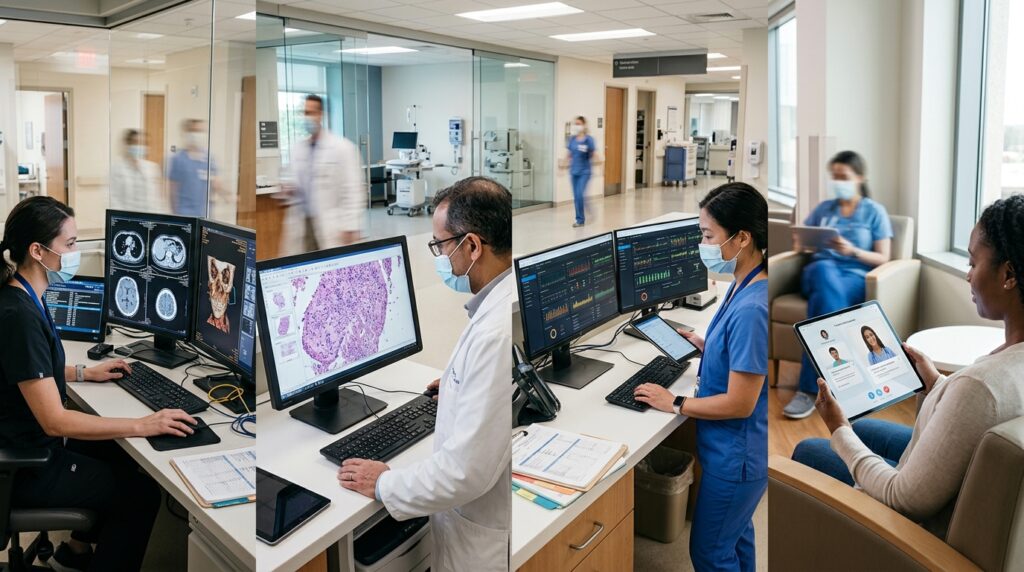
The spectrum of clinical software is expanding rapidly, from computer-vision systems analyzing radiological scans to virtual assistants supporting patient navigation. Evaluating the capabilities and regulatory classifications of AI in medicine is vital for hospital administrators, clinicians and healthcare technology leaders seeking to modernize operations safely.
Not all healthcare software serves the same clinical function. An administrative assistant transcribing appointment notes operates under fundamentally different safety and regulatory standards compared to an authorized diagnostic device. Understanding the scope of AI in medicine ensures organizations implement the right software for their clinical needs.
1. AI-Powered Medical Imaging and Radiology Tools
Radiology remains the flagship domain for clinical artificial intelligence. FDA-authorized software assists radiologists with image reconstruction, nodule detection, stroke triage and mammographic density assessment. These tools prioritize critical scans in the PACS queue, helping radiologists evaluate urgent cases promptly.
2. Digital Pathology and Tissue Analysis
Digital pathology platforms digitize glass biopsy slides for automated morphological analysis. Deep learning algorithms highlight cellular anomalies, quantify biomarkers (such as HER2 or Ki-67 in oncology) and assist pathologists in establishing accurate diagnoses.
3. Surgical Planning and Navigation Systems
Preoperative planning platforms synthesize CT and MRI datasets into 3D anatomical models, allowing surgeons to rehearse complex interventions. In the operating room, AI-assisted navigation systems track surgical instruments in real time to enhance procedural precision.
4. Clinical Documentation and Ambient Scribes
Ambient voice assistants transcribe doctor-patient consultations and automatically structure standard SOAP notes inside electronic health record (EHR) systems, dramatically reducing administrative overhead and physician documentation burden.
5. Clinical Decision-Support Systems (CDSS)
Algorithmic decision-support tools synthesize lab values, patient history and pharmacological databases to alert clinicians to adverse drug interactions, abnormal lab trajectories and guideline-based care pathways.
6. Remote Patient Monitoring and Telehealth Platforms
Connected biosensors track patient vitals post-discharge, utilizing automated telemetry analysis to identify physiological decompensation. In telemedicine, intelligent intake chatbots gather symptoms and medical histories prior to virtual consultations.
For a complete strategic analysis of clinical AI applications, read our pillar guide on AI in medicine across diagnostics and patient care.
Framework for Evaluating AI Medical Tools
- Intended Clinical Use: Clarify whether the software is designed for diagnostic screening, clinical triage or administrative support.
- Regulatory Authorization: Verify medical device clearance (such as FDA 510(k), De Novo or CE mark) appropriate for the tool’s clinical claims.
- External Clinical Validation: Review peer-reviewed studies demonstrating algorithm performance on patient populations matching your institution.
- Data Privacy & Security: Confirm compliance with healthcare data regulations and India’s DPDP Rules. Explore our detailed guide on the ethical implications of AI in medicine for key compliance considerations.
Ensuring Public Trust and Information Quality
When publishing guidance regarding medical technology, institutions must uphold strict editorial standards. Structuring online educational resources according to E-E-A-T for YMYL content standards guarantees health information is authoritative, scientifically verified and trustworthy for patients.
Connecting Healthcare Systems with Automated Pipelines
Integrating hospital scheduling, laboratory feeds and billing systems requires resilient integration middleware. Healthcare IT teams utilize tools like n8n vs Make.com vs Zapier to route non-clinical data efficiently between administrative platforms.
Medical institutions also deploy agentic AI content and operational workflows to streamline patient onboarding and resource scheduling. To build comprehensive patient knowledge hubs, organizations structure educational content using a pillar-cluster content architecture, apply search everywhere optimisation, and ensure clinical insights get cited by ChatGPT and AI answer engines.
Healthcare providers planning technology investments should evaluate realistic AI automation agency pricing in India to budget for deployment, customization and clinician training. Digital agencies like HuAI Content assist organizations in architecting compliant, scalable digital operations.
Conclusion
Deploying specialized AI in medicine tools provides clinicians with powerful support across imaging, documentation and patient management. By rigorously validating clinical evidence and maintaining human oversight, healthcare institutions can harness artificial intelligence to enhance patient outcomes and improve clinical efficiency.
Frequently Asked Questions
What are AI-powered medical tools?
They are specialized software applications that apply machine learning, computer vision or natural language processing to assist with healthcare tasks such as diagnostic imaging, documentation, patient monitoring and surgical planning.
Are all AI healthcare tools considered medical devices?
No. Software intended for administrative scheduling or general wellness is generally not regulated as a medical device, whereas tools intended for clinical diagnosis or treatment guidance undergo formal medical device review.
Can virtual health assistants replace doctors?
No. Virtual assistants handle routine appointment booking, medication reminders and basic health information, but they cannot perform clinical examinations or provide comprehensive medical diagnoses.
How should a hospital select an AI medical tool?
By evaluating its intended clinical use, regulatory authorization status, external clinical validation studies, data security protocols, EHR integration capabilities and staff training requirements.