
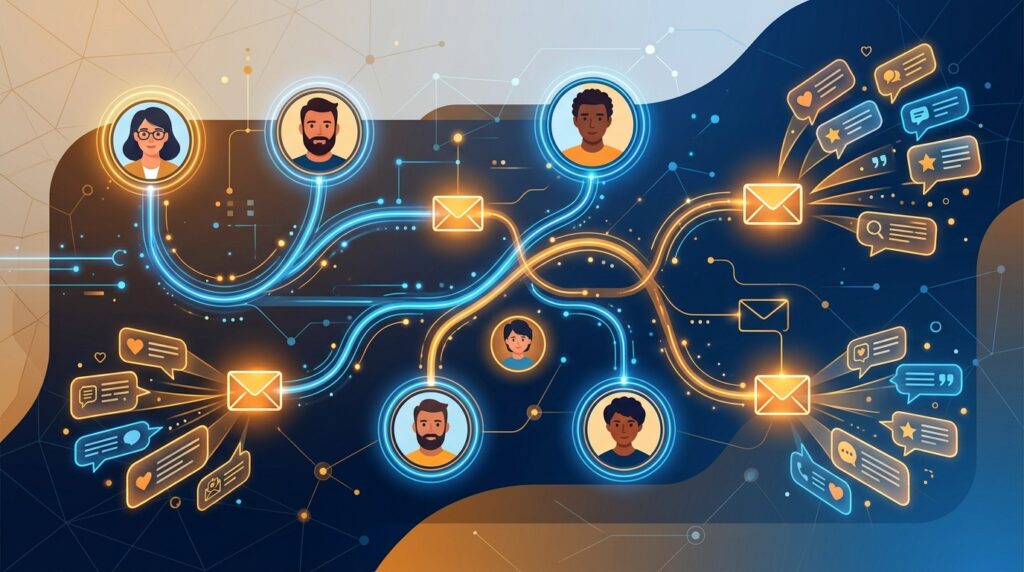
AI in email marketing has moved far beyond sending the same newsletter to an entire subscriber list. Modern AI-powered systems can analyse customer behaviour, identify patterns, personalise messages and determine when different subscribers are most likely to engage — making AI-powered customer engagement one of the most powerful capabilities available to email marketers today.
What Is AI in Email Marketing for Customer Engagement?
AI-powered customer engagement means using artificial intelligence to make communication more relevant and responsive to individual customer behaviour. Instead of a single audience receiving one message, the model becomes: different behaviours lead to different journeys and different messages. This approach connects naturally to broader search everywhere optimisation strategies, where relevance across every channel is the goal.
AI can help marketers understand what customers are interested in, what they have purchased, what content they engage with, when they usually interact, whether they are becoming inactive and which products may interest them.
1. Personalised Campaigns Using AI in Email Marketing
Personalisation is one of the most established applications of AI in email marketing across modern digital commerce. AI can personalise subject lines, product recommendations, content blocks, offers, CTAs, send times and frequency. However, personalisation should provide relevance rather than simply demonstrate that a company possesses personal data.
“Hi Rahul” is basic personalisation. “Here are three products related to the category you recently explored” is behavioural relevance. For brands building trust with audiences, this distinction matters — the principles of E-E-A-T for YMYL content apply equally to commercial email communication.
2. Send-Time Optimisation
The time at which an email arrives can affect whether it receives attention. AI can examine historical engagement patterns and estimate when an individual subscriber or segment is most likely to interact. Modern email platforms increasingly include predictive send-time functionality. But timing should not become an excuse to increase email frequency excessively. A perfectly timed unwanted email is still unwanted.
3. Smarter Subject Lines
AI can generate multiple subject-line options based on campaign objective, audience, brand voice, previous performance and message content. It can then help marketers test different versions. The key principle is relevance — a high-performing subject line that misrepresents the email may increase opens but damage trust and generate complaints.
4. Behaviour-Based Journeys Driven by AI in Email Marketing
AI becomes significantly more useful when connected to customer behaviour. For example, a customer visits a product page, AI identifies high purchase intent, the customer receives a relevant email, they purchase, AI removes them from acquisition messaging and they enter an onboarding journey. This is more sophisticated than simply scheduling newsletters.
The workflow automation capabilities that enable these journeys — such as those compared in our guide to n8n vs Make.com vs Zapier — are what make sophisticated lifecycle management achievable without large teams.
5. Re-Engaging Inactive Customers
AI can identify subscribers whose engagement is declining. A re-engagement campaign might offer new products, useful content, a preference update, a special offer or an opportunity to change email frequency. However, the goal should not always be to keep every subscriber. Sometimes removing consistently inactive contacts can improve list health.
6. Product Recommendations
AI can combine browsing behaviour, purchase history, product relationships, customer preferences and similar-customer behaviour to generate recommendations. This is particularly useful for ecommerce. For example, a customer who purchased running shoes might receive recommendations for socks, accessories or related products. The recommendation becomes more useful when there is a genuine connection to customer intent.
7. AI-Assisted Customer Feedback Analysis
AI can process large volumes of replies, reviews and survey responses. It can identify recurring themes such as delivery complaints, product issues, pricing concerns, feature requests and positive experiences. This turns email from a one-way marketing channel into a source of customer intelligence.
8. 24/7 Automated Assistance
When adopting AI in email marketing, automated assistants can answer basic customer questions and guide users to relevant resources. But email-based customer engagement should include escalation mechanisms. For complex problems, the customer should be able to reach a human.
AI Does Not Automatically Mean Better Engagement
AI can increase efficiency. It does not automatically create better relationships. Customer engagement improves when communication is relevant, timely, useful, accurate, respectful and appropriately personalised. Sending more emails simply because AI makes them cheaper to produce can have the opposite effect.
Measuring AI-Powered Engagement
Evaluating the true commercial impact of AI in email marketing requires a comprehensive measurement framework, including engagement metrics (click-through rate, conversion rate, reply rate), relationship metrics (repeat purchases, retention, customer lifetime value), list-health metrics (bounce rate, spam complaints, unsubscribe rate, inactive subscribers) and business impact metrics (revenue per recipient, revenue per campaign, cost per acquisition, incremental revenue).
The Importance of Deliverability
Customer engagement starts with getting the email into the inbox. Google’s sender guidelines require authentication measures and establish additional requirements for bulk senders. Gmail also recommends maintaining low spam complaint rates and gradually increasing sending volume rather than creating sudden spikes. AI-driven engagement should therefore always connect to a proper deliverability strategy.
Building an Engagement System with AI in Email Marketing
A practical system follows this flow: AI analyses behaviour, a human defines customer strategy, AI personalises content, a human reviews sensitive messaging, AI delivers automatically, AI analyses results and a human interprets and improves. This prevents automation from becoming disconnected from the actual customer relationship.
For businesses that are also building visibility in AI-powered search results, this human-centred approach aligns with strategies for getting an Indian business cited by ChatGPT. Both require consistency, relevance and authentic expertise — the hallmarks of a strong pillar-cluster content architecture. Visit HuAI Content to see how we implement this across our client programmes.
Conclusion
AI has changed customer engagement in email marketing by making individualised communication possible at much greater scale. It can identify patterns, personalise messages, optimise timing and automate customer journeys. But meaningful engagement still depends on relevance and trust. The most successful email marketers will use AI not to communicate more, but to communicate more intelligently.
For the full strategic picture, read our pillar guide on AI in email marketing.
FAQs
How does AI improve email engagement?
It can improve relevance through segmentation, personalisation, behavioural triggers, send-time optimisation and automated lifecycle journeys.
Can AI personalise every email?
Technically, platforms can create highly personalised messages, but the appropriate level depends on available data, privacy requirements and campaign objectives.
Can AI decide when to send emails?
Many platforms can predict optimal send times using historical engagement data.
Does personalisation always improve engagement?
No. Poor or excessive personalisation can feel intrusive. Relevance and appropriate data use are more important than personalisation for its own sake.
Can AI replace customer-service teams?
AI can handle routine questions, but complex, sensitive or consequential customer interactions should have appropriate human escalation.