
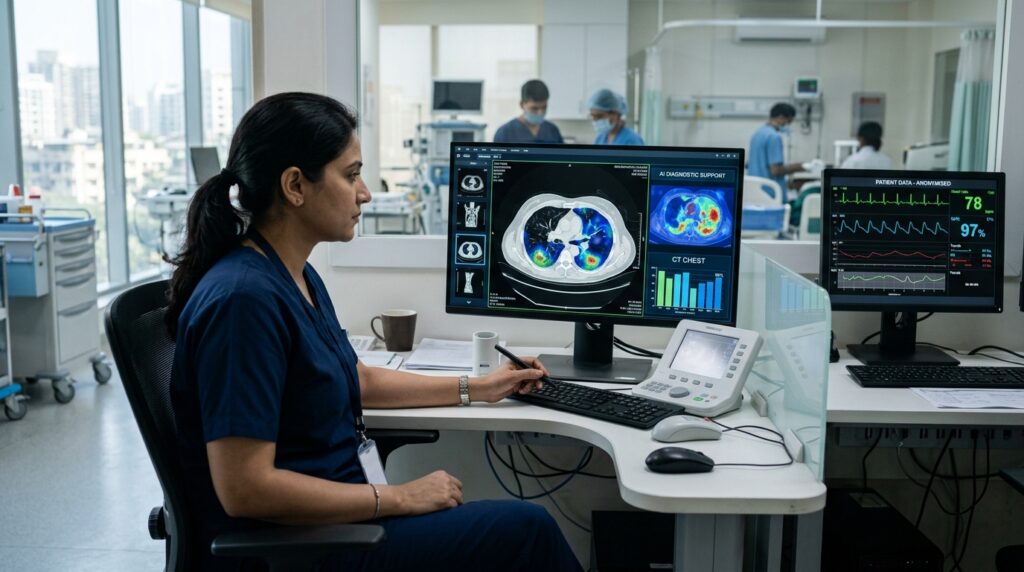
Healthcare professionals make critical clinical decisions using medical histories, laboratory results, diagnostic images, clinical guidelines and observations gathered throughout a patient’s care journey. Analysing this vast information can be time-consuming, particularly when clinicians need to coordinate care across multiple hospital departments. Deploying AI in medicine is helping modern healthcare organisations process complex data, recognise pathology patterns and support clinical workflows.
From advanced medical imaging and digital pathology to remote patient monitoring and clinical documentation, AI in medicine is becoming an indispensable part of healthcare delivery. The US Food and Drug Administration (FDA) maintains a regularly updated list of authorized medical devices, illustrating how algorithmic tools are transitioning into regulated clinical settings. However, the true value of artificial intelligence in healthcare depends on whether it improves diagnostic accuracy, supports medical staff and contributes to safer patient outcomes.
At HuAI Content, we explore how data-driven automation frameworks and verified clinical research intersect to build trustworthy health communications.
What Is AI in Medicine?
In modern healthcare, AI in medicine refers to the application of machine learning, computer vision, natural language processing and generative models to support patient care and operational tasks. Clinical applications range from evaluating X-rays and identifying histological abnormalities to summarising electronic health records and discovering novel therapeutics.
Crucially, healthcare AI systems differ considerably in their intended purpose and risk profile. An administrative transcription assistant operates under vastly different regulatory requirements compared to an autonomous diagnostic imaging device.
How Is AI in Medicine Used in Healthcare Today?
1. AI-Assisted Medical Diagnostics
Medical imaging represents one of the most established areas of clinical AI adoption. FDA-authorized algorithms assist radiologists with mammography screening, CT scan interpretation, MRI analysis, retinal pathology detection and cardiovascular assessments. These tools highlight suspicious anomalies and prioritize urgent cases, direct clinicians to critical findings without replacing human diagnostic review.
2. Digital Pathology
Pathologists examine tissue biopsies to identify cellular abnormalities and confirm clinical diagnoses. Machine-learning models assist by evaluating gigapixel digital pathology slides, measuring morphologic features and identifying regions of interest, reducing manual scanning time and improving workflow consistency.
3. Predictive Medicine and Risk Stratification
Probabilistic models evaluate longitudinal clinical variables to forecast patient deterioration, intensive care admissions and hospital readmission risks. For an in-depth examination of risk modeling, explore our detailed cluster guide to AI in predictive medicine and early disease detection.
4. Personalised Treatment Planning
Patients presenting identical symptoms frequently respond differently to therapeutic regimens. Algorithmic platforms synthesize patient genetics, biomarker panels and past treatment outcomes to help oncologists and physicians tailor individualized therapy plans.
5. Remote Patient Monitoring
Connected wearable devices and telemetry systems transmit continuous physiological measurements directly to clinical teams. Algorithmic anomaly detection flags declining vital signs, allowing medical teams to intervene before acute deterioration occurs.
6. Clinical Documentation and Administrative Support
Healthcare professionals dedicate significant hours to charting, billing and documentation. Generative AI assistants transcribe patient consultations, structure notes and reduce clinician burnout, freeing more time for bedside patient interaction.
Benefits and Opportunities of AI in Medicine
- Accelerated Information Processing: Rapidly synthesising vast clinical records and imaging studies.
- Diagnostic Decision Support: Uncovering subtle abnormalities that warrant specialist investigation.
- Operational Efficiency: Streamlining administrative workflows and appointment scheduling.
- Enhanced Research: Accelerating computational drug discovery and clinical trial matching.
Navigating Ethical Challenges, Data Privacy, and Patient Trust
Because healthcare data represents deeply sensitive personal information, deploying algorithmic models creates significant ethical responsibilities. In our dedicated analysis of the ethical implications of AI in medicine, we examine informed patient consent, data governance under India’s DPDP Rules, algorithmic bias and professional accountability.
When publishing medical resources or healthcare guidance, adhering to rigorous standards is essential. Aligning online health content with E-E-A-T for YMYL content ensures that published clinical information remains verified, credible and safe for patients seeking care advice.
Integrating Clinical Workflows with Modern Automation
In modern health systems, connecting imaging archives, lab systems and electronic health records requires robust data pipelines. Healthcare technology teams utilize integration platforms like n8n vs Make.com vs Zapier to route non-clinical data securely between departmental software.
As health systems evolve, administrative workflows increasingly leverage agentic AI content and workflow architectures to coordinate multi-step scheduling and patient intake. To build authoritative patient education libraries, institutions structure content using a scalable pillar-cluster content architecture. When expanding digital discovery, healthcare organizations adopt search everywhere optimisation and optimize their knowledge bases to get cited by ChatGPT and AI answer engines.
Healthcare administrators planning technology deployments should evaluate realistic AI automation agency pricing in India to budget for software validation, staff training and compliance audits. For a comprehensive overview of specialized clinical tools, read our guide to AI-powered medical tools across imaging and virtual assistants.
Conclusion
Deploying AI in medicine is transforming how healthcare professionals interpret diagnostic data, monitor patients and execute clinical workflows. However, technological capability cannot replace professional medical judgement, empathy and ethical oversight. The most successful healthcare systems will unite machine intelligence with human clinical expertise to deliver safer, more equitable patient care.
Frequently Asked Questions
What is AI in medicine?
AI in medicine refers to the use of artificial intelligence technologies—such as computer vision, machine learning and natural language processing—to support clinical diagnosis, treatment planning, documentation and patient care.
Can AI in medicine replace human doctors?
No. While AI tools provide powerful diagnostic assistance and workflow automation, clinical judgement, physical examination, ethical decision-making and patient relationships remain irreplaceable human responsibilities.
How is AI in medicine regulated for clinical safety?
Regulatory agencies such as the US FDA and global health authorities evaluate medical AI algorithms as software as a medical device (SaMD), requiring rigorous clinical validation before market authorization.
What are the biggest risks of AI in medicine?
Key risks include algorithmic bias, unrepresentative training data, data privacy breaches, automated hallucinations and overreliance on computer-generated suggestions without independent clinical review.