
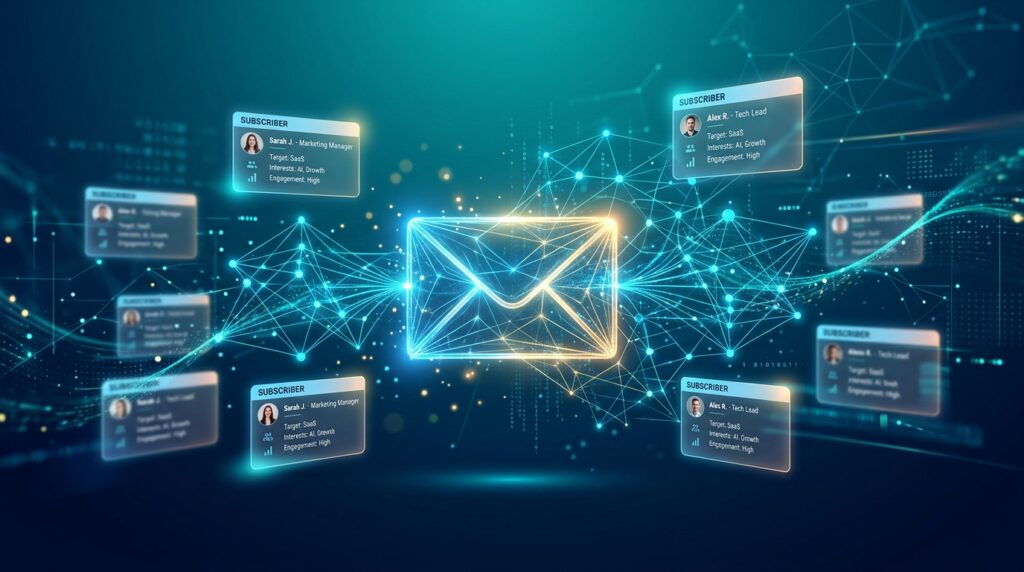
AI in email marketing is changing how email campaigns are planned, personalised and delivered. Email marketing has always depended on sending the right message to the right person at the right time. The difficulty is that doing this manually becomes increasingly complicated as subscriber lists grow. Artificial intelligence is changing that equation.
Deploying AI in email marketing enables modern marketing systems to analyse customer behaviour, identify audience segments, generate content variations, recommend send times, automate customer journeys and analyse campaign performance. This guide covers what AI in email marketing means, the key benefits, practical applications and how to build a responsible strategy.
What Is AI in Email Marketing?
AI in email marketing refers to the use of machine learning, predictive analytics, natural-language processing and generative AI to improve how email campaigns are planned, created, delivered and measured.
Depending on the platform, AI can help marketers:
- Generate subject lines
- Draft email copy
- Segment audiences
- Personalise messages
- Recommend products
- Predict customer behaviour
- Optimise send times
- Automate customer journeys
- Analyse campaign performance
- Identify inactive subscribers
- Improve campaign testing
In 2026, AI email marketing tools commonly span six broad areas: content generation, personalisation, optimisation, automation, deliverability and analytics.
Benefits of AI in Email Marketing
1. Smarter Segmentation
Traditional segmentation might divide subscribers according to age, location or purchase history. AI can combine many behavioural signals.
For example, an ecommerce business could identify customers who viewed a product repeatedly, added it to their cart, did not purchase, previously bought related products and frequently respond to promotional emails. The resulting audience can be much more relevant than a generic mailing list.
2. Personalised Content
AI can adapt email content according to customer information and behaviour. Personalisation can include product recommendations, content topics, offers, images, calls to action, subject lines and email frequency.
However, effective personalisation is not simply inserting a customer’s first name. It means providing information that is genuinely relevant to that person’s situation. This is also a consideration covered in our guide to E-E-A-T for YMYL content, where trust and relevance underpin every communication.
3. Automated Campaigns
AI can support lifecycle campaigns such as welcome, education, conversion, retention and re-engagement. For example, a customer who abandons a cart could enter one journey, while an existing customer who has not purchased for six months could enter another.
These automated workflows are similar in structure to the agentic AI automation strategies that are reshaping how content and customer communications are managed.
4. Predictive Analysis
AI can analyse historical behaviour to estimate which customers may be more likely to purchase, churn, engage, respond to an offer or need re-engagement. These are predictions, not guarantees. A good marketing team uses predictive scores as decision-support signals rather than treating them as certain outcomes.
5. Send-Time Optimisation
Not every subscriber checks email at the same time. AI-powered platforms can use historical engagement data to estimate when individual recipients are more likely to engage. Modern email platforms increasingly provide individual-level or segment-level timing optimisation.
6. Faster Content Production
Generative AI can create initial versions of subject lines, preview text, email bodies, product descriptions, promotional messages, newsletter sections and calls to action. Human review remains important for accuracy, brand voice and originality.
10 Ways to Use AI in Email Marketing
1. Generate Subject-Line Variations
AI can create multiple subject-line concepts based on the campaign objective and audience. The marketer can then test them rather than automatically selecting the AI’s favourite.
2. Draft Email Copy
AI can transform a campaign brief into a first draft. A strong workflow is: Brief → AI draft → fact check → brand editing → approval → send.
3. Personalise Newsletters
AI can help determine which content blocks are most relevant to different subscribers. Instead of creating ten completely separate newsletters, a business can create one campaign with dynamic sections.
4. Improve Deliverability
AI can help identify engagement patterns and inactive subscribers. However, deliverability is not something AI can solve by itself. Authentication, sender reputation, consent, list quality and recipient engagement remain fundamental. Businesses can also explore workflow automation tools to keep list hygiene processes running automatically.
5. Optimise Send Times
Use behavioural data to determine when individual recipients or segments tend to engage.
6. Manage Customer Lifecycle Emails
AI can help identify when a customer moves from acquisition to onboarding, conversion, retention or re-engagement.
7. Recommend Products
Retail and ecommerce brands can use browsing and purchase data to recommend relevant products.
8. Run Smarter Experiments
AI can help generate test variants and analyse results. Useful variables include subject line, preview text, CTA, offer, layout, message length, send time and audience segment.
9. Analyse Sentiment
AI can classify customer replies and feedback into broad sentiment categories. The results can help identify recurring customer concerns, although sentiment models should not be treated as perfect interpretations of emotion.
10. Connect Email with Other Channels
Modern customer-engagement platforms increasingly connect email with SMS, CRM data, websites and other channels. For brands that want to be cited and discovered across AI platforms, email is one component of a broader multi-channel presence. This is also central to a pillar-cluster content architecture where each article supports the others.
AI Email Marketing Tools in 2026
Current platforms and capabilities include:
- HubSpot — CRM-connected AI email creation, personalisation, targeting and analytics.
- Klaviyo — ecommerce-focused behavioural and predictive personalisation.
- Mailchimp — AI-assisted optimisation and campaign analytics.
- Customer.io — event-driven customer journeys and behavioural messaging.
- ActiveCampaign — automation, segmentation and predictive capabilities.
- Seventh Sense — send-time optimisation.
- SendGrid — high-volume email infrastructure and deliverability.
- Mailgun — transactional email infrastructure and validation.
These platforms should not be treated as interchangeable. Their usefulness depends on business model, database size, CRM integration, ecommerce requirements, automation complexity and budget.
How to Build an AI-Driven Email Strategy
Step 1: Define the Business Goal
Decide whether the objective is more qualified leads, more purchases, better retention, higher engagement, reduced churn or better customer education.
Step 2: Audit Your Data
AI cannot compensate for poor customer data. Check whether your records are accurate, relevant, current, permission-based and properly organised.
Step 3: Select the Right AI Capability
Do not purchase a platform simply because it says “AI”. Identify the actual problem first. Understanding your true implementation costs matters — see our breakdown of AI automation agency pricing for guidance on budgeting these investments.
Step 4: Establish Human Review
Decide which emails can be automated and which require approval.
Step 5: Test
Run controlled experiments instead of changing everything simultaneously.
Step 6: Measure Business Outcomes
Do not stop at open rate. Also monitor click-through rate, conversion rate, revenue per recipient, unsubscribe rate, spam complaints, bounce rate, customer retention and lifetime value.
Deliverability Factors for AI in Email Marketing
One of the biggest mistakes marketers can make is assuming that better AI-generated content automatically means better inbox placement. It does not.
Google requires senders to authenticate email and has specific requirements for bulk senders, including SPF, DKIM, DMARC, alignment, spam-rate controls and one-click unsubscribe for relevant marketing messages. Good AI copy + poor deliverability = poor campaign. Technical email infrastructure still matters.
Can AI Replace Email Marketers?
AI can automate many repetitive email-marketing activities. It can draft faster, analyse more data, identify patterns and optimise repetitive decisions. But successful email marketing still requires customer understanding, strategy, brand voice, storytelling, offer development, ethical judgement and editorial review.
This mirrors the broader pattern of search everywhere optimisation, where the channels change but human strategy remains the differentiator. You can explore the full picture at HuAI Content.
Conclusion
AI is transforming email marketing from a campaign-production activity into a more intelligent customer-engagement system. The strongest implementation combines human strategy, AI analysis, AI-assisted creation, human review, automated delivery and continuous AI-driven optimisation. That combination provides the scalability of automation without sacrificing the judgement that makes communication meaningful.
FAQs
What is AI in email marketing?
AI in email marketing uses machine learning, predictive analytics and generative AI to assist with segmentation, content, personalisation, automation, optimisation and analytics.
Can AI write email campaigns?
Yes. AI can create drafts, subject lines, CTAs and variations, but human review remains important for accuracy, brand voice and compliance.
Can AI improve email conversion rates?
It can help marketers optimise segmentation, personalisation, timing and testing, but performance depends on data quality, offer quality, audience fit and execution.
Is AI-generated email content safe to send automatically?
Not universally. Low-risk repetitive messages may be suitable for automation, while sensitive claims, customer-specific decisions and high-impact communications should receive human review.
What is the best AI email marketing tool?
There is no universal best platform. The right choice depends on CRM integration, audience size, ecommerce requirements, automation needs, deliverability requirements and budget.