
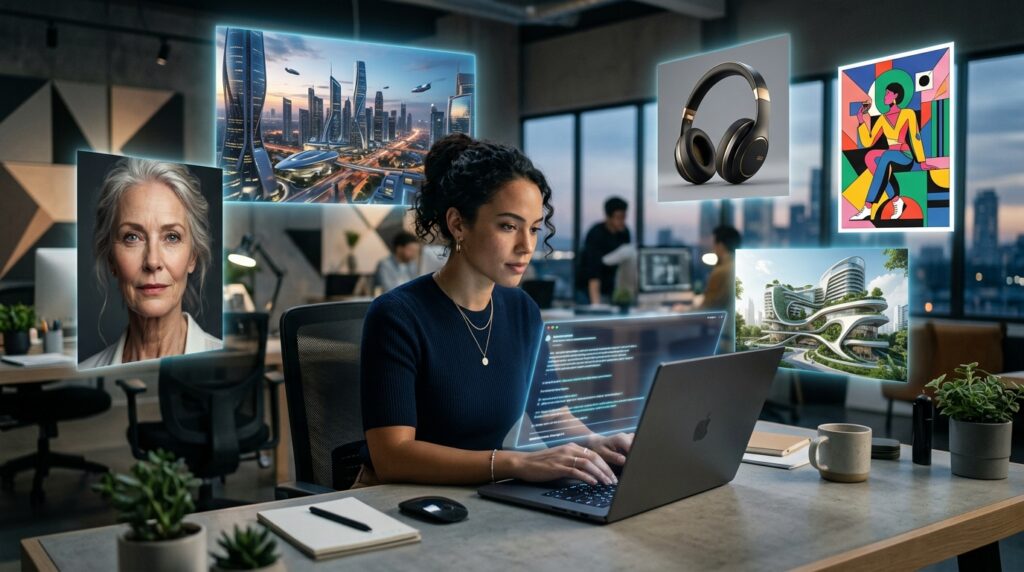
Imagine typing “a woman gazing at the night sky from a rooftop in Kolkata, cinematic photography, warm city lights” and receiving a completely new, production-ready visual within seconds. That is the practical magic of modern free AI image generators.
What started as an experimental technology has evolved into a mainstream creative tool used by marketers, designers, businesses, writers, architects, content creators and entrepreneurs. Today’s generative engines can synthesize imagery from text prompts, transform existing photos, extend compositions, remove or replace elements, adapt distinct visual aesthetics and support precise editing.
The biggest change since the first generation of AI art tools is that image generation is no longer limited to isolated sandbox platforms. AI visual synthesis has become woven into broader creative ecosystems, including conversational assistants, cloud design suites, and enterprise creative software. For growing ventures and lean teams, these accessible free AI image generators make it possible to ideate and produce visual assets in a fraction of traditional production time.
In this comprehensive guide, we’ll examine how generative vision models function, review the most powerful free and freemium platforms available in 2026, explore real-world use cases, examine commercial licensing and copyright nuances, and outline actionable best practices for enterprise implementation.
What Are AI Image Generators?
An AI image generator is software that uses machine learning models to synthesize or manipulate visual content based on instructions provided by a user.
The instruction can be a concise text prompt such as:
“A golden retriever running through a meadow of wildflowers at golden hour sunset, shallow depth of field.”
Or it can be a comprehensive, multi-layered creative directive:
“Luxury restaurant interior, black marble and warm gold palette, contemporary Indian minimalist design, dramatic brass pendant lighting, editorial architectural photography, 35mm lens, photorealistic reflections.”
Modern engines interpret deep spatial, textural, lighting, and semantic relationships between language and visuals. Beyond simple text-to-image synthesis, advanced free AI image generators frequently support:
- Generative Inpainting: Selecting specific regions within an image to modify, replace, or erase.
- Outpainting / Generative Expand: Expanding canvas boundaries while hallucinating continuous, contextually coherent scenery.
- Image-to-Image Variations: Supplying a reference sketch or photo to steer composition, color palette, or artistic style.
- Typography Rendering: Integrating legible, styled text into marketing banners, book covers, and product packaging.
- Rapid Concept Prototyping: Exploring dozens of visual angles before investing in studio photography or 3D rendering.
Rather than merely generating novelty “AI art,” these platforms function as high-velocity visual ideation and production engines.
How Do AI Image Generators Work?
Modern generative vision models represent a dramatic architectural leap over early generative adversarial networks (GANs). Contemporary platforms primarily utilize latent diffusion models, transformer-based autoregressive models, and multimodal foundation networks.
The generative pipeline follows an elegant progression:
Text Prompt → Semantic Encoding → Latent Noise Denoising → Feature Synthesis → High-Resolution Pixel Decoding
During training, foundation models analyze billions of image-text pairs to learn the mathematical relationships between visual concepts and descriptive language. When a prompt is submitted, the model doesn’t retrieve or collage existing photos from the web. Instead, it begins with pure Gaussian visual noise and progressively denoises the latent space step-by-step, assembling a completely original visual output based on learned representations.
However, generating imagery from scratch does not mean legal, licensing, or ethical considerations disappear. Training data provenance, platform terms of service, commercial usage restrictions, and intellectual property frameworks remain vital considerations for any business deploying free AI image generators.
How Artificial Intelligence Creates Art and Designs
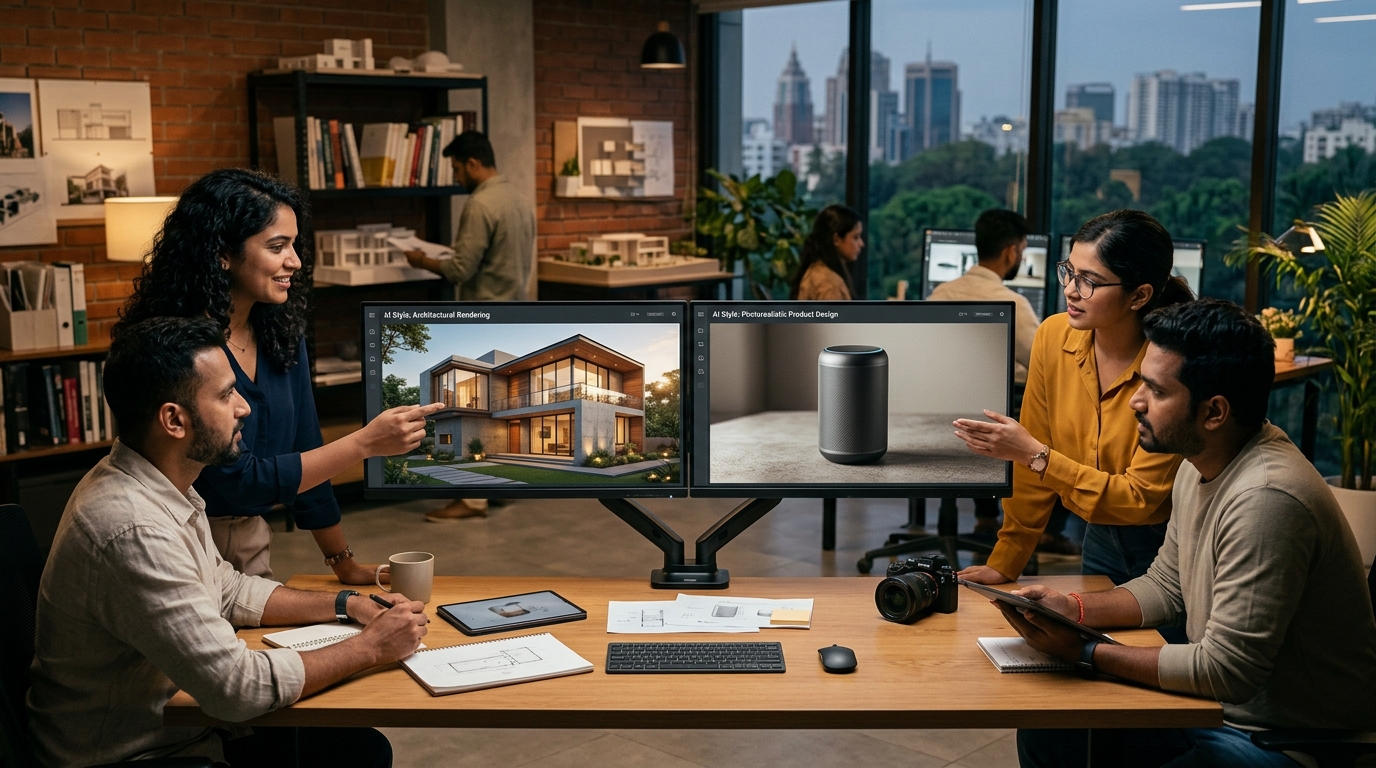
AI-assisted design is fundamentally a creative partnership: human direction provides the vision, emotional resonance, brand context, and editorial judgment, while the machine provides speed, multi-variant exploration, and rendering agility.
1. Generative Diffusion Models
Diffusion models form the core of modern visual synthesis. By learning to reverse a noise-adding process, these systems create coherent textures, organic lighting, and anatomical details from pure randomness.
2. Neural Style Transfer
Style transfer isolates the aesthetic signature (color palette, brushstrokes, lighting) of one visual and applies it across the semantic structure of another, enabling instant adaptation of brand guidelines.
3. Context-Aware Generative Editing
Modern editing models can isolate foreground subjects, adjust virtual lighting angles, swap backdrops, or alter materials without disrupting the overall scene composition.
4. Multimodal Conversational Workflows
The boundary between text, vision, and conversation has dissolved. Designers can now converse directly with an AI assistant—uploading a draft, critiquing specific elements, and iteratively requesting refined versions within a unified chat window.
Best Free AI Image Generators to Try in 2026
When evaluating free AI image generators, it is important to recognize that most top-tier platforms operate freemium models. They provide free tiers, recurring daily or monthly credits, or trial allowances rather than unlimited compute. Below is an objective analysis of the leading options in 2026 and where each excels.
1. ChatGPT Image Generation (DALL-E & Multimodal Vision)
ChatGPT provides one of the most natural, user-friendly entry points into generative imagery. Because it operates conversationally, you do not need to memorize cryptic prompt parameters or command-line syntax.
- Best For: Blog illustrations, rapid brainstorming, editorial visual concepts, and conversational image refinement.
- Key Advantage: Contextual iteration. You can request nuanced changes like “Keep the composition identical, but change the lighting to warm sunset tones and add a rainy street reflection” without restarting from scratch.
- Free Access: Free tier users receive access to daily image creation allowances, with higher volume reserved for Plus and Team plans.
2. Google Gemini Image Generation (Imagen Ecosystem)
Google Gemini merges high-fidelity image synthesis with deep web research and multimodal intelligence. It allows creators to move seamlessly from factual research to creative ideation and visual generation.
- Best For: Marketing ideation, educational visuals, research summaries, and integrated Google Workspace workflows.
- Key Advantage: Photorealistic handling of natural landscapes, modern corporate environments, and authentic human expressions.
- Free Access: Accessible at no cost within standard Gemini accounts subject to fair-use rate limits.
3. Canva AI (Magic Media Suite)
Canva excels at bridging the gap between raw AI image generation and complete graphic design layouts.
- Best For: Social media graphics, promotional flyers, presentation slide decks, and marketing banners.
- Key Advantage: Instant design integration. Generated visuals drop directly into Canva’s canvas alongside typography, vector shapes, animations, and social templates.
- Free Access: Free accounts include recurring monthly Magic Media credits.
4. Midjourney
Midjourney remains the gold standard for artistic aesthetics, dramatic lighting, and cinematic realism.
- Best For: Concept art, fashion editorial mockups, architectural visualization, and high-end advertising aesthetics.
- Key Advantage: Unmatched photorealistic detail, micro-textures, and fine-art style emulation.
- Access Note: While historically offering trial promotions, Midjourney primarily operates on subscription plans; occasional promotional trials and web portal access make it a benchmark for quality comparison.
5. Adobe Firefly
Adobe Firefly is engineered specifically for commercial safety and deep integration within Adobe Creative Cloud (Photoshop, Illustrator, Express).
- Best For: Generative fill, background expansion, commercial advertising assets, and professional photo retouching.
- Key Advantage: Trained exclusively on Adobe Stock, openly licensed content, and public domain materials, providing enterprise teams with robust intellectual property reassurance.
- Free Access: Free Adobe accounts receive a monthly allocation of generative credits on the Firefly web portal and Adobe Express.
6. Ideogram
Ideogram has earned a stellar reputation for solving generative AI’s historic Achilles’ heel: precise typography and text rendering inside images.
- Best For: Poster design, event invitations, logo ideation, apparel graphics, and typography-centric marketing collateral.
- Key Advantage: Crisp, correctly spelled text rendered in diverse stylistic fonts directly embedded in synthesized artwork.
- Free Access: Generous free tier offering daily renewable prompt generation credits.
7. Leonardo AI
Leonardo AI offers an advanced studio dashboard tailored for gaming studios, illustrators, and visual designers who demand fine-grained parameter control.
- Best For: Video game assets, character model consistency, digital merchandise, and stylized 3D concepts.
- Key Advantage: Granular control over LoRAs, negative prompts, custom fine-tuned models, and image-to-image weightings.
- Free Access: Generous daily credit refresh (150 fast tokens refreshed every 24 hours).
Benefits of Free AI Image Generators for Modern Teams
When incorporated intelligently into creative pipelines, free AI image generators deliver tangible operational and strategic advantages:
1. Total Control Over Creative Scenarios
Traditional stock photo libraries force you to select from static catalogs. With generative AI, you dictate exact parameters—from cultural setting and architectural styling to precise product placements—eliminating endless hours searching through generic stock photos.
2. Exponentially Faster Creative Prototyping
A conventional commercial campaign lifecycle involves creative briefs, agency consultations, studio bookings, post-production, and revision cycles. With generative tools, creative directors can visualize 20 distinct creative concepts in an afternoon, refining the vision before spending capital on physical production.
3. Low-Cost Creative Experimentation
Zero-cost free tiers allow startups and marketing agencies to test unconventional ideas, A/B test ad variations across demographics, and experiment with bold aesthetics without financial risk.
4. Granular Creative Personalization
A single visual narrative can be rapidly adapted into customized dimensions, localized backgrounds, and demographic variations tailored for LinkedIn, Instagram, website landing pages, and email campaigns.
For businesses exploring broader multimedia workflows, our practical breakdown of the Top 15 AI Video Editing Tools in 2026 illustrates how generative video complements these image pipelines.
Ownership, Copyright and Privacy Considerations
The legal landscape surrounding generative imagery is evolving rapidly across global jurisdictions. Organizations must understand the legal parameters governing AI-synthesized media:
- Copyright Protection & Authorship: The US Copyright Office and major legal authorities have consistently ruled that purely machine-generated imagery without substantial human creative input cannot be copyrighted. Human selection, significant manual modification, and arrangement are necessary to establish proprietary rights.
- Commercial Use Licensing: Always review the specific Terms of Service of each tool’s free tier. While platforms like Adobe Firefly grant commercial rights, certain platforms restrict free tier outputs to personal or non-commercial use, reserving commercial clearance for paying subscribers.
- Data Privacy & Confidentiality: Never upload proprietary product blueprints, unreleased patents, or confidential customer portraits into public AI image tools. Many platforms retain uploaded inputs for model training unless opted out through enterprise governance controls.
To understand how AI platforms monetize these services while balancing free tiers, read our analysis on The Business Model Behind Free AI Tools.
Quality Control and Responsible Usage
While generative models have achieved astonishing fidelity, human oversight remains indispensable. Teams should establish systematic review checklists for every AI-generated asset:
AI Visual Quality Checklist
- Anatomy & Hands: Verify fingers, joints, eyes, and teeth for structural distortion.
- Physical Consistency: Check light sources, shadow directions, and reflections across glass and water surfaces.
- Perspective & Architecture: Ensure structural lines, doorframes, and background horizons maintain natural perspective.
- Text & Logos: Remove accidental gibberish text or distorted brand marks.
- Brand Authenticity: Ensure the visual aligns with corporate tone rather than looking visibly synthetic or generic.
How to Implement Free AI Image Generators in Your Company
Successful adoption requires strategic alignment rather than haphazard tool hoarding. Follow this structured roadmap:
- Audit Visual Bottlenecks: Identify where your team spends excessive time or budget—social media thumbnails, blog headers, presentation decks, or ad mockups.
- Select Specialized Platforms: Match tools to tasks—use Ideogram for typography, Canva for social banners, ChatGPT for conversational ideation, and Adobe Firefly for commercially cleared assets.
- Establish Brand Guidelines: Document company prompt templates specifying preferred lighting styles, color codes, lens focal lengths, and cultural representation.
- Combine AI with Human Craftsmanship: Treat AI outputs as high-fidelity raw materials. Have professional designers perform final color grading, typography styling, and retouching.
- Monitor Productivity & Engagement: Measure production turnaround time and audience engagement rates to calculate concrete ROI.
The Future of AI-Assisted Visual Creation
The next frontier of generative imagery is shifting from isolated prompts toward interconnected multimodal pipelines. By combining free AI image generators with automated workflow engines and video models, creative teams can seamlessly translate raw ideas into comprehensive multimedia campaigns.
Explore our broader ecosystem analysis in The Best Online AI Tools in 2026 and discover how lean founding teams scale operations in our guide on Boosting Startups with Free AI Tools.
Frequently Asked Questions
Are free AI image generators truly free?
Most leading platforms operate on a freemium model. They provide free renewable credits or daily allowances rather than unlimited generation. For higher resolution, faster generation speeds, and full commercial indemnification, premium tiers are available.
Can businesses legally use AI-generated images for commercial advertising?
Yes, provided the specific platform’s terms of service grant commercial usage rights on that tier (e.g., Adobe Firefly, Canva, and paid Midjourney plans). Always verify the platform license before deploying visuals in advertising campaigns.
What makes an effective prompt for free AI image generators?
An effective prompt combines multiple layers: Subject + Environment + Composition + Lighting + Camera/Style + Mood. Providing clear stylistic and environmental context produces significantly more detailed and realistic results than vague instructions.
Can AI image generators render legible text within graphics?
While early models struggled with text, specialized platforms like Ideogram now render clear, stylized typography directly inside synthesized artwork, making them ideal for posters and marketing graphics.
Will AI image generators replace human graphic designers?
No. While generative tools automate repetitive rendering and asset creation, human creative direction, brand strategy, emotional storytelling, and aesthetic curation remain vital to building memorable visual identities.
Browse our complete archive of actionable automation tutorials, agency playbooks, and AI benchmarking guides on the HuAI Content Blog.