
The Future of Work: Top Online AI Tools Revolutionising Industries

Artificial Intelligence (AI) and automation are not new; it’s just that they are evolving and bringing incredible advancements in technology. We feel privileged to live in an age where there is an abundance of data, computing power and increasingly capable AI models to turn new possibilities into practical applications. Artificial intelligence is growing rapidly, and businesses have started using online AI tools to make their everyday tasks smoother, faster and more efficient.
They are transforming businesses from healthcare to finance, while also changing how employees create, analyse, communicate and make decisions. At the same time, this technological advancement is transforming the future of work itself.
The effect of AI on employment is more nuanced than simply replacing human workers. Goldman Sachs estimated in 2023 that generative AI could expose the equivalent of 300 million full-time jobs to automation, while also noting that many occupations are more likely to be complemented than completely replaced. More recent research from the International Labour Organization estimates that about one in four jobs globally is potentially exposed to generative AI, with job transformation more likely than outright replacement.
The World Economic Forum’s Future of Jobs Report 2025 similarly highlights a changing labour market, projecting 170 million jobs to be created and 92 million displaced by broader structural trends by 2030, resulting in a potential net increase of 78 million jobs.
Here is a detailed overview of the importance of AI, how AI is reshaping industries, the challenges faced by companies in implementing AI, and some of the leading AI tools and platforms available online.
Why Do We Need AI?

Before looking into which industries have started using AI, we should look at its importance. Businesses need AI because it can process large volumes of information, automate repetitive work, identify patterns and support decision-making at a speed that would be difficult to achieve manually.
AI can therefore enable companies to move forward with routine processes while allowing employees to spend more time on higher-value activities.
However, AI is not a technology that businesses can simply deploy once and forget about. Models, software, data, governance practices and security requirements continue to evolve. Companies also need to keep their employees prepared through continuous upskilling and reskilling. This makes it easier for workers to collaborate effectively with AI tools online.
When AI and humans work together, AI can handle repetitive or data-intensive activities while people provide judgement, creativity, context and accountability.
Artificial intelligence can automate many time-consuming tasks. Thus, businesses or developers can adopt AI to enhance their workflow over time. When employees have the right tools to improve and optimise their workflow, overall organisational productivity can increase.
According to Stanford University’s AI Index 2026, 88% of surveyed organisations reported using AI in 2025, while 70% reported using generative AI in at least one business function.
From Healthcare to Finance: How AI Is Reshaping Industries
Artificial Intelligence (AI) has played an increasingly important role in revolutionising a wide array of industries, ranging from healthcare and transportation to finance and manufacturing.
The healthcare industry uses AI for areas such as medical imaging, clinical decision support, health-system management and drug development. The finance industry uses AI for activities including fraud detection, risk analysis, customer service and automation. Meanwhile, manufacturing organisations are adopting AI for predictive maintenance, quality inspection, robotics and supply-chain optimisation.
AI is also influencing marketing, human resources, software development and many other knowledge-intensive sectors.
However, AI use in these industries raises important concerns, including data privacy, algorithmic bias, security, explainability, regulation and workforce disruption.
Here, we will consider these developments along with the role of artificial intelligence in reshaping different industries.
AI in Healthcare
 Healthcare is one of the sectors that can benefit significantly from AI. The healthcare sector can utilise AI to analyse large amounts of patient data, medical images, electronic health records and other information.
AI can support clinicians by helping them identify patterns, prioritise information and improve operational workflows. It is also being explored and used in areas such as diagnosis, medical imaging, drug development, disease surveillance and health-system management. The World Health Organization identifies these areas as important applications while emphasising that AI in healthcare must be deployed safely, ethically and equitably.
AI-powered chatbots and virtual assistants can also support patients and healthcare organisations with administrative communication, information retrieval and other limited tasks. However, AI-generated recommendations should not replace professional medical judgement.
Common Use Cases of AI in Healthcare
 Because of advances in data analytics and connected health technologies, AI can help healthcare professionals interpret information more efficiently.
AI-powered systems can assist with medical imaging, early detection, administrative workflows, patient communication and monitoring. Wearable devices and connected sensors can continuously collect health information, while AI can help identify patterns that may require attention.
Chatbots can also collect preliminary information from patients and direct appropriate requests to healthcare staff. Image-recognition systems can assist in examining scans for abnormalities, although final clinical decisions remain the responsibility of qualified healthcare professionals.
The WHO stresses that ethical governance, human oversight, transparency and safety are essential when AI is used in healthcare.
AI in Marketing
 With the introduction of targeted advertising, companies have vastly improved their capabilities to reach customers with more relevant products and services. Using data analytics and AI, digital marketing teams can better understand customer behaviour and identify patterns in campaign performance.
There are also AI-powered chatbots that answer customer queries, generate content, summarise information and provide recommendations based on available data.
The rapid adoption of generative AI has expanded the role of AI in marketing. Businesses can now use AI to assist with campaign ideation, content generation, personalisation, customer segmentation, analytics and workflow automation.
Common Use Cases of AI in Marketing
AI has become prominent in the marketing sector, particularly with the growth of generative AI.
Marketing teams can use online AI tools to create first drafts of marketing copy, develop campaign ideas, personalise customer experiences, analyse performance data and produce variations of content for different audiences.
AI-powered recommendation systems can also improve how businesses present products and services to customers.
Companies such as Amazon have long used recommendation technologies to personalise the shopping experience. Today, AI is also being applied to areas such as forecasting, customer service, fraud detection, inventory management and supply-chain optimisation across e-commerce.
AI in Human Resource
AI helps HR departments optimise processes and introduce intelligent automation. It can assist HR professionals with employee information, recruitment workflows, administrative tasks, workforce analytics and internal communication.
The objective is not simply to automate HR but to reduce repetitive work so HR professionals can focus more on employees, organisational culture and strategic workforce planning.
Common Use Cases of AI in Human Resource
HR departments frequently perform repetitive tasks such as screening information, scheduling, drafting communications and managing employee requests. AI can assist with many of these activities.
AI systems can help organise candidate information, identify relevant qualifications, support scheduling and automate routine employee interactions.
However, AI-assisted recruitment also introduces important risks. Biased training data or poorly designed algorithms can influence hiring decisions unfairly. Organisations therefore need appropriate testing, transparency, human oversight and governance.
Job displacement is another concern. As routine tasks become automated, some roles may change significantly. Employees should therefore be encouraged to upskill and reskill themselves to remain prepared for a changing employment landscape.
AI in Manufacturing
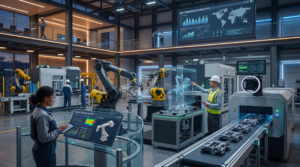 The manufacturing sector has also greatly benefited from advances in AI technologies. AI can assist with quality inspection, predictive maintenance, process optimisation, robotics, inventory management and supply-chain planning.
AI has immense potential for manufacturers because industrial systems generate large quantities of operational data. Machine-learning systems can use this information to identify patterns and potentially detect anomalies before they lead to equipment failures.
Common Use Cases of AI in Manufacturing
The manufacturing industry uses AI for improving efficiency, product quality and workplace safety.
AI-powered robots can perform or assist with repetitive operations, while computer vision can inspect products for defects. Predictive maintenance systems can analyse equipment data and identify signs of potential problems.
AI can also support inventory management and supply-chain optimisation.
The combination of AI, robotics, sensors and industrial data is helping manufacturers move towards smarter and more connected production environments.
AI in Finance
AI has obtained an important position in the finance sector because financial institutions process enormous amounts of structured and unstructured data.
AI can assist organisations with fraud detection, risk assessment, customer service, document processing, forecasting and other financial workflows.
Investment and financial-analysis tools can also process large datasets containing market information, company reports and other relevant material to help professionals analyse financial conditions.
Common Use Cases of AI in Finance
One of the most common uses of AI in finance is fraud detection. AI systems can identify unusual transaction patterns and flag potentially suspicious activity for further investigation.
AI can also help automate document processing and customer-service interactions.
Predictive analytics can provide insights into customer behaviour and financial patterns. At the same time, financial institutions need strong governance because AI-driven decisions can affect loans, investments, insurance and other areas with significant consequences for individuals.
Data quality, privacy, cybersecurity, explainability and bias therefore remain important considerations.
Challenges of Implementing AI
There are several benefits of AI but, at the same time, there are challenges of implementing AI that businesses need to overcome.
Different industries face unique problems, but some common challenges include:
- Lack of skilled talent:
Organisations need people who understand both AI technology and the business context in which it is being used. - Data quality:
AI systems depend heavily on the quality, relevance and availability of data. - Security and privacy:
Organisations need to protect sensitive information and prevent inappropriate access or leakage. - Bias and fairness:
AI systems can reproduce or amplify problems present in their training data or design. - Transparency:
Some AI systems are difficult to explain, making governance and accountability more complicated. - Regulation:
Businesses increasingly need to consider AI-related regulations, intellectual-property requirements, consumer protection and data-protection obligations.
AI is gradually bringing rapid changes across different sectors while creating new business opportunities. Businesses that successfully adopt AI will need not just the right software but also the right people, processes and governance.
Healthcare
There are important ethical consequences of using AI in healthcare because AI-assisted decisions can influence human health.
The biggest concern is that an AI system can sometimes produce an incorrect or poorly explained result. Healthcare professionals therefore need sufficient oversight, validation and context before acting on AI-generated recommendations.
Bias in healthcare datasets can also affect the reliability of AI systems. The WHO continues to emphasise safety, ethics, transparency, governance and equity as central considerations for responsible AI in health.
Trust is another important factor. Physicians and healthcare organisations need confidence that AI systems are producing appropriate and sufficiently validated information.
The final responsibility for clinical decisions should remain with qualified healthcare professionals.
Human Resource
Human resource departments depend on a close connection between employees and HR professionals. While many administrative HR activities can be automated, employee experience, communication and organisational culture still require human judgement.
A major challenge is algorithmic discrimination. If an AI system learns from biased historical data or uses inappropriate variables, its recommendations may unintentionally disadvantage certain candidates or employees.
Another concern is job displacement. As organisations automate repetitive HR processes, certain responsibilities may change or disappear.
Employees should therefore be encouraged to develop new skills and become comfortable working alongside AI tools online.
Marketing
AI systems often rely on customer and behavioural data, which makes data privacy a major consideration for marketers.
Transparency is equally important. AI-powered recommendations may appear like “black boxes” when users do not understand why certain decisions have been made.
Businesses implementing AI in marketing therefore need appropriate data governance, security, consent and human oversight.
Smaller businesses can also face cost and infrastructure challenges when adopting advanced AI systems. Rather than adopting AI simply because it is new, organisations should evaluate whether the technology offers a meaningful business benefit.
Legal and regulatory considerations are equally important, especially when AI is being used for advertising, personalisation, customer profiling or automated content generation.
Manufacturing
With an increase in automation, manufacturers are implementing AI-powered technology to improve efficiency, product quality and safety.
However, many industrial environments contain a mixture of modern and legacy equipment. Older machines and software may not be designed to connect easily with newer AI systems.
Manufacturers may therefore need sensors, data platforms and integration layers before AI can deliver its full potential.
Real-time decision-making is another important factor. Industrial systems may need to respond within seconds or even milliseconds when detecting production defects or safety risks.
AI can help with these tasks, but manufacturers must understand the limitations of their models and ensure that critical systems have appropriate safeguards.
AI can also support SMEs as they modernise production processes and adopt greater levels of automation.
Finance
 As data-management practices evolve with AI, financial organisations must remain aware of security, reliability and governance challenges.
Data quality is one of the most important factors. Poor-quality data can produce inaccurate analysis and unreliable predictions.
Financial institutions also need to consider bias and fairness because AI-assisted decisions can influence access to financial services.
These concerns become especially important when AI is involved in credit decisions, investment processes, insurance underwriting or fraud investigations.
Human oversight, model validation, explainability and appropriate governance are therefore essential parts of responsible AI implementation.
Innovative AI Online Platforms with Features
In recent years, countless businesses have implemented AI tools for everyday work. To maximise their potential, it is important to have a clear understanding of popular online AI tools and the types of problems they can solve.
The AI landscape has changed significantly since the original version of this article. Older platforms that focused primarily on individual machine-learning functions have increasingly evolved into broader AI development, generative AI and AI-agent platforms.
Here is a detailed explanation of some of the widely used AI tools and platforms.

1. Google Cloud AI
Google’s cloud AI offering has evolved considerably from the older Google Cloud Machine Learning Engine referenced in the original article. Google Cloud currently offers a broader generative AI and agent-development ecosystem built around Gemini and its evolving AI platform.
Businesses and developers can use Google Cloud’s AI services for generative AI applications, machine learning, multimodal systems, AI agents and other enterprise workloads.
Its current direction places greater emphasis on building, scaling, governing and integrating AI applications rather than simply training individual models.
Key features include:
- Generative AI development.
- Gemini models.
- AI-agent development.
- Model development and customisation.
- AI application integration.
- Enterprise AI infrastructure.
- Governance and security.
2. TensorFlow
TensorFlow remains a major open-source framework for machine learning and continues to be relevant for developers building and deploying machine-learning applications.
Unlike consumer-facing AI tools online, TensorFlow is primarily a development framework rather than a simple no-code AI application.
It can be used for research, machine-learning development, training and deployment across different environments.
Key features include:
- Machine-learning development.
- Model training.
- Deep-learning workflows.
- Model deployment.
- Open-source development.
- Support for a broad range of machine-learning applications.
3. IBM watsonx
The original article referred to IBM Watson as a general AI platform. IBM’s current enterprise AI ecosystem is centred on watsonx, including watsonx.ai.
watsonx.ai is an integrated AI development studio designed to help organisations build, test and scale enterprise AI applications. It combines foundation models, AI-agent tooling, machine learning, APIs and runtimes in a unified environment.
Key features include:
- Enterprise AI development.
- Foundation models.
- Generative AI.
- AI-agent development.
- Machine learning.
- AI lifecycle management.
- Integration with enterprise data and infrastructure.
4. OpenAI Platform
The original article described OpenAI primarily through GPT-4. That description is now outdated.
The OpenAI platform has evolved into a broader development environment that enables developers to integrate AI capabilities into applications through APIs and other platform services.
Today, businesses can use OpenAI’s platform to build applications involving text, reasoning, multimodal interaction, automation and agent-like workflows.
Key features include:
- Access to current OpenAI models.
- API-based AI application development.
- Text and multimodal processing.
- AI-powered automation.
- Agentic application development.
- Integration into business software and workflows.
5. Microsoft Foundry
The older article described Microsoft Azure as a broad cloud platform. Microsoft’s current AI development direction is represented by Microsoft Foundry, its enterprise platform for building, grounding and governing AI applications and agents.
Microsoft describes Foundry as a unified platform covering model selection, AI-agent development, tools, observability, governance and security. It currently provides access to thousands of models and more than 1,400 pre-built connections to business systems.
Key features include:
- AI-agent development.
- Access to large numbers of AI models.
- Model customisation.
- AI application development.
- Enterprise integrations.
- AI governance and security.
- Monitoring and observability.
6. NVIDIA AI Enterprise
NVIDIA AI Enterprise is designed for organisations that need to develop, deploy and manage AI applications at scale.
The platform brings together AI frameworks, NIM microservices, SDKs and infrastructure-management capabilities for production AI workloads. NVIDIA describes it as a production-ready platform spanning cloud, data-centre and edge environments.
Key features include:
- Production AI development.
- AI deployment and management.
- GPU-accelerated computing.
- AI microservices.
- AI infrastructure management.
- Enterprise support.
- Cloud, data-centre and edge deployment.
7. H2O AI Cloud
H2O AI Cloud is an enterprise AI and machine-learning platform designed to help organisations build, deploy and operate AI applications.
The platform combines AutoML, machine learning, application development and operational capabilities while supporting cloud and self-hosted environments.
Key features include:
- Automated machine learning.
- No-code and low-code workflows.
- Model development.
- AI application development.
- Model deployment.
- Model monitoring.
- Cloud and on-premise deployment.
8. DataRobot AI Platform
DataRobot has evolved into a broader enterprise AI platform covering predictive AI, generative AI, AI agents, observability and governance.
Its current platform is designed to help organisations develop, deliver and govern AI solutions across cloud, SaaS, virtual private cloud and on-premise environments.
Key features include:
- Predictive AI.
- Generative AI.
- AI-agent workflows.
- Model development.
- AI observability.
- AI governance.
- Enterprise deployment.
9. Fotor
Fotor is an online visual-content platform offering AI-powered image generation and editing tools.
Its AI capabilities can assist users with image generation, enhancement, background removal and other creative workflows.
Fotor is particularly suited to marketers, content creators and businesses looking for accessible AI tools online for visual content.
Key features include:
- AI image generation.
- AI photo editing.
- Background removal.
- Image enhancement.
- Creative design tools.
- Online editing.
How Online AI Tools Are Changing the Future of Work
The importance of online AI tools goes beyond individual software products. The larger shift is happening in how work itself is organised.
AI systems are increasingly capable of handling routine information-processing tasks while supporting humans with research, analysis, communication and decision-making.
The result may be less about humans competing directly with machines and more about employees learning how to use AI effectively.
The International Labour Organization’s 2025 research found that transformation is more likely than complete job replacement for many occupations exposed to generative AI.
At the same time, the World Economic Forum expects technological developments, including AI, to contribute to major changes in employment by 2030, with significant job creation occurring alongside displacement.
This makes reskilling and continuous learning increasingly important.
The Role of AI in the Future of Work
AI is changing the workplace in several important ways.
- Automating Repetitive Work
Tasks involving repetitive data processing, summarisation, classification and routine communication can increasingly be assisted by AI.
- Augmenting Human Decision-Making
AI can process large quantities of information and highlight patterns, allowing employees to make more informed decisions.
- Creating New Roles
Technological changes can also create new positions. AI specialists, data professionals, AI product managers, AI governance specialists and other technology-related roles are becoming increasingly important.
- Changing Skill Requirements
Employees increasingly need a combination of technical understanding, domain expertise and human skills such as communication, creativity, problem-solving and judgement.
- Increasing the Importance of Human Oversight
As AI becomes more capable, organisations still need people to evaluate outputs, identify errors, manage risk and make important decisions.
Artificial Intelligence (AI) is radically bringing changes to various industries and reshaping them.
The nature of work is changing as businesses integrate AI into healthcare, finance, marketing, manufacturing, human resources and other sectors.
The barrier to using advanced AI has also reduced because increasingly capable cloud platforms and online AI tools allow businesses to access powerful technologies without developing every component from scratch.
However, successful AI adoption is not simply about purchasing software. Businesses also need quality data, skilled employees, appropriate infrastructure, security, governance and a clear understanding of where AI can genuinely create value.
The future of work is therefore unlikely to be defined by AI alone. Instead, it will increasingly be shaped by how effectively humans and AI systems work together.
Businesses that invest in responsible AI adoption and employee upskilling will be better positioned to respond to the changing technological landscape.
FAQs About Online AI Tools
- What are online AI tools?
Online AI tools are software applications or platforms that use artificial intelligence through a web-based or cloud-connected environment.
They can perform tasks such as content generation, data analysis, automation, image creation, customer service, research, software development and business intelligence.
- How are AI tools changing the future of work?
AI tools are changing the future of work by automating repetitive tasks, assisting employees with analysis and creating new workflows.
The impact is not limited to job replacement. Recent research indicates that many occupations are more likely to experience task transformation and human-AI collaboration.
- Which industries use AI the most?
AI is being adopted across many industries, including healthcare, finance, manufacturing, marketing, retail, technology and human resources.
The specific applications vary according to the industry’s data, processes and regulatory environment.
- Are online AI tools expensive?
Not necessarily. Some AI tools online offer free or low-cost plans, while enterprise AI platforms can involve significant infrastructure, licensing and implementation costs.
The right choice depends on the complexity of the task and the scale at which the organisation needs to operate.
- Can AI completely replace human workers?
AI can automate certain tasks and may reduce demand for some roles, but complete replacement is not the outcome expected for most occupations.
The ILO’s 2025 global analysis found that transformation is generally more likely than full replacement for jobs exposed to generative AI.
- Why is AI training important for employees?
AI training helps employees understand how to use AI tools effectively, identify errors, protect sensitive information and integrate AI into existing workflows.
As AI changes job responsibilities, continuous learning and reskilling can help employees adapt.
- What are the biggest challenges of implementing AI?
The biggest challenges include data quality, cybersecurity, privacy, lack of skilled talent, model reliability, bias, transparency, regulatory requirements and integration with existing systems.
- Is AI safe for healthcare?
AI can provide valuable support in healthcare, but it needs appropriate governance and human oversight.
The WHO emphasises that AI in health should be safe, ethical, equitable and appropriately governed.
- What is the difference between AI tools and AI platforms?
An AI tool generally focuses on a particular task, while an AI platform provides a broader environment for developing, integrating, deploying or managing multiple AI capabilities.
For example, an online AI writing tool may solve one specific problem, whereas enterprise platforms such as Microsoft Foundry, IBM watsonx and NVIDIA AI Enterprise provide broader AI-development and deployment capabilities.
- Should businesses adopt AI?
Businesses should evaluate AI based on their specific needs rather than adopting it simply because it is popular.
A good AI strategy should identify suitable use cases, measure expected benefits, address data and security requirements, train employees and establish appropriate governance.