
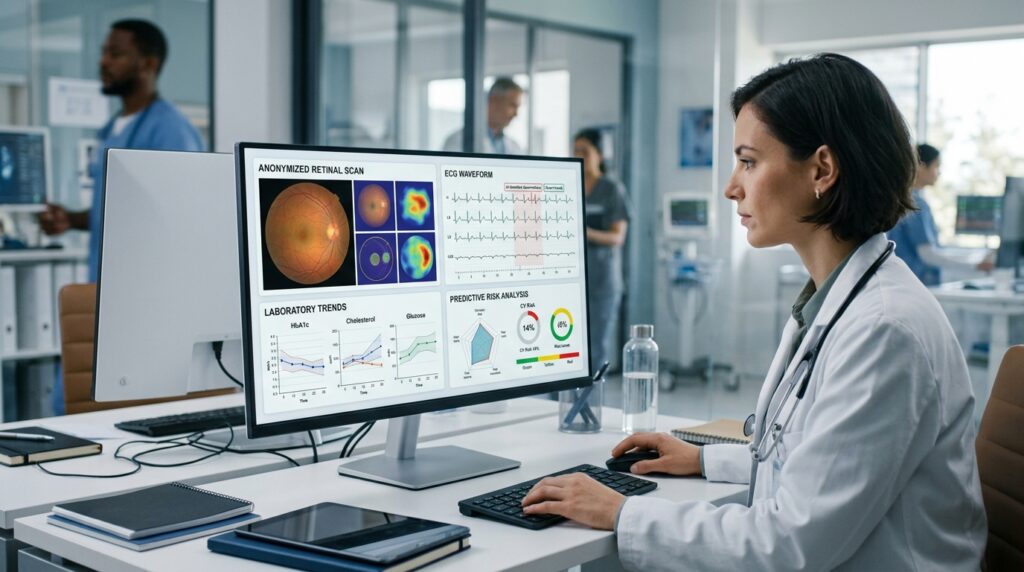
Many chronic and acute illnesses develop silently before visible symptoms appear. Identifying clinical warning signs early creates opportunities for timely assessment, targeted prevention and life-saving interventions. The application of AI in medicine is accelerating predictive healthcare analytics by processing complex multi-modal patient datasets to identify subtle disease patterns that manual reviews might miss.
Predictive medicine utilizes historical health records, diagnostic imaging, genomic sequencing and continuous vital signs to estimate health risks. Deploying AI in medicine provides decision-support evidence for clinicians, helping medical teams intervene proactively before acute complications emerge.
Understanding Predictive Medicine and Early Detection
While often used interchangeably, clinical prediction and early detection represent distinct milestones in patient care:
- Disease Risk Prediction: Estimating the statistical likelihood of a future medical event (e.g., forecasting cardiovascular risk or 30-day hospital readmission based on longitudinal biometric trends).
- Early Disease Detection: Identifying subtle microscopic or physiological signs of an existing pathology before clinical symptoms manifest (e.g., detecting microaneurysms in diabetic retinopathy screening).
Key Applications of AI in Medicine for Predictive Care
1. Retinal Image Screening and Systemic Health
Validated deep-learning algorithms analyze non-invasive fundus photographs to identify diabetic retinopathy, hypertensive changes and early cardiovascular indicators, enabling community-wide screening without requiring a specialist at every testing site.
2. Clinical Deterioration Forecasting in Acute Care
Continuous monitoring models in intensive care units evaluate multi-parameter telemetry—such as blood pressure, heart rate variability, oxygen saturation and lab markers—to predict septic shock and respiratory failure hours before overt clinical collapse.
3. Oncologic Screening and Computer-Aided Detection
Computer-vision systems assist radiologists by identifying suspicious nodules on low-dose chest CTs and microcalcifications on mammograms, prioritizing suspicious scans for immediate radiologist review.
4. Genomic Pattern Analysis and Precision Medicine
Machine learning models examine genomic sequences and biomarker profiles to identify associations between genetic mutations and targeted therapy responsiveness, advancing personalized oncology care.
For a complete strategic overview of clinical technologies, explore our pillar guide on AI in medicine across diagnostics and patient care.
Clinical Evidence, False Positives, and Patient Safety
Predictive healthcare algorithms must be evaluated beyond simple headline accuracy. In clinical practice, false positive alerts generate unnecessary patient anxiety and expensive secondary testing, while false negatives provide dangerous false reassurance. Predictive models must demonstrate high specificity, robust calibration and peer-reviewed external validation.
When presenting health risk information to the public, maintaining absolute credibility is vital. Structuring medical education under the principles of E-E-A-T for YMYL content ensures health resources are scientifically grounded and trustworthy. For broader ethical governance, read our companion analysis on the ethical implications of AI in medicine.
Operationalizing Predictive Health Data
Modern hospitals coordinate predictive data across laboratory information systems and patient portals. Operational teams deploy integration workflows using n8n vs Make.com vs Zapier to sync non-clinical appointment alerts and notification systems.
Healthcare organizations also utilize agentic AI content and workflow frameworks to manage administrative communication and patient follow-up. To ensure medical resources are easily discovered by patients, institutions adopt search everywhere optimisation strategies, organize articles via a pillar-cluster content architecture, and optimize clinical content to get cited by ChatGPT and AI search platforms.
Healthcare providers planning technology infrastructure should consult realistic AI automation agency pricing in India to budget for data pipeline integrations and security controls. Consultancies like HuAI Content assist organizations in building robust, compliant digital architectures.
Conclusion
The role of AI in medicine for predictive healthcare offers transformative potential for earlier disease intervention. By combining algorithmic pattern recognition with expert clinical judgment, healthcare providers can shift medicine from reactive treatment to proactive, preventive care.
Frequently Asked Questions
How does AI in medicine support predictive healthcare?
By analyzing longitudinal health records, vital sign trends, imaging data and lab results to identify patterns associated with disease risks and clinical deterioration.
Can predictive AI diagnose diseases before symptoms appear?
Validated AI screening systems can detect early physiological signs of certain conditions (such as diabetic retinopathy or lung nodules) before patients experience symptoms, though confirmatory clinical diagnosis remains necessary.
What is the difference between AI prediction and medical diagnosis?
Prediction estimates statistical risk or probability of future health events, whereas diagnosis establishes the specific nature of a current condition through clinical evaluation and diagnostic testing.
Are predictive AI models always accurate?
No. Performance varies based on training data quality, patient demographics and clinical context. Both false positive and false negative results can occur.