
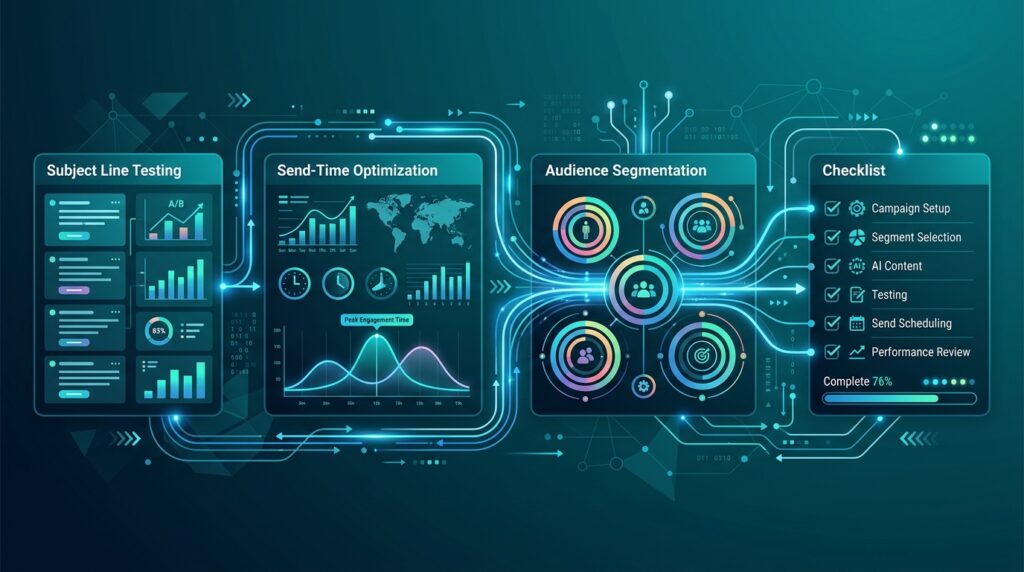
AI has changed almost every stage of AI in email marketing. It can help marketers generate subject lines, create email copy, segment audiences, personalise content, predict send times, automate journeys and analyse campaign performance. This comprehensive guide covers the current best practices for 2026 — from subject lines to send times — so you can build a workflow that actually delivers results.
What AI in Email Marketing Can Deliver for Brands
Modern applications of AI in email marketing generally support six major areas: content generation, personalisation, optimisation, automation, deliverability and analytics. Understanding which capability solves which problem is more important than choosing a platform based on its feature list.
1. Use AI to Generate Subject-Line Variations
A marketer can give AI the campaign objective, audience, offer, brand voice, key message and character limitations, then request multiple subject-line concepts. The important point is that AI should generate options, not automatically determine the final answer.
2. Optimise Preview Text
Preview text is often overlooked. AI can generate variations that complement the subject line rather than repeating it. A good combination is: subject line captures attention, preview text provides context, email body delivers the promised value.
3. Use AI for Email Copy
Leveraging AI in email marketing can significantly accelerate first-draft creation, but provide the model with a structured brief that includes audience, objective, offer, tone, key facts, CTA, restrictions and brand terminology. This produces substantially better results than simply asking “Write a promotional email.”
4. Maintain Brand Voice
One of the biggest risks of generative AI is producing technically competent but generic content. Create a brand-voice document containing preferred vocabulary, words to avoid, tone, sentence style, brand values and examples of good copy. Then use it consistently across AI workflows. This is the same principle behind maintaining consistent authority that makes a pillar-cluster content architecture work effectively.
5. Use AI for Segmentation
AI can identify patterns that may not be obvious from basic demographic segments. Useful signals include purchase frequency, product interest, website behaviour, email engagement, customer lifecycle stage, recency and monetary value. This can produce actionable segments such as high-value + highly engaged, high-value + declining engagement, new customer + high engagement and inactive + previously high value.
6. Optimise Send Times Using AI in Email Marketing
A premier advantage of AI in email marketing is analysing historical recipient engagement to predict optimal sending times. But avoid assuming that there is one universal “best time”. The right time depends on audience, geography, industry, customer behaviour, message type and device usage. Individualised timing can therefore be more useful than generic rules such as “always send Tuesday at 10 AM.”
7. Automate A/B Testing
You can test subject lines, preview text, CTAs, offers, images, layout, email length, send times and landing pages. AI can help generate variants and interpret results. However, tests should still have a clear hypothesis.
8. Lifecycle Marketing Strategies with AI in Email Marketing
AI can support journeys covering welcome, activation, conversion, retention, re-engagement and suppression. For example, consistently unengaged contacts are reduced or removed from promotional sending. This is more sophisticated than simply scheduling newsletters, and connects to the kind of agentic AI automation that handles multi-step customer workflows.
If you are evaluating which automation platform to use for these workflows, our comparison of n8n vs Make.com vs Zapier covers the key differences for email and marketing automation use cases.
9. Improve Deliverability
AI may help identify engagement patterns, but marketers must still manage the technical foundations of email delivery. Google’s sender requirements include authentication such as SPF or DKIM for all senders, while bulk senders need SPF, DKIM and DMARC, alongside one-click unsubscribe functionality. Google also recommends monitoring spam rates and gradually increasing sending volume rather than making sudden volume jumps.
An AI email strategy should always include: authentication + consent + list hygiene + reputation + relevant content.
10. Use AI for Campaign Analytics
AI can help summarise campaign performance and identify unusual patterns. Instead of manually comparing dozens of reports, marketers can ask: which segment performed best, which campaign generated the most revenue, which subject-line style consistently underperformed, where did engagement decline and which customers are becoming inactive.
AI Email Marketing Tools in 2026
Evaluate tools according to capability rather than age or popularity:
- HubSpot — useful for teams wanting CRM-connected email creation, personalisation, targeting and analytics.
- Klaviyo — particularly relevant to ecommerce brands using behavioural and purchase data.
- Customer.io — useful for event-driven customer journeys and behavioural messaging.
- Mailchimp — offers AI-assisted optimisation, experimentation and analytics.
- ActiveCampaign — useful for businesses building sophisticated lifecycle automation.
- Seventh Sense — focused on individual-level send-time optimisation.
- SendGrid — focused on scalable email delivery infrastructure and deliverability.
- Mailgun — useful for developers managing transactional email infrastructure.
Understanding the true cost of these platforms is important. Our guide to AI automation agency pricing explains how to budget for platform, integration and implementation costs together.
The End-to-End Workflow for AI in Email Marketing
A practical workflow: define campaign objective → identify audience → analyse customer data → generate content variations → human review → test → send → analyse → optimise → feed learning into the next campaign. This creates a continuous improvement loop.
What AI Should Not Do Without Oversight
Avoid giving an AI system unrestricted authority to make sensitive customer decisions, send unverified claims, change important customer data, contact users who have opted out, increase sending volume without controls or upload sensitive information into unapproved AI services. Automation should have boundaries.
The Human Role in AI Email Marketing
AI can create the message. A marketer still needs to decide: why should we send it, who should receive it, what should we promise, is the offer genuinely valuable, does the message sound like our brand and could it create customer frustration. This is why the most effective AI email marketing strategy remains human-led.
For brands looking to build authority across AI-powered search platforms, the same human judgement applies. See how Indian businesses can get cited by ChatGPT through expert, trustworthy content — and why the search everywhere optimisation framework starts with content quality rather than volume. HuAI Content brings this approach to email, SEO and agentic automation.
Final Checklist Before Sending an AI-Assisted Email
Content: Is the message accurate? Does the subject line match the content? Is the CTA clear? Does the message provide genuine value?
Personalisation: Is personalisation relevant? Is the data accurate? Is the level of personalisation appropriate?
Compliance: Was the recipient appropriately subscribed or otherwise lawfully contacted? Is the unsubscribe mechanism working? Are applicable privacy requirements satisfied?
Deliverability: SPF/DKIM configured? DMARC configured where required? Sending reputation monitored? Spam complaints monitored?
Brand: Does the email sound like the brand? Has a human reviewed important content?
Conclusion
AI has transformed email marketing from a largely manual campaign process into a data-driven, adaptive system. The winning formula is not AI plus more emails — it is better data plus better segmentation plus better content plus better timing plus responsible automation plus human judgement.
Read the full strategic overview in our pillar article on AI in email marketing.
FAQs
What are the best AI tools for email marketing in 2026?
Platforms such as HubSpot, Klaviyo, Customer.io, Mailchimp, ActiveCampaign and specialised tools such as Seventh Sense offer different AI-assisted capabilities. The appropriate choice depends on the business model and workflow.
Can AI write complete email campaigns?
Yes, AI can create subject lines, copy, CTAs and variations, but human review is recommended for accuracy, brand consistency and compliance.
Can AI determine the best email send time?
Yes. Some platforms use historical engagement data to predict individual or segment-level send times.
How can AI improve email deliverability?
AI can help analyse engagement and identify problematic patterns, but authentication, consent, list quality, reputation and sending practices remain fundamental.
What should marketers measure besides open rates?
Track clicks, conversions, revenue, unsubscribe rates, spam complaints, bounce rates, retention and revenue per recipient.